Премии качества
Is
it tougher for small organizations to receive the award?
The
Baldrige Award’s small business recipients have proven that any
U.S. organization can improve by using the criteria’s
performance excellence framework. But, given the importance of
smaller businesses to the U.S. economy, NIST is mapping out ways to
strengthen awareness of the award program and criteria among these
organizations.
Can
only U.S. organizations receive the award?
Any
for-profit organization headquartered in the United States or its
territories may apply for the award, including U.S. subunits of
foreign companies.
Do
the award criteria take into account an organization’s
financial performance?
Yes.
The criteria include many factors that contribute to financial
performance, including business decisions and strategies that lead to
better market performance, gains in market share, and customer
retention and satisfaction. Organizations are urged to use financial
information, including profit trends, in analyzing and reporting on
improved overall performance and to look for the connection between
the two.
Does
the award amount to a product or service endorsement for the award
recipients?
No.
The award is given because an organization has shown it has an
outstanding system for managing its products, services, human
resources, and customer relationships. As part of the evaluation, an
organization is asked to describe its system for assuring the quality
of its goods and services. It also must supply information on quality
improvement and customer satisfaction efforts and results. That does
not mean that a recipient’s products or services are endorsed.
Why
are the Baldrige Award recipients asked to share their successful
strategies?
One
of the main purposes of the award is to pass on information about the
recipient’s performance excellence strategies that other
organizations can tailor for their own needs. Representatives from
the award recipients willingly have shared their organizations’
performance strategies and methods with thousands.
To
what extent are they asked to share their strategies?
The
managers of each recipient must decide how much time and effort to
devote to activities such as speaking engagements and tours of
facilities. The requirements of the award program are minimal.
Recipients are asked to participate in the award’s annual
conference and several co-sponsored regional conferences, to provide
basic materials to those who request it on their organization’s
performance strategies and methods, and to answer news media
inquiries.
Do
advertising and publicity diminish the image and prestige of the
award?
The
law establishing the award states that an award recipient may
publicize its receipt of such award and use the award in its
advertising. Promoting public and business awareness of quality
improvement is one of the prime goals of the program, and advertising
is one way to meet this goal. Guidelines help organizations assure
their advertising is appropriate in representing their Baldrige Award
recognition.
Are
organizations simply chasing after the award and ignoring the lessons
of performance improvement?
The
perception by some that receiving the award is the goal of U.S.
organizations is not supported by the facts. Says Earnest Deavenport,
chairman and chief executive officer of Eastman Chemical Company,
“Eastman, like other Baldrige Award winners, didn’t apply
the concepts of total quality management to win an award. We did it
to win customers. We did it to grow. We did it to prosper and to
remain competitive in a world marketplace.” Thousands of
organizations are using Baldrige Award performance excellence
criteria to assess their organization and to improve. The program has
helped to stimulate an amazing movement to improve U.S.
organizations, including companies; academic institutions; and
federal, state, and local government agencies.
If
this is a federal government program, why are organizations charged a
fee to apply?
Federal
funding for this program is about $5 million annually and is used by
NIST to manage the program. The application fees are charged to cover
expenses associated with distribution and review of applications and
development of feedback reports. The application and review process
is considered to be a very cost-effective and comprehensive business
health audit. For an application fee ranging from $5,000 for large
organizations to $500 for non-profit education institutions,
organizations receive at least 300 hours of review by a minimum of
eight business and quality experts. Site-visited organizations
receive over 1,000 hours of in-depth review. Every applicant receives
an extensive feedback report highlighting strengths and areas to
improve. An article in the Journal for Quality and Participation
said, “The Baldrige feedback report is arguably the best
bargain in consulting in America.”
May
an organization hire a consultant to help prepare answers for the
Baldrige application?
Applicants
for the award are asked to supply facts and data to substantiate
their claims concerning their management practices. Consultants,
including members of the Board of Examiners, may provide services on
performance management issues as well as the Baldrige Award process.
However, since there are no secret answers or even right or wrong
answers to the Baldrige application, the award cannot be received by
hiring someone to fill in the blanks.
An organization must show through facts and data that it has a world-class management system in place and that it is continually looking for ways to improve.
As a final check before recommending recipients, members of the Board of Examiners visit the more outstanding candidates for the award. During these site visits, examiners interview employees and review pertinent records and data. The objective is to verify the information provided in the application and to answer questions raised during the board’s review. An organization that hired someone to fill out its application would never make it through this rigorous review if its performance management system was not supported by facts and data.
Is
it a conflict of interest for members of the Board of Examiners to
work as consultants?
No.
Members of the Board of Examiners are experts in evaluating
performance management systems. They are in demand as speakers, as
information resources, and as consultants. These activities serve as
a way to make more people aware of performance improvement techniques
and the Baldrige Award.
However, since the examiners and judges on the board review applications for the award and are involved in recommending award recipients, precautions are taken to prevent a conflict of interest or even the appearance of conflict. Rigorous rules are followed at every stage of the review.
Primarily, this means all members of the board must abide by a code of ethics requiring, among other things, that they disclose all business affiliations that might create a conflict. In such cases, they cannot review an application, comment on it, or make any judgments that could affect it. It is a violation of the code for board members even to ask for information on applications other than those to which they are assigned.
Other safeguards and checks also are built into the four-step review process. For example, during the first step, each application is evaluated independently by at least eight different examiners. By the time the review is over, some applicants will have gone through over 1,000 hours of evaluation.
Is
the number of applications for the award an indicator of interest
about quality and the Baldrige Award?
The
number of applicants for the national Baldrige Award is not an
indicator of overall interest in quality or the award program.
Interest continues to grow both nationwide and internationally.
For example, participation in state and local award programs has increased steadily. In 1991, fewer than 10 states had award programs. Now, 44 states have or are establishing award programs. Most are modeled after the Baldrige Award, and many organizations opt to compete for them first before considering a Baldrige Award application. Many of the Baldrige Award recipients also have won state quality awards.
Internationally, nearly 60 quality programs are in place. Most have been established within the past several years, and many are based on the Baldrige Award. In Japan, home of the Deming Prize, an award that closely resembles the Baldrige Award has been established.
Also, it is important to remember the award program is much more than a contest. While recognizing organizations that have successful performance management systems is the most visible part of the program, its intent is much broader. Equally important is the award’s role in raising awareness about quality by encouraging all U.S. businesses and organizations to set up performance improvement programs whether or not they intend, or are even eligible, to apply for the award.
How
does the Baldrige Award differ from ISO 9000?
The
purpose, content, and focus of the Baldrige Award and ISO 9000 are
very different. The Baldrige Award was created by Congress in 1987 to
enhance U.S. competitiveness. The award program promotes quality
awareness, recognizes quality achievements of U.S. organizations, and
provides a vehicle for sharing successful strategies. The Baldrige
Award criteria focus on results and continuous improvement. They
provide a framework for designing, implementing, and assessing a
process for managing all business operations.
ISO 9000 is a series of five international standards published in 1987 by the International Organization for Standardization (ISO), Geneva, Switzerland. Companies can use the standards to help determine what is needed to maintain an efficient quality conformance system. For example, the standards describe the need for an effective quality system, for ensuring that measuring and testing equipment is calibrated regularly and for maintaining an adequate record-keeping system. ISO 9000 registration determines whether a company complies with its own quality system.
Overall, ISO 9000 registration covers less than 10 percent of the Baldrige Award criteria.
Is
the Baldrige Award a U.S. version of Japan’s Deming award?
The
basic purposes of both awards are the same: to promote recognition of
quality achievements and to raise awareness of the importance and
techniques of quality improvement. However, the Baldrige Award:
focuses more on results and service,
relies upon the involvement of many different professional and trade groups,
provides special credits for innovative approaches to quality,
includes a strong customer and human resource focus, and
stresses the importance of sharing information.
Why
was NIST selected by Congress to manage the award and what is the
role of ASQ?
NIST
is a non-regulatory agency of the Commerce Department’s
Technology Administration. NIST develops and promotes measurements,
standards, and technology to enhance productivity, facilitate trade,
and improve the quality of life. NIST was selected by Congress to
design and manage the award program because of its role in helping
U.S. organizations compete, its world-renowned expertise in quality
control and assurance, and its reputation as an impartial third
party.
ASQ—the American Society for Quality—assists NIST with the application review process, preparation of award documents, publicity, and information transfer. ASQ is a professional, non-profit association serving more than 80,000 individual and 700 corporate members in the United States and 62 other nations.
1. Руководство (10 %). Оцениваются успехи высшего руководства (top management) в создании культуры качества внутри компании.
2. Информация и анализ (7,0 %). Оцениваются успехи компании в сборе и анализе информации и как эта информация используется для улучшения качества и в планировании качества работы.
3. Стратегия планирования качества (6 %). Оцениваются успехи компании в интеграции требовании потребителя для улучшения качества работы компании.
4. Человеческие ресурсы (15 %). Ревизорами изучается вопрос о том, насколько успешно компания вовлекает своих служащих в работу по улучшению качества и как их знания и опыт используются компанией.
5. Уверенность в качестве товаров и услуг (14 %), обеспечиваемая соответствующим управлением качеством процесса, которое и должно создавать уверенность в качестве товаров и услуг. Оцениваются деятельность компании в достижении хорошего качества всех операций технологического процесса и цель компании в постоянных улучшениях.
6. Результаты качества (18 %). Изучаются успехи компании в работе по качеству и его улучшению, оцениваемые соответствующими количественными показателями качества и подтвержденные результатами измерений.
7. Фокус на потребителя и удовлетворение его нужд и пожеланий (30 %). Анализируется вопрос о том, насколько хорошо компания определяет требования потребителей своей продукции и насколько хорошо эти требования удовлетворяются.
Все эти семь критериев составляют важнейшую часть работы любой организации в области качества, делая при этом основной упор на предупреждающие (превентивные) действия и непрерывное улучшение.
Приведенный в скобках процентный вес каждого критерия соответствует тому максимальному числу очков, которое могут дать эксперты, участвующие в рассмотрении претендентов на премию М. Бэлдриджа. Так, 10 % веса критерия "Руководство" соответствует максимум 100 очкам, которые могут быть даны ревизорами при оценке работы претендента, в то время как удовлетворенность потребителей оценивается максимальным числом очков, равным 300 (рис. 3).
Рассмотрение включает в себя изучение представленных претендентами документов на премию М. Бэлдриджа и ознакомление группы ревизоров с работой компании непосредственно в самой компании и за ее пределами у потребителей. Ревизоры ищут, например, доказательства того, что высшее руководство широко использует "ценности" качества в повседневном управлении; являются ли продукты или услуги претендента, по крайней мере, такими же хорошими, как у конкурентов, или лучше; обучены ли сотрудники компании статистическим методам и методам совершенствования качества; работает ли компания с поставщиками по улучшению качества; удовлетворены ли потребители. Придавая большое значение вопросу удовлетворения потребителя, модель оценки МВА (как и модель оценки ДАР) предусматривает развертку этой оцениваемой категории 1-го уровня на 2-м уровне (см. рис. 3).
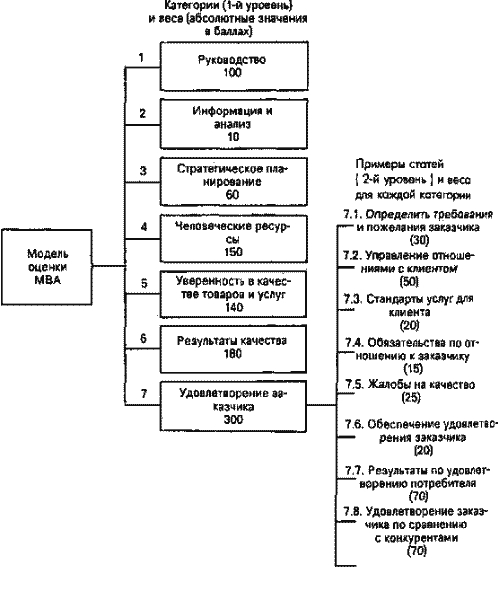
Рис. 3. Развертка 1-го уровня и примеры статей (категорий) при развертке 2-го уровня в модели оценки МВА (1991 г.)
Все претенденты получают письменный отчет о результатах работы группы ревизоров с обязательным указанием сильных и слабых сторон управления качеством у претендента и с предложениями этой группы по улучшению деятельности компании в области качества.
Процесс прохождения конкурса может потребовать много усилий как для рабочих, так и для администрации при существенных затратах компании. Однако участие в конкурсе мотивирует работу компании по улучшению качества. В результате некоторые из участвующих в конкурсе компаний делают гигантские шаги в улучшении качества и конкурентоспособности своей продукции.
Каждая компания, претендующая на награду, а не только победители, может впоследствии изучить оценку и комментарии, как и в случае с DAP. Обратной связью будет то, что точка зрения экспертов (ревизоров) действительно очень важна в непрерывном процессе улучшения качества.
Первая премия М. Бэлдриджа была присуждена в 1988 г. В группу производственных компаний, получивших премию, вошла компания Motorola с примерно 99 000 служащими, известная всеми миру своими коммуникационными системами и полупроводниковыми приборами. Целью компании, как заявил ее руководитель Роберт Гэлвин на церемонии присуждения премии, является "нуль дефектов во всем, что мы делаем". Для достижения этой цели компания создала свой центр обучения и потратила более 170 млн. дол. США на подготовку своих рабочих по программе улучшения качества в течение 1983-1987 гг.
Среди компаний малого бизнеса премия была присуждена компании Globe Metallurgical Inc., которая в первой половине 1985 г. провела успешную подготовку руководящего состава в области статистического контроля процесса, а уже к концу года разработала широкомасштабную фундаментальную систему улучшения качества, названную "Качество, эффективность и стоимость" (QEC — Quality, Efficiency and Cost). Цели по улучшению качества были интегрированы в стратегическое планирование, исследования и деятельность. Руководство компании, возглавившее систему QEC, еженедельно встречалось со служащими для уточнения и корректировки хода выполнения работ. Тесное взаимодействие всего коллектива, задействованного в системе QEC, дало результаты уже к середине 1987 г., когда компания, насчитывающая около 200 человек, стала выпускать примерно 100 тонн высококачественных ферросплавов и кремниевых металлов для более чем 300 потребителей по самым низким в США. ценам.
Однако, как показали результаты конкурсов с 1988 по 1993 гг., приведенные в табл. 9.8, многим компаниям США оказались не по плечу требования премии М. Бэлдриджа, что свидетельствовало о том, что они еще не перешли в полной мере на работу в условиях TQM, хотя и были сертифицированы. Как видно из табл. 9.8, были даже неоднократные случаи (для сервисных компаний), когда ни одному претенденту не была присуждена премия М. Бэлдриджа. И только тогда, когда даже всемирно известные и ранее преуспевающие компании почувствовали, что они начинают вытесняться из рынка компаниями с более конкурентоспособным качеством продукции, они вынуждены были перейти на работу в условиях TQM. Так, американская компания Xerox Business Products and Systems, которая в начале 1970-х годов была і практически абсолютным монополистом в копировальном бизнесе, уже через 10 лет потеряла почти 50 % своего рынка, который заняли в первую очередь японские компании. Чтобы исправить создавшееся критическое положение, компания к 1982 г. разработала программу "Руководство через качество" (Lidership Through Quality — LTQ), которая к концу 1980-х годов позволила