The Development of foreign trade of Ukraine

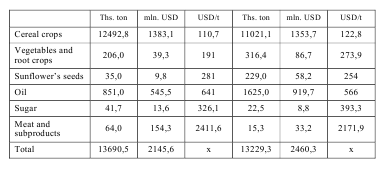
From above-explained it is possible to come to the conclusion, that Ukraine was not yet able to occupy the own reliable niches of supply of the prepared commodities in the world market, but not raw material and low- technological products. Overwhelming part it most point-of-sale partners on the indexes of GDP and export on one person are at considerably higher level .
For development of export potential of Ukraine it is necessary in the nearest prospect: — to promote the competitiveness of the Ukrainian producers on the basis of activation of structural reformation of economy, foremost export-oriented sector; to carry out the high-quality changes of specialization of Ukraine in the world division of labor on the basis of development and realization of complex export strategy, oriented to the increase of part in the export of the innovative and traditional Ukrainian products with the high level of valueadded, increase of grant of highly technological services: — reorient the imported strategy in direction of providing of complex decision of problems of modernization of national industry and active policy of import substitution (limitation of import of the imported commodities is during intensification of analogical production in Ukraine); — to solve the problem of disparate of purchase and imported prices on the products of agrarian sector.
2.2 Export and import flows of commodities
Ukraine foreign trade operations carried out with partners from 200 countries.
The volume of export deliveries to CIS countries amounted to - 35.1% of total exports, Asia - 27,8%, Europe - 25,8% (including the EU - 24,2%), Africa - 6,8 %, USA - 4,3%, Australia and Oceania - 0,1%.
The largest volumes of export deliveries to the Russian Federation - 24.9% of total exports from Ukraine, Turkey - 6.6%, Italy - 4,6%, Belarus - 3,5%, Poland - 3,2 %, Germany - 3,1%, India - 2,9%.
The export of goods also in all major partner countries: Italy - by 89,7%, Poland - by 71.8%, Russian Federation - on 68,2%, Turkey - by 56.8%, Belarus-40, 7%, Germany - by 37,8%, India - 25,6%.
In total exports of goods in January-May 2010, compared to January-May 2009 increased share of ferrous metals - from 27,5% to 30,9%, energy materials, petroleum refining and products - from 4,3% to 7,3%, mechanical machines - from 6,2% to 6,5%, railway or tramway locomotives, Putnam equipment - from 2,1% to 4,1%, fats and oils of animal or vegetable origin - of 4 9% to 5,1%, ores, slag and ash - from 3% to 4,2%.
Volume of exports of finished products made from imported raw materials, was $ 1.4545 billion, which is 77,5% more than in January-May 2009.
Ukrainian exports of more than 50 percent of gross national product of Ukraine.
Today the main export industries are metallurgy (metal products), agriculture (wheat), machine building and chemical industries, whose share is over 80 percent of Ukrainian exports. The feature of the development of domestic export-oriented industries is their raw nature and high level of dependence on fluctuations in world markets.
Main exports of Ukrainian goods to the Economic Unions:
§ the Asia-Pacific Economic Cooperation (APEC): ferrous and nonferrous metals and articles thereof;
§ CIS: machinery, ferrous and nonferrous metals and products, prepared foods;
§ no-country Central European Free Trade Area (TSEFTA): mineral products, ferrous and nonferrous metals and articles thereof;
§ EU: ferrous and nonferrous metals and articles thereof, mineral products, vegetable products;
§ of the country's manufacturers and exporters of petroleum (OPEC): ferrous and nonferrous metals and products, herbal products.
| The main product groups | Export | Imports |
| Ferrous metals and articles there of | 40.2 | 5,0 |
| Mineral products | 10.1 | 30,0 |
| Agricultural products | 8,6 | 3,3 |
| Chemical industry products | 10.9 | 14,2 |
| Machinery, equipment and tools | 8.7 | 17.5 |
| Non-ferrous metals | 2,9 | 2,8 |
| Textiles and textile products | 2.4 | 3,0 |
| Wood Products Industry | 3,2 | 3,2 |
| Processed food | 3,6 | 3,7 |
| Means of transport | 5,4 | 11,4 |
The volume of exports from Ukraine increased in 2010 comparing with 2009 by 29,6% and amounted to 51 billion 430.5 million U.S. dollars. At the same time imports grew by 33,7% and reached 60 billion 739.9 million dollars.
The largest share (85%) in exports were transport services - 3 billion, including pipeline transport services (52%), sea transport (13%), rail (10%), air transport (6%).
2.3 Export and import flows of services
In January-March exports of services exceeded imports by 1 430.7 million. Told the State Statistics Committee, submit the "Ukrainian News".
According to Goskomstat, service exports in January-March 2010 was 2 557.4 million, an increase of 19,6% compared with January-March 2009.
Imports of services amounted to 1 126.7 million, decreased by 0,2% compared with January-March 2009. The increase in services exports was primarily due to growth in services exports pipelines - in 2,3 times to 959.2 million dollars, travel - by 16.4% to 50.3 million dollars and transportation services - 33 9% to 1 884.3 million.
Imports of services decreased mainly due to imports of financial services - by 22,7% to 228.1 million dollars, various business, professional and technical services - by 11,6% to 188.1 million dollars of services - by 39.4% to 27.7 million, and insurance services - by 46% to 13,2 million dollars. In January-March 2010, service exports to CIS countries increased by 82,1% compared with January-March 2009 to 1 370.0 million.
Imports of services from the CIS in January-March 2010 increased by 13,2% compared with January-March 2009 to 179.7 million dollars.
It was reported that in 2009 exports of services exceeded imports by 4352 million. Exports of services in 2009 amounted to 9 520.8 million, decreased by 18,9% compared with 2008. Imports of services amounted to 5 168.8 million, decreased by 20,1% compared with 2008.In 2009, service exports to CIS countries decreased by 10.3% compared with 2008 to 3 808.7 million.
| Countries | Member million. U.S. $% | of the total volume of foot |
| Total | 3486,8 | 100 |
| Russia | 2049 | 58,8 |
| United Kingdom | 123,2 | 3,5 |
| United States | 122,7 | 3,5 |
| Germany | 105,0 | 3,0 |
| Belgium | 70,5 | 2,0 |
| Cyprus | 68,4 | 2,0 |
| Switzerland | 47,8 | 1,4 |
| Other | 900,1 | 25,8 |
2.4 Problems of foreign trade of Ukraine
In recent years, Ukraine has passed most of the hurdles of postcommunist economic transformation. Macroeconomic stabilization was accomplished long long. Prices and trade are liberalized. Privatization has proceeded so that about two-thirds of GDP arises in the private sector. For the last three years, Ukraine has had a sound average economic growth of over 6 percent a year, and it is likely to stay around 6-8 percent a year for the foreseeable future.
A fast economic restructuring is taking place. Industries in which Ukraine appears to have comparative advantages have grown particularly fast: steel, food processing, agriculture, and light industry. Within each sub-industry a desirable consolidation of 3-5 leaders is apparent. Although a few oligarchic groups hold out, they are becoming more normal conglomerates, and a sizeable number of new large and medium-size corporations have emerged. While corruption and repression remain problems, business surveys undertaken by the European Bank for the Reconstruction and Development (EBRD) and the World Bank in 1999 and 2002 suggest great improvements. Ukraine's transition to a market economy has succeeded.
In this situation, foreign trade attracts new attention for many reasons. First, with an official GDP at current exchange rates of about $40 billion, the Ukrainian economy is rather limited, and access to export markets is critical for future economic growth. In recent years, Ukrainian exports have expanded fast by slightly over 10 percent a year and are driving economic growth, but clearly much more can and should be accomplished. The old adage "trade rather than aid" describes what Ukraine needs now.
Second, the Ukrainian economy is very open with exports corresponding to about half of GDP, and exports have increased at over ten percent a year for the last three years. Exports comprise the growth engine in the Ukrainian economy.
Third, while the domestic market in Ukraine appears to work reasonably well, regional distortions in foreign trade are all too apparent. The most recent statistics for 2002 demonstrate that as little as 19 percent of Ukraine's exports went to the European Union (EU). According to the gravity model, which assesses how much countries should trade with one another, given the size of their economies and the distance between them, it should have been about 60 percent. Meanwhile, the share of Ukrainian exports going to Russia has fallen steadily to only 17 percent last year. Instead, Ukraine is increasingly exporting to all kinds of new distant Third World markets in Asia and the Far East, notably China, and the Middle East, which are more open. It is more important that exports grow than where they go, but this is not a normal development. With little doubt, this represents trade distortion, and Ukraine would benefit if it were able to export more to big markets in its neighborhood. Although Ukraine is a very open economy, agriculture is considered to be 93 percent self-sufficient, suggesting substantial sectoral distortions as well.
Fourth, Ukraine suffers from a predominance of so-called sensitive products in its exports, that is, goods that are particularly exposed to protectionist measures by other countries. They account for about three-quarters of Ukraine's total exports. Steel comprises 40 percent of Ukraine's exports, while each of the three sensitive commodity groups, agricultural goods, chemicals and textiles, account for over 10 percent. According to the WTO, Ukraine came in the 10th place in the world in terms of suffering from actual antidumping measures from January 1995 to June 2002, with no less than 37 antidumping measures concluded by various countries.
Fifth, Ukraine is now facing critical changes in its foreign trade agreements. Its negotiations about accession to the World Trade Organization (WTO) are approaching their final stage. The EU is suggesting that its Partnership and Cooperation Agreement (PCA) with Ukraine should be replaced with an agreement on a Common European Economic Area (EEA). The Presidents of Russia, Ukraine, Kazakhstan and Belarus just signed a declaration of their intention to negotiate a free trade zone. Thus, Ukraine is facing monumental decisions on its foreign trade relations in all directions.
Yet, sixth, although Ukraine is facing so many important problems and decisions in foreign trade, trade issues have been all but ignored in the country until recently. The preoccupation with getting the domestic market economic reforms has been so great. In the mid-1990s, Ukrainians had a tendency to blame the outside world for their hardships. Now, on the contrary, Ukrainians tend to blame themselves for whatever problems they encounter. While an admirably humble attitude, it does not necessarily reflect the truth.
There are always many barriers to trade. First, everybody mentions the problem for exporters to obtain a value-added tax refund. Another query is what the Ukrainian economy looks like at enterprise level, but it appears a rather normal market economy. Then, the three big trade issues come, trade relations with the EU, trade with Russia and WTO accession. The EU should be Ukraine's main export market, but its imports from Ukraine remain surprisingly low, while Ukrainian exports to Russia are swiftly dwindling. WTO accession appears to be the key to Ukraine's trade policy. Agricultural concerns are a topic on their own, but they appear to be less severe than widely presumed.
Ukraine has great export potential. With an area of 0.4% of the total global land and the population at 0,8% of global, Ukraine makes 5% of world mineral and food processing. The main strategic goal for Ukraine - the transition to economic development, export oriented and, therefore, the production of goods able to compete in the global market.
A fast economic restructuring is taking place. Industries in which Ukraine appears to have comparative advantages have grown particularly fast: steel, food processing, agriculture, and light industry. Within each sub-industry a desirable consolidation of 3-5 leaders is apparent. Although a few oligarchic groups hold out, they are becoming more normal conglomerates, and a sizeable number of new large and medium-size corporations have emerged. While corruption and repression remain problems, business surveys undertaken by the European Bank for the Reconstruction and Development (EBRD) and the World Bank in 1999 and 2002 suggest great improvements. Ukraine's transition to a market economy has succeeded.
CHAPTER III. DEVELOPMENT PERSPECTIVES OF UKRAINE’S FOREIGN TRADE
3.1 Strategy of foreign trade of Ukraine
Since 1996, Ukraine has repeatedly stated that it wants to become a member of the European Union at the highest official level. The EU has however cold-shouldered them, although Article 49 of the Treaty of the European Union stipulates that any European state may apply to become a member of the European Union. Many European politicians and EU commissioners have publicly ruled out Ukrainian membership of the EU, but formally the question remains open. A broad Ukrainian opinion favors the country's "European choice," though its implications are usually left open.
The institutional cooperation between the European Union and Ukraine has been rudimentary. The EU offered Partnership and Cooperation Agreements (PCA) to the CIS countries, which were little but a codification of WTO principles for non-WTO members. They do not offer any trade concessions beyond what the EU accords to its WTO partners, while the EU has concluded free trade agreement with many other countries. Ukraine has been treated as one CIS country among many. The Ukrainian PCA was concluded in 1994, but it did not come into force until 1997. It is valid for ten years and can be prolonged. Although it is comprehensive, covering political dialogue, trade in goods and services, economic, environmental, scientific, cultural and legal matters, it contains little of substance. The EU's only subsequent trade policy