Synchronization and effect of Zommerfelda as typical resonant samples
 .
Stationary oscillations in the absence of energy dissipation
Now the usual
condition of a steady motion, i.e.
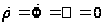 ,
is applied. We are looking now for the stationary oscillatory regimes
in vacuo, i.e.
 .
The solution corresponding to these regimes reads
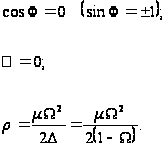
This solution
describes a typical resonant curve at
 .
The plus sign in front of the unit is selected when
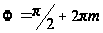 ,
otherwise
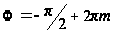 .
The next stage of the study is to test the stability properties of stationary solutions. To solve this problem, one should obtain the equations in perturbations. The procedure for deriving these equations is that, firstly, one performs the following change of variables
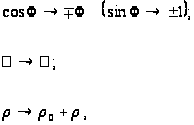
where
 is the steady-state amplitude of oscillations, then after replacing
the variables the perturbation equations get the following form
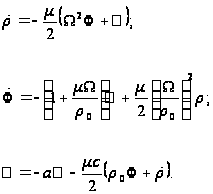
To solve the stability problem evoking the Lyapunov criterion we formulate the eigenvalue problem defined by the following cubic polynomial, implicitly presented by determinant of the third order
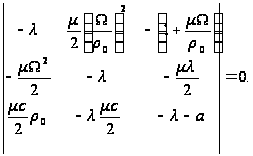
Now we can apply one
of the most widely known criteria, for example, the Hurwitz
criterion, for the study the stability properties in the space of
system parameters. The result is that the descending branch of the
resonant curve, when ,
cannot be practically observed because of the volatility associated
with the fact that the driver is of limited power. This cannot
maintain the given stationary oscillation of the elastic base near
the resonance. This result corresponds to the well-known paradigm
associated with the so-called Sommerfeld effect.
Formally, there are
stable stationary regains, when
 .
However, this range of angular velocity is far beyond the accuracy of
the first-order nonlinear approximation.
Damped stationary oscillations
A small surprise is
that the response of the electromechanical system (2) has a
significant change in the presence of even very small energy
dissipation. Depending on the parameters of the set (2) the small
damping can lead to typical hysteretic oscillatory patterns when
scanning the detuning parameter .
While let the dissipation be sufficiently large, then a very simple
stable steady-state motions, inherent in almost linear systems, holds
true.
From the stationary
condition, one looks for the stationary oscillation regimes
 ,
 and
 ,
as
 .
The equations corresponding to these regimes are the following ones
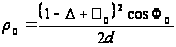 ;
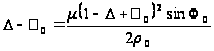 ;
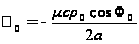 .
For a small damping
the solution of these equations describes a typical non-unique
dependence between the frequency and amplitude, i.e.
 ,
defined parametrically upon the phase
.
Near the resonance
 (
 ),
at some given specific parameters of the problem, say,
 ,
 ,
 and
 ,
the picture of this curve is shown in Fig. 1. Accordingly, the
dependence of the angular velocity is presented in Fig. 2.
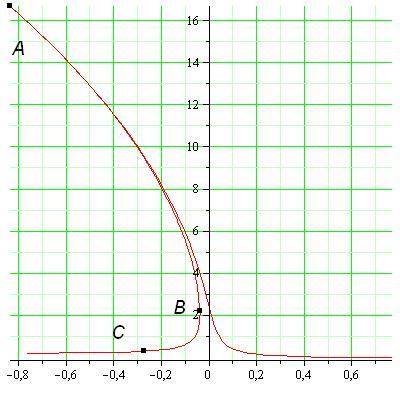
Fig. 1. The
frequency-amplitude dependence
near the resonance at
(arbitrary units).
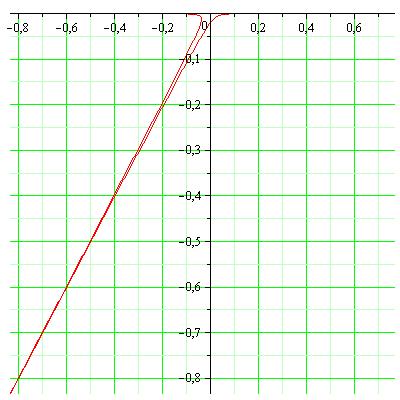
Fig. 2. The angular
velocity changes (arbitrary units).
To study the stability problem of stationary solutions to the perturbed equations we should formulate the eigenvalue problem. This leads to the following characteristic cubic polynomial

with the coefficients1
 ;
 ;
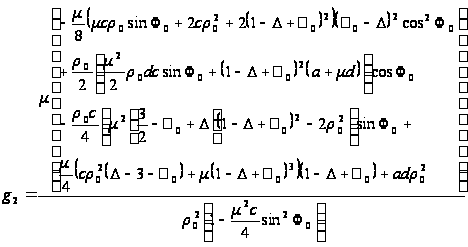 ;
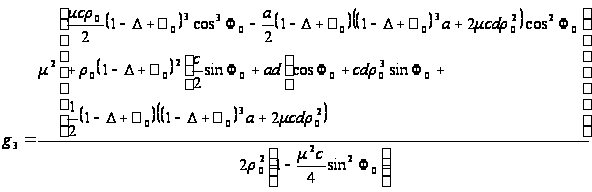 .
Now one traces the
stability properties by finding the areas of system parameters by
applying the Routh-Hurwitz criterion, which states the necessary and
sufficient conditions of positivity of the following numbers
 ,
 ,
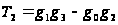 ,
 .
These conditions are violated along the frequency-amplitude curve
when scanning the parameter
between the points A and C. The characteristic points A and B
originate from the traditional condition that the derivative of
function
approaches infinity. The point C appears due to the multiple and zero
valued roots of the characteristic equation
 ,
as the determinants in the Routh-Hurwitz criterion approach zero,
more precisely,
 .
At the direct scanning of the parameter
together with increasing the angular velocity of the driver, one can
observe a “tightening” of oscillations up to the point A.
Then, the upper branch of the resonant curve becomes unstable and the
stationary oscillations jump at the lower stable branch. At the
reverse scan the angular velocity of the driver at the point C, in
turn, there is a loss of stability of stationary oscillations at the
lower branch and the jumping to stable oscillations with the greater
amplitude at the upper branch of the resonance curve. The point B,
apparently, is physically unrealizable mode of oscillations.
However, with the growth of the dissipation the instability zone shrinks. Then the frequency-amplitude curve becomes unambiguous, and the instability zone is completely degenerated. In this case the Sommerfeld effect also disappears.
Conclusions
Near the resonance the rotor is substantially influenced by the pair of forces acting from the vibrating base. The average value of this moment is a definite value proportional to quadrate of the amplitude of vibrations of the base. Therefore, near the resonance some increase in the angular velocity of the engine is experienced. This leads to the phenomenon of ‘pulling’ hesitation, despite the fact that the elastic properties of the base are linear. Together with the growth of dissipation the zone of the Sommerfeld instability narrows down to its complete disappearance. This leads to the idea of efficiency of utilizing vibration absorbers to stabilize the motion of electromechanical systems.
Acknowledgments
The work was supported in part by the RFBR grant (project 09-02-97053-р поволжье).
References
Vibrations in Engineering, v. 2, Moscow. Mechanical Engineering, 1979: 351 (in Russian).
Frolov K.V. Vibrations of machines with limited capacity power source and the variable parameters (Proc. K.V. Frolov ed.), Nonlinear oscillations and transient processes in machines, Moscow: Nauka, 1972: 5-16 (in Russian).
Kononenko V.O. Nonlinear vibrations of mechanical systems. Kiev: Nauk. Dumka, 1980: 382 (in Russian).
Nagaev R.F. Quasiconservative systems. St. Petersburg: Nauka, 1996: 252 (in Russian).
Blekhman I.I. Synchronization in Nature and Technology. Moscow: Nauka, 1977: 345 (in Russian).
Blekhman I.I., Landa P.S., Rosenblum M.G. Synchronization and chaotization in interacting dynamical systems (J) Appl. Mech. Rev., 1995, 11(1): 733-752.
Samantaray A.K., Dasguptaa S.S.and R. Bhattacharyyaa. Sommerfeld effect in rotationally symmetric planar dynamical systems (J), Int. J. Eng. Sci., 2010, 48(1): 21-36.
Masayoshi Tsuchidaa, Karen de Lolo Guilhermeb and Jose Manoel Balthazarb. On chaotic vibrations of a non-ideal system with two degrees of freedom: Resonance and Sommerfeld effect (J), J. Sound and Vibration, 2005, 282(3-5): 1201-1207.
Leonov G.A., Ponomarenko D.V. and Smirnova V.B. Frequency-domain methods for nonlinear analysis. Theory and applications. Singapore: World Sci., 1996: 498.
Zhuravlev V.F., Klimov D.M. Applied methods in oscillation theory, Moscow: Nauka, 1988: 328 (in Russian).
Размещено на
1 It should be noted that the characteristic polynomial coefficients are calculated with a somewhat inflated for the first-order approximation accuracy. In fact, it is easy to prove by series expansion in the small parameter. However, the coefficients in the truncated form are such that again lead to a transcendental equation. Therefore, the value of such asymptotics is small.