Biopolitics in Russia: History and Prospects for the Future
In 1995, Dr. Zub defended a Doctor of Science dissertation at MSU on the Philosophic and Methodological Foundations of Biopolitics. Dr. Oleskin gave talks on this subject at conferences organized by the International Center for Economics and Ecology in 1994 (Tubingen, Germany) and in 1995 (Miscolc, Hungary). Biopolitical matters were also discussed by him at an international German Limnological Society conference (Berlin, 1995). His presentation was also included into a broadcast by one of the Moscow radio stations. As it happened, the Deputy Administration Chief of the Moscow City Council Mrs. Olga A. Bektabegova heard this broadcast while driving to her office. She set up a creative lab, Future of Russia, under the aegis of the City Council. Biopolitics was incorporated into the research and development projects carried out by this lab, which generally concerned itself with long-term urban planning and optimizing social and political structures in Moscow.
Two talks on biopolitics-related matters (by Prof. Franz Wuketitz from Vienna, Austria, and Oleskin) were given at a Synergetics Conference in Moscow in January 1996. A travel grant from the American Council of Teachers of Russian (ACTR) enabled Dr. Oleskin to spend six months at Dartmouth College, working under Prof. R. Masters on biopolitics and to establish contacts with M. Gruter from the Gruter Institute for Law and Behavioral Research and with Professors Albert Somit, Steven Peterson, James Schubert, Peter Corning, Peter Meyer, and others during the ESS/IPSA/APLS Meeting in Alfred (July 22-27, 1996). One of the goals of Dr. Oleskin's visit was to intensify the cooperation between Russian and American biopoliticians (and scholars in related fields).
Following is a brief description of selected biopolitical problems which are currently being actively researched in Russia.
3. Biopolitics and Social Technologies. The Network Group (Hirama) ProjectSocial technologies are interpreted here as including all kinds of techniques aimed at (1) ameliorating interpersonal and intergroup relations in various social settings (families, worker collectives, research teams, artistic creative groups, parliamentary commissions, etc.) and (2) improving the organizational patterns of human social structures per se. With the aid of other scientific approaches (based on game theory, decision-making theory, small group sociology, management theory, etc.), biopolitics can be expected to make its contribution to a number of Russian social and economic problems. Biopolitics-related social techniques should help the country accumulate its "social capital" (Nichols, 1996), i. e. establish dependable relationships between the incumbents of various social roles (bank clerks, clients, sales assistants, production managers, etc.), based on the rule of democratic law.
The project discussed below has been developed by the Sector for Biosocial Problems at MSU and by the Creative Lab at the City Council of Moscow. This project envisages establishing a system of social networks, whose organizational patterns are in conformity with the recent data and concepts of evolutionary biology. The variant of network structures promoted in Russia by biopoliticians has been termed "the hirama model", since these small-scale networks resemble the Middle East hiramas established about 2,000 years ago3. There is, nevertheless, also a modern interpretation of the word hirama (High-Intensity Research and Management Association). The hirama-type networks promote non-hierarchical (horizontal) relationships among people. This principle is in conformity with
the data on primate social structures, suggesting that they do not always represent "close-knit" rigid hierarchies, can easily disintegrate in response to environmental changes, and often coexist with horizontal relations based on friendly bonds (e. g., among young vervets, McGuire, 1982). Ape groups are characterized by prevailing loose, impermanent friendly relationships (food sharing, greeting, grooming, and game behaviors), despite the presence of dominant individuals ("silver-back" males in gorilla groups). the widely accepted concepts on primitive human societies, which are envisioned as relatively small groups (up to 50—100 people) engaged in gathering, scavenging, and/or hunting. Conventionally described as "hunter-gatherers," these were cooperation-promoting, low-density networks which give an individual a chance to migrate and to stay isolated (see, e. g., Maryanski and Turner, 1992). ethological data suggesting the involvement of the following factors in behavioral coordination: (1) hierarchy and imitation of the leader's behavior by most individuals in the biosocial system, a widespread biosocial pattern occurring in primates (McGuire, 1982), social insects (Zakharov, 1991), and presumably even microorganisms (Oleskin, 1993, 1994c). However, it does not represent the only option; (2) local interactions among neighbors which stimulate and imitate each other's behavior (Holzman, 1984)—the practice colloquially known as "keeping up with joneses", such interactions are involved in nest construction by ants (Zakharov, 1991), collective hunting by lions (Stander, 1992), and the movements of "anonymous flocks" (Lorenz, 1966) such as leaderless fish shoals; (3) diffuse behavior-stimulating agents permeating the biosocial system (chemical agents, physical fields). For instance, olfaction is an ancient and evolutionarily conservative communication channel operating even in human face-to-face groups. historical data on horizontal network structures successfully tested in various historical epochs and countries. These structures can be exemplified by Swiss Gemeinden (originally "non-hierarchical, undivided ... valley communities", Steinberg, 1976, p.11), modern Israeli kibbutzim, American communes such as "Twin Oaks" (with communal ownership and communal satisfaction of the members' needs), cooperatives in the US and West Europe (e. g., "Mondragon" in Spain), as well as Russian "informal groups", which flourished under Gorbachov's regime. finally, with the fact that these networks are spontaneously generated by humans. For example, as new scholarly disciplines emerge in universities,we see them everywhere complementing the existing Departments (themselves networks of individuals who cooperate and compete in complex ways). At the other end of the social scale, we find gangs emerging in otherwise anomic ghetto environments. Hence, from the highest to the lowest social strata, we see informal social networks as essential components of more complex institutional or social behavior (cf. Peterson, 1991; J. Schubert, 1991).What is the structure of a modernized hirama-type network like? It is a creative group of 10 to 20 people. It deals with an interdisciplinary task/problem such as Small-Quantity Generators of Environmental Pollution or Culture as a Self-Organizing Evolutionary System. The problem (task) is subdivided into several subproblems. However, despite subdividing the problem into subproblems, the group is not subdivided into parts. The group members work, in parallel, on several (ideally on all) subproblems. The subproblems, therefore, should overlap and provide for a broad interdisciplinary vision of the group's focus.
Roles or functions in this network structure as not fixed or defined, as with the "offices" in a Weberian bureaucracy. Often only one person, the subproblem leader, is explicitly attached to a particular subproblem (see Fig. 1). This person collects ideas on this subproblem, generated by other group members. A hirama-type network group has also a psychological leader. The individual in this functional role estimates the contributions of all members to the intellectual "money-box" of the network group. The psychological leader, however, does not overemphasize this controller function. This role is rather that of a helper, providing advice, support, and psychological help that is often sought by other group members. Like a "socio-emotional leader" in any task-oriented groups, this individual "can reinforce or reward people on a personal level, take care of the emotional well-being of the group, and behave in ways designed to reduce tension and provide orientation for the group" (Burgoon et al. 1974: p. 146).
A network of this kind typically also includes an "external affairs" leader. This individual with this role is responsible for organizing the activities outside the group itself, propagandizing hirama-promoted ideas, establishing contacts with other network groups and organizations, and shaping the pastime and leisure activities, thus contributing to the development of informal loyal relationships among group members. Both the psychology and external affairs functions entail personalizing and harmonizing the relations among members. Modernized hirama-type networks usually make alterations in the group's organizational pattern. For instance, additional leader roles are introduced:
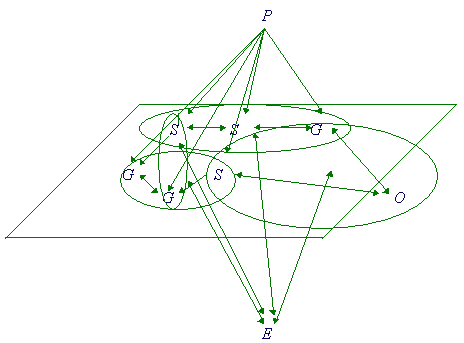
Figure 1. Hirama networking pattern. This is a "momentary close-up" picture, since this structure is dynamic, and creative subunits included in it are constantly in the process of formation & disintegration (fission-fusion structures, resembling the hunter-gatherer society pattern, see Maryansky and Turner, 1992). Designations: S, subproblem leaders; G - just group members; O - an outsider collaborating with the group on one of the subproblems. Thin-line circles are temporary creative subunits or discussion groups. These relationships all correspond to the "task-fullfillment plane" shown in the picture. The psychology and "external affairs" leader (P and E, respectively), are beyond this plane. Types of relations: → partial (task-limited) leadership; ↔ horizontal networking; no symbol between two individuals, standing by and watching.
a commercial leader, responsible for searching for sponsors and grant opportunities and for marketing and other profit-making activities; an organizational leader who is particularly important while a hirama-like group is organizing its work and legalizing its status; a spiritual leader (a "guru"). It is evident from the above historical examples that the operation of community-type structures depends on unitary spiritual values, often implying collective attempts at "attaining certain ideals" (Kanter, 1972: p.2). This conceptual basis is personified by the "guru" image.The group members strive to attain the goals formulated by the "guru" (King Hiram was probably the first of such "gurus"). Importantly, this "spiritual guidance" by the "guru" should be prevented from transforming into an authoritarian dictatorship, which would be quite incompatible with the decentralized non-hierarchical character of a hirama-like group. For this reason, "hiramists" typically prefer a legendary "guru" (like Wilhelm Tell in Switzerland), a long-deceased person whose ideas are contained in his/her works, or, finally someone sufficiently far away from the group's location (the Moscow University hirama dealing with biopolitics has recently suggested an American biopolitician as the "spiritual leader").
Hirama-type structures, despite all modifications, retain some general structural similarity to a primitive hunter-gatherer band. Some essential social functions in a hunter-gatherer group have their equivalents in a hirama. For instance, the "headman" described by Maryansky and Turner (1992) corresponds to the "external affairs" leader in a network group, the shaman resembles the "psychology leader", and the influential people, who are especially skillful in doing certain jobs, are clearly related to creative "subproblem leaders".
Hiramas and similar groups can be useful in a number of different ways in post-communist countries. As internally dynamic and flexible, informal relationships-enhancing collectivities, they can effectively operate in an unstable, unpredictable, turbulent, and ruthless social