On a decomposition of an element of a free metabelian group as a productof primitive elements


 , that is a product of three
primitive elements.
4. A decomposition of an element of a free metabelian group of rank 2 as a product of primitive elements
For further reasonings we need the
following fact: any primitive element  of a group A2 is induced by a
primitive element
 ,
 . It can be explained in such way.
One can go from the basis
 to some other basis by using a
sequence of elementary transformations, which are in accordance with elementary
transformations of the basis <x,y> of the group M2.
The similar assertions are valid for
any rank  .
Предложение 3. Any element of group M2 can be presented as a product of not more then four primitive elements.
Доказательство. At first consider the elements in
form  . An element
 is primitive in A2 by lemma 1,
consequently there is a primitive element of type
 . Hence,
 Since, an element
 is primitive, it can be included
into some basis
 inducing the same basis
 of A2. After rewriting in this new
basis we have:
 ,
and so as before



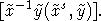
Obviously, two first elements above are primitive. Denote them as p1, p2. Finally, we have

 , a product of three primitive
elements.
If  , then by proposition 1 we can find
an expansion
 as a product of two primitive elements,
which correspond to primitive elements of M2: v1xk1yl1,v2xk2yl2,v1,v2
 .
Further we have the expansion

The element w(v1xk1yl1) can be presented as a product of not more then three primitive elements. We have a product of not more then four primitive elements in the general case.
5. A decomposition of elements of a
free metabelian group of rank  as a product of primitive elements
Consider a free metabelian group
Mn=<x1,...,xn> of rank .
Предложение 4. Any element  can be presented as a product of not
more then four primitive elements.
Доказательсво. It is well-known [2], that M'n as
a module is generated by all commutators  . Therefore, for any
 there exists a
presentation








Separate the commutators from (4) into three groups in the next way.
1)  - the commutators not including the
element x2 but including x1.
2) - the other commutators not
including the x1.
3) And the third set consists of the
commutator  .
Consider an automorphism of Mn, defining by the following map:


 ,
 .
The map  determines automorphism, since the
Jacobian has a form
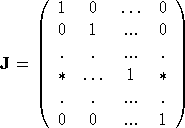 ,
and hence, det Jk=1.
Since element  can be included into a basis of Mn,
it is primitive. Thus any element can be presented in form







 x3x2x1]
[x1-1x2-1x3-1]. =p1p2p3p4 a product of four primitive elements.
Note that the last primitive element p4=x1-1x2-1x3-1 can be arbitrary.
Предложение 5. Any element of a free metabelian group Mn can be presented as a product of not more then four primitive elements.
Доказательство. Case 1. Consider an element  , so that g.c.m.(k1,...,kn)=1. An
element
 is primitive by lemma 1 and there
exists a primitive element
 ,

An element from derived subgroup can be presented as a product of not more then four primitive elements with a fixed one of them:

Then  .
Case 2. If  , then by lemma 2

 , where

 are primitive in An. There exist
primitive elements

