Sport in the UK
Rugby
There is another game called rugby football, so called because it originated at Rugby, a well-known English public school. In this game the players may carry the ball. Rugby football (or 'rugger') is played with an egg-shaped ball, which may be carried and thrown (but not forward). The ball is passed from hand to hand rather than from foot to foot. If a player is carrying the ball he may be 'tackled' and made to fall down. Each team has fifteen players, who spend a lot of time lying in the mud or on top of each other and become very dirty, but do not need to wear such heavily protective clothing as players of American football.
There are two forms of rugby - Rugby Union, which is strictly amateur, and Rugby League, played largely in the north, which is a professional sport. Rugby Union has fifteen players, while Rugby League has thirteen, but the two games are basically the same. They are so similar that somebody who is good at one of them can quickly learn to become good at the other. The real difference between them is a matter of social history. Rugby union is the older of the two. In the nineteenth century it was enthusiastically taken up by most of Britain's public schools. Rugby league split off from rugby union at the end of the century. There are two versions of this fast and aggressive ball game: rugby union and rugby league. Although it has now spread to many of the same places in the world where rugby union is played (rugby union is played at top level in the British Isles, France, Australia, South Africa and New Zealand; also to a high level in North America, Argentina, Romania and some Pacific islands). Rugby can be considered the 'national sport' of Wales, New Zealand, Fiji, Western Samoa and Tonga, and of South African whites. Its traditional home is among the working class of the north of England, where it was a way for miners and factory workers to make a little bit of extra money from their sporting talents. Unlike rugby union, it has always been a professional sport.
Because of these social origins, rugby league in Britain is seen as a working class sport, while rugby union is mainly for the middle classes. Except in south Wales. There, rugby union is a sport for all classes, and more popular than football. In Wales, the phrase 'international day' means only one thing — that the national rugby team are playing. Since 1970, some of the best Welsh players have been persuaded to 'change codes'. They are 'bought' by one of the big rugby league clubs, where they can make a lot of money. Whenever this happens it is seen as a national disaster among the Welsh.
Rugby union has had some success in recent years in selling itself to a wider audience. As a result, just as football has become less exclusively working class in character, rugby union has become less exclusively middle class. In 1995- it finally abandoned amateurism. In fact, the amateur status of top rugby union players had already become meaningless. They didn't get paid a salary or fee for playing, but they received large 'expenses' as well as various publicity contracts and paid speaking engagements.
Cricket
The game particularly associated with England is cricket. Judging by the numbers of people who play it and watch it ( look at ‘Spectator attendance at major sports’), cricket is definitely not the national sport of Britain. In Scotland, Wales and Northern Ireland, interest in it is largely confined to the middle classes. Only in England and a small part of Wales is it played at top level. And even in England, where its enthusiasts come from all classes, the majority of the population do not understand its rules. Moreover, it is rare for the English national team to be the best in the world.
C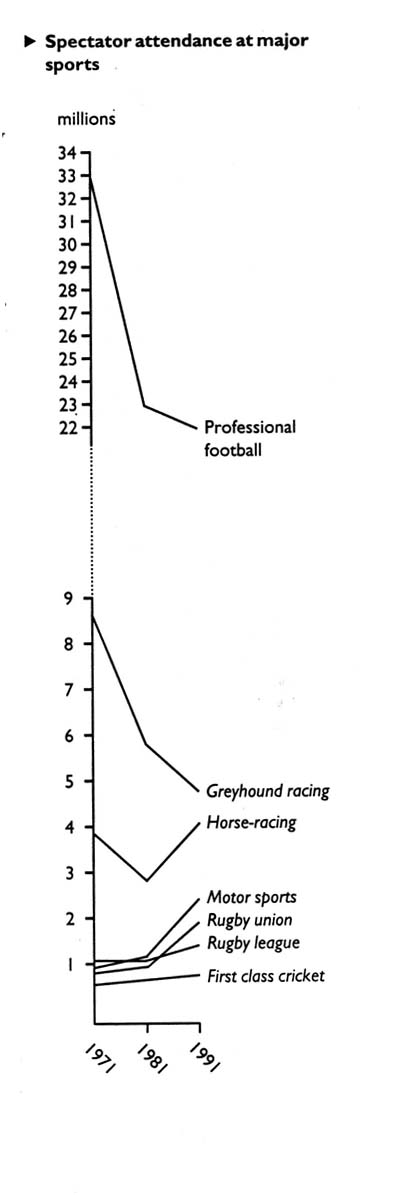 ricket
is, therefore, the national English game in a symbolic sense.
However,
to some people cricket is more than just a symbol. The comparatively
low attendance at top class matches does not give a true
picture of the level of interest in the country. One game of cricket
takes a terribly long time, which a lot of people
simply don't have to spare. Eleven
players in each team. Test
matches between national teams can last up to five days of six hours
each. Top club teams play matches lasting
between two and four days. There are also one-day matches lasting
about seven hours. In
fact there are millions of people in
the country who don't just enjoy cricket but are passionate about it!
These people spend up to thirty days each summer tuned to the live
radio commentary of ‘Test’ (= international) Matches.
When they
get the chance, they watch a bit of the live television coverage.
Some
people even do both at the same time (they turn the sound down on the
television and listen to the radio). To these people, the
commentators become well-loved figures. When, in 1994, one famous
commentator died, the Prime Minister lamented that 'summers
will never: be the same again'. And if cricket fans are too busy to
listen to the radio commentary, they can always phone a special
number to be given the latest score!
Many other games which are English in origin have been adopted with enthusiasm all over the world, but cricket has been seriously and extensively adopted only in the former British empire, particularly in Australia, New Zealand, India, Pakistan, Sri Lanka, the West Indies and South Africa. Do you know how to play cricket? If you don't live in these countries you won't learn it at school. English people love cricket. Summer isn't summer without it. Even if you do not understand the rules, it is attractive to watch the players, dressed in white playing on the beautiful green cricket fields. Every Sunday morning from May to the end of September many Englishmen get up very early, and take a lot of sandwiches with them. It is necessary because the games are very long. Games between two village teams last for only one afternoon. Games between counties last for three days, with 6 hours play on each day. When England plays with one or other cricketing countries such as Australia and New Zealand it is called a test match and lasts for five days. Cricket is played in schools, colleges and universities and in most towns and villages by teams which play weekly games. Test matches with other cricketing countries are held annually.
Cricket is also played by women and girls. The governing body is Women's Cricket Association, founded in 1926. Women's cricket clubs have regular weekend games. Test matches and other international matches take place. The women's World Cup is held every four years. But There is The Marylebone Cricket Club (MCC) and Lord's cricket ground in the United Kingdom. The MCC was founded in 1787, and is still the most important authority on cricket in the world. As a club it is exclusively male. No woman is allowed to enter the club buildings. There are special stands for members and their wives and quests.
Organised amateur cricket is played between club teams, mainly on Saturday afternoons. Nearly every village, except in the far north, has its cricket club, and there must be few places in which the popular image of England, as sentimentalists like to think of it, is so clearly seen as on a village cricket field. A first-class match between English counties lasts for up to three days, with six hours play on each day. The game is slow, and a spectator, sitting in the afternoon sun after a lunch of sandwiches and beer, may be excused for having a little sleep for half an hour.
When people refer to cricket as the English national game, they are not thinking so much of its level of popularity or of the standard of English players but more of the very English associations that it carries with it. Cricket is much more than just a sport; it symbolizes a way of life - a slow and peaceful rural way of life. Cricket is associated with long sunny summer afternoons, the smell of new-mown grass and the sound of leather (the ball) connecting with willow (the wood from which cricket bats are made). Cricket is special because it combines competition with the British dream of rural life. Cricket is what the village green is for! As if to emphasize the rural connection, ‘first class’ cricket teams in England, unlike teams in other sports, do not bear the names of towns but of counties (Essex and Yorkshire, for example).
ANIMALS IN SPORT
Traditionally, the favourite sports of the British upper class are hunting, shooting and fishing. The most widespread form of hunting is foxhunting — indeed, that is what the word ‘hunting’ usually means in Britain. Foxhunting works like this. A group of people on horses, dressed in eighteenth century riding clothes, ride around with a pack of dogs. When the dogs pick up the scent of a fox, somebody blows a horn and then dogs, horses and riders all chase the fox. Often the fox gets away, but if not, the dogs get to it before the hunters and tear it to pieces. As you might guess in a country of animal-lovers, where most people have little experience of the harsher realities of nature, foxhunting is strongly opposed by some people. The League Against Cruel Sports wants it made illegal and the campaign has been steadily intensifying. There are sometimes violent encounters between foxhunters and protestors (whom the hunters call 'saboteurs').Foxhunting is a popular pastime among some members of the higher social classes and a few people from lower social classes, who often see their participation as a mark of newly won status. The hunting of foxes is sport associated through the centuries with ownership of land. The hounds chase the fox, followed by people riding horses, wearing red or black coats and conforming with various rules and customs. In a few hill areas stags are hunted similarly. Both these types of hunting are enjoyed mainly by people who can afford the cost of keeping horses and carrying them to hunt meetings in 'horse boxes', or trailer vans. Both, particularly stag-hunting, are opposed by people who condemn the cruelty involved in chasing and killing frightened animals. There have been attempts to persuade Parliament to pass laws to forbid hunting, but none has been successful. There is no law about hunting foxes, but there is a fox-hunting seasons – from November to March.
Killing birds with guns is known as 'shooting' in Britain. It is a minority pastime confined largely to the higher social classes; there are more than three times as many licensed guns for this purpose in France as there are in Britain. The birds which people try to shoot (such as grouse) may only be shot during certain specified times of the year. The upper classes often organize 'shooting parties' during the 'season'. The British do not shoot small animals or birds for sport, though some farmers who shoot rabbits or pigeons may enjoy doing so. But 'game birds', mainly pheasant, grouse and partridge, have traditionally provided sport for the landowning gentry. Until Labour's election victory of 1964 many of the prime ministers of the past two hundred years, along with members of their cabinets, had gone to the grouse moors of Scotland or the Pennines for the opening of the shooting season on 12 August. Since 1964 all that has changed. Now there are not many leading British politicians carrying guns in the shooting parties, though there may be foreign millionaires, not all of them from America. Some of the beaters, whose job is to disturb the grouse so that they fly up to be shot, are students earning money to pay for trips abroad. But there is still a race to send the first shot grouse to London restaurants, where there are people happy to pay huge amounts of money for the privilege of eating them.
The only kind of hunting which is associated with the working class is hare-coursing, in which greyhound dogs chase hares. However, because the vast majority of people in Britain are urban dwellers, this too is a minority activity.
The one kind of ‘hunting’ which is popular among all social classes is fishing. In fact, this is the most popular participatory sport of all in Britain. Between four and five million people go fishing regularly. When fishing is done competitively, it is called ‘angling’. The most popular of all outdoor sports is fishing, from the banks of lakes or rivers or in the sea, from jetties, rocks or beaches. Some British lakes and rivers are famous for their trout or salmon,