Cultural Values
I had an opportunity to live with a family and be included in family life- crises and arguments included. I really experienced normal Russian life in more depth than many.
Positive things: meeting very friendly people/ hospitality and the nurturing manner of Russian women. The sincerity I -have felt from the sympathy expressed by Russians about the attacks in the U.S.
What is the worst thing that happened to you?
The first week I was living in my flat, and felt like a stranger in my landlady's home, my landlady and her husband would share nothing with me. I had to buy my own dish washing liquid and toilet paper. They would not allow me to wash my own clothes and wanted to charge me 20 rubles per shin. (While this may not be typical, this incident it is a true story.)
In St Petersburg, I got ripped off. 60 or 70 dollars in a money exchange on the street It can happen anywhere, though, and it didn't change my feelings; but there are nasty rip-offs in St Petersburg and Moscow.
Negative things: indifference to issues of lateness and when things don't work or something goes wrong. How things tend to be more black / white or how things are taken more literally. How certain some Russians are about certain issues.
If you were to compare Russian and American culture, what are some of the broad distinctions you might draw?
Economics. In the US everything is about money. Sometimes Russians are very concerned about money and talk about money because it's a necessity. They have no qualms about asking how much money you make. That's a taboo question in the States.
Russians are more traditional, especially the way women want to be treated by men. Feminism doesn't seem to exist. (Said by a man)
Russians drink more. There are few laws about drinking in public. You can drink beer in public but not vodka. It's strange, in the springtime, to be the only sober person walking down the street.
Russians are less tolerant of racial differences and of sexual orientation. Russian men are very homophobic.
There is no one word or phrase for "cultural identity," vanity, or privacy in Russian language; you would have to explain your intention in order to be understood.
Can you describe some situations/incidents in which cultural expectations caused a misunderstanding?
American men are not expected to be as attentive as Russian men. Men pour drinks for women, carry packages for women, etc.
If I'm silent, people see me as standoffish.
Americans separate business and pleasure
By living in Russia, have you learned anything new about yourself and your native culture?
I learned a lot of about myself as an American. There are some things I feel proud about. I stopped taking things for granted, things I would have demanded in the past.
I value independence and self-reliance.
I notice consumerism in the US more. Everything is packaged, everything is for sale. There's more media and advertising everywhere. People need things NOW: fast food, quick and efficient customer service.
Shallow, superficial friendliness and customer service. But I like it anyway! Maybe it's not so shallow. Maybe it says something about egalitarianism.
The number of trashcans and the amount of waste produced in the US. In Russia there's no place to put trash and there are lots of wrappers and litter on the streets. In America there ate lots of receptacles because we produce lots of waste -packaging, wrappers, etc. We even sell special 10-gallon trash bags!
The main thing I noticed and was overwhelmed by was by the amount of choice in everything- it was great but too much to handle sometimes, whether I was shopping or trying to decide what to eat in a restaurant.
I can live in an arctic climate but I'm still not a fan of long winters.
Americans value individualism and the right to speak their minds freely
Some Americans can be as ethnocentric as some Russians can be and more concerned with events at home, but what culture isn't?
RUSSIAN INTERVIEW RESPONSES
When you first arrived in the USA, what stood out?
The traffic system is orderly and well organized. Drivers are polite and stop for pedestrians.
How Americans are relaxed, they have a relaxed posture, free behavior, a relaxed way of dressing, usually sports clothes
Aged parents very seldom live with their grown children and prefer living alone or moving to a nursing home
Americans prefer to live in suburbs in their own houses and thus a car play a very important role in one's life and there might be several cars in the family
They use computers a lot in everyday life
Stereotypes of Americans You Were Aware Of
Pragmatic
Rich
Overweight
Always smile
Body conscious and fond of healthy life styles
American women are too independent
How do you think Americans viewed Russian culture, in general terms?
As far as I remember, everyone I met was very friendly, considerate and helpful and eager to get to know Russians better and learn more about our culture.
Advice friends or family members gave you
To find some things they wanted
To set up an aim you want to achieve in this country and to do it. For example, to visit all the museums.
Try to make new friends and make the most of your stay
My mother told me to try every kind of food I can
Why questions you asked
Why do Americans love their cars so much?
Why do they never dress up?
Why do they mingle at parties? Why do they invite so many people?
Why do they leave their nests? Why do they so often change cities?
Why are university professors so informally dressed in class?
Why do children prefer to live separately from parents when they complete high school and almost never come back to
live with the parents again?
Why questions others asked you
Why do Russians stay at one place (at a table) at a party?
Why do Russians have more long lasting friendships?
Why do you prefer jeanswear: is it because you like American style clothing or do you find this kind of clothing more comfortable?
Do people in Russia know foreign languages?
Stereotypes of Russians You Discovered
Russians are poor.
Russians dance very well. They like to dance.
There is Mafia in Russia.
Russian women do a lot of work at home.
Russians don't know how to work.
Russian women do too much work for the family. They do not respect themselves.
Russians are strong and hard working.
The new generation will change the country.
Russians don't know foreign languages.
Starving and wearing shabby clothing
Russians don't smile on the street.
One young American guy mentioned he wouldn't be interested in meeting a Russian woman because Russian women are
hairy and don't shave.There are few cars in Russia.
All women are prostitutes because that's the only way to earn a living.
How has your experience changed your original view or expectations?
I don't think Americans are rich. They get more money but they economize and spend more rationally.
If you were to compare Russian and American culture, what are some of the broad distinctions you might draw?
Russian culture belongs to the eastern type and American to the western type.
Americans are more matter-of-fact and business-like; they are more active; they are not afraid of making severe life changes.
Can you describe some situations/incidents in which cultural expectations caused a misunderstanding?
When you are in Russia, invited to someone's home, you are asked to have tea or some food. In America this does not happen in every house.
What things stood out the most or what things did you most notice about Russia when you returned home?
The one thing that pleased me is that my family was so glad to see me.
People not smiling. Not helpful.
Gloomy people on the streets; impolite shop assistants; dirty public places; no adaptation of public places for disabled
People are less polite; there is garbage everywhere; there are no non-smoking areas
By visiting the USA, have you learned anything new about yourself and your native culture?
Russians are hospitable, collective. They discuss things in groups before making decisions. They are always ready to share.
Russians are more family oriented.
I learned that I should not feel inferior to other people because of being physically disabled.
Being in the US I am conscious of being Russian and proud of it. I don't that I stand out in American culture and most Americans can't say I am from a different country unless I tell them, but somehow I always "feel" Russian and tell people I am from Russia with a sense of pride.
CONCLUSION
Let's sum up everything considered above.
Now there is a problem of misunderstanding among people of the different countries. This misunderstanding is shown owing to different attitudes to life, to business, to family, to fellow workers. Also because of ignorance of traditions, customs, etiquette of other countries.
Excellent knowledge of foreign language is not a guarantee of successful cooperation of firms or pleasant dialogue of people from different continents. To know language is only half-affair. The most important is to understand priorities of other people, to try to look at the world by their eyes.
If the country is more advanced in economic, political, social spheres, it gives more attention to studying other cultures for successful cooperation (for example, the USA, Japan).
It is important to note, that the closer cultures to each other, the fewer problems arise at their interaction. If cultures are opposite, then the essence of intercultural dialogue is reduced to understanding of different values.
For greater success in relations between the countries it is necessary to take into account all these features.
LITERATURE:
«Communication and Culture» / Alfred G. Smith // Hold, Rinehart and Winston, Inc., the United States of America,1966
«Crossing Cultural Borders - Russia» / Julie E. Zdanoski // Petrozavodsk, 2003
«Culture Learning: The Fifth Dimension in the Language Classroom» / Louise Damen
«Culture Matters. How Values Shape Human Progress» / Lawrence E. Harrison, Samuel P. Huntington // Basic Books, A Member of the Perseus Books Group, the United States of America, 2000
APPENDIX
A CULTURAL MODEL OF INTERACTION
When a person from a national society with hierarchical tendencies encounters a person from a society with egalitarian tendencies, and moreover when the country of the latter is generally "high" in the estimation of the former, the idealized paradigm as shown in Figure 1 would be approximated. In this diagram, X, the person from a country with egalitarian views, behaves toward Y, the person from a hierarchically oriented country, as if he occupied the same "level"; that is, in equalitarian terms.
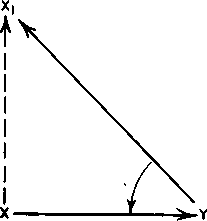
Figure 1.
TABLE 1. SOME IMPLICIT CULTURAL ASSUMPTIONS
North American (USA)
Personal control of the environment
Change inevitable and desirable
Equality of opportunity
Individualism
Future orientation
Action orientation
Directness and openness
Practicality; pragmatic; rational
Problem-solving orientation
Cause-and-effect logic
Informality
Competition
DO-it-yourself approach to life
Contrast American
Nature dominating man
Unchanging; traditional
Class structure dominant; hierarchical Interdependence but individuality
Present or past orientation
Being orientation
Suggestive; consensus-seeking; group orientation
Feeling orientation; philosophical
Inactive; enduring; seeking help from others Knowing
Formality
Group progress
Intermediaries
TABLE 2 VALUE ASSUMPTIONS OF EAST AND WEST: JAPAN AND THE UNATED STATES
Values concerning
1. Nature and Culture vertically
(octopus pot)(draws in)
(outside/inside)
2. Interpersonal Relationships
Unated States
Heterogeneity; horizontal society guilt sasara (bamboo wisk)
Doing
Pusning
Omote predominates
Independence; I/you clash symmetrical relationships informality
Achieved status
Japan
Homogeneity; shame takotsubo
Being
Pulling
Omote/ura
We over I; amae complementary
Ascribed status