The Old Indian Civilization
Book III Ch.313
“The Mahabharata”
The following represents a selection of the questions and answers that passed between the Spirit and Youdhishthira:
“What is greater than Earth? What is higher than heaven?” “Mother is greater than Earth; father is higher than heaven.”
“In what one thing is all dharma summed up? What single thing constitutes all fame? What sole means takes one to heaven?” “Skill in the discharge of one’s duties sums up all dharma; giving sums up all fame; truthfulness is the sole road to heaven and good conduct is the one means to happiness”.
“What is the foremost wealth?” “Learning”.
“What is the best gain?” “Health”.
“What is the supreme happiness?” “Contentment”.
“What is superior to all other dharmas in the world?” “Benevolence”
“Whose control leads to absence of sorrow?” “The control of mind”.
“Which friendship ages not?” “That with good souls”.
“By abandoning what thing does man become rich?” “Desire”.
“By giving up what, does one become happy?” “Avarice”.
“What is penance?” “Penance is the observance of one’s own obtained duty.”
“What is self –control?” “Control of the mind”.
“What is forbearance?” “Putting up with opposites”. (pleasure and pain, profit and loss)
“What is shame?” “Aversion to do reprehensible act is shame”.
“What is straight forwardness?” “Equanimity”.
“Who is the enemy hard to be won?” “Anger”.
“What is the endless disease?” “Avarice”.
“Who is said to be a good man?” “He who is benevolent to all things”.
“Who is a bad man?” “He who is barren of sympathy”.
“What is the best path?” “To cast away all mental dirt”.
“What is gift?” “Protection of life”.
“What is the wonder of the world?” “Every day live beings enter the abode of death; those who remain think that they will survive; what greater wonder is there than this?”
“What is the news of the world?” “With Earth as the pot, the firmament as the covering lid, the sun as the fire, day and nights as faggots and the seasons and months as the stirring ladle. Time cooks all beings; this is the great news”.
Extract from Mahabharata
Romayana (adventures of Rama) is the earliest of the two great Sanscrit epics, the incidents of which precede the Mahabharata by about 150 years. Rama was a king before he became translated into a deity. In course of time, his story and epic became sacred and the belief became established that spiritual and other blessings would be conferred on its knowers ramayana became popular in India in every Hindy home. The story is told in 7 books (96 000 lines).
At instigation of his second queen Dasaratha sends Rama, his eldest son, into exile for 14 years. He is accompanied by Sita, his young Wife and Lakshmana, his younger brother, when they are living happily in the forest, Sita is abduced by Ravana (King of Lanka) Rama and Lakshmana go through many adventures, battles, etc in their pursuit of Ravana, in which they’re assisted by Sugriva, the monkey king and his general, Hanuman. Eventually, Lanka is stormed and set fire to by Hanuman; Ravana is killed; Sita is rescued and victorious party returns to Ayodhya, their capital city. Later because her chastity is suspected (because she stayed in Ravana’s house), Sita proves her innocence voluntarily undergoing an ordeal by fire.
Rama accepts her but for the same reason banishes her (again) the next time. She goes away to Valmiki’s ashram, where her twin sons are born and brought up. She prays to the earth goddess to take her away if she is innocent who seated on her throne appears out of the earth and seating Sita on her lap takes her away for good.
The epics Ramayana and Mahabharrata arose to supplement and reinforce the teaching of the Vedas, particularly in respect of the moral, religious and spiritual ideas of men and women. Since remote times, the two epics have been the two eyes of the nation guiding it and holding up before it the ideas of the truth and righteousness of Rama and Yudhishthira and of chastity and wifely devotion of Sita, as also of the negative example of Ravana and other characters who came to grief because of their lust, avarice and wickedness.
These epics were expected to fulfil the mission of placing before the people examples of how virtue triumphed and vicefell.
This was also an age of advance in mathematics, science, and medicine. Our so called Arabic numerals originally came from India. Indian mathematicians were among the first to use negative numbers, the decimal, and the zero. Centuries before Isaac Newton, Indian Scientist developed their own theories of gravity. Indian astronomers knew that the earth was round and that it rotated on its axis. If in need of medical attention, the people of the Gupta Empire could go to free hospitals where Indian physicians were able to perform many surgical procedures and mention 300 different operations and 20 instruments.
Customs in India
India has many customs. The practice of self-information by fire has a strange and terrible place in the lore of India, and it brings to mind the practice of suttee, widow burning. This barbaric survival of ancient customs lasted in India to a late day.
In 1817 there were 706 cases of suttee in Bengal alone. This was at a time when the British authorities were making efforts to stop the practice. They were afraid to prohibit window burning entirely in the face of fanatical.
Hindu addiction to tradition, and resorted to intensive persuasion. No suttee was permitted until the prospective, victim had been examined by a magistrate, who made sure that she was proceeding of her own free will and urged her to give up her ghastly intention.
The great source of information in that period is a massive volume “Hindu Manners, Customs and ceremonies” by the Abbe Dubois, a French missionary who spent years in India at the end of the eighteenth century and the beginning of the nineteenth. He writes:
T he
last king of Tanjore, who died in 1801, left behind him four lawful
wives. The Brahmins decided that two of these should be burnt with
the body of their husband, and selected the couple that should have
the preference. It would have been the everlasting shame to them and
the grossest insult to the memory of the deceased had they hesitated
to accept this singular, honor, so they seemed perfectly ready to
yield to the terrible lot which awaited them. The necessary
preparations for the obsequies were completed in a single day.
Three or four leagues from the royal residence a square pit of no great depth, and about twelve to fifteen feet square, was excavated
Within it was erected a pyramid of sandalwood, resting on a kind of scaffolding of the same wood. The posts which supported it were so arranged that they could easily be removed and would thereby cause the whole structure to collapse suddenly. At the four courners of the pit were placed huge brass jars filled with ghee, to be thrown on the wood in order to hasten combustion .
The following was the order of the procession as it wended its way to the pyre. It was headed by a large force of armed soldiers. Then followed a crowd of musicians chiefly trumpeters, who made the air ring with the dismal sound of their instruments. Next came the king’s body borne in a splendid open palanquin, accompanied by his guru, his principal officers, and his nearest relatives, who were all on foot and wore no turbans in token of mourning.
Then came two victims, each borne on a richly decorated palanquin. They were loaded rather than decked, with jewels. Several ranks of soldiers surrounded them to preserve order and to keep back the great crowds that flocked in from every side.
The two queens were accompanied by some of their favorite women, with whom they occasionally conversed.
Then followed relatives of both sexes, to whom the victims had made valuable presents before leaving the palace. An innumerable multitude of Brahmins and persons of all castes followed in the rear.
On reaching the spot where their fate awaited them, the victims were required to perform the ablutions and other ceremonies proper on such occasions and they went through the whole of them without hesitation and without the least sign of fear. When, however, it came to walking round the pyre, it was observed that their features underwent a sudden change.
During this interval the body of the king had been placed on the top of the pyramid of sandalwood. The two queen, still wearing their rich attire and ornaments, were next compelled to ascend the pyre. Lying down beside the body of the deceased prince, one on the right and other on the left, they joined hands across the corpse.
The officiating Brahmins then sprinkled the pile with holy water, and emptied the jars of ghee over the wood, setting fire on it at the same moment. The flames quickly spread and the props being removed, the whole structure collapsed and in its fall must have crushed to death the two unfortunate victims. Thereupon all the spectators shouted aloud for joy.
During the sixth century the Gupta Empire collapsed under the repeated attacks of the White Huns (perhaps related to the Huns who plagued the Roman Empire during the fifth century) India again entered a period of political disorder; the country became divided into small warring kingdoms. Waves of foreign invaders again entered the land; but as in the past, Hinduism absorbed these foreign elements into Indian society. However, the history of India took a dramatic turn when northern India fell under the domination of Muslims who brought with them a religion and culture as strong as Hinduism.
After years of constant raids, Muslim warriors conquered much of northern India, where they established a Muslim kingdom in 1206 near the city of Delhi. Almost immediately a conflict arose between the Muslim and Hindu elements within Indian society. This was a struggle not only between two religions, but between two distinct ways of line. The Hindus believed in many gods, but the Muslims acknowledged only one.
The Hindus followed the rigid caste system while the Muslims believed in the equality of all men before their god, Allah.
Although Muslim control of northern India ended at the close of the fourteenth century, the hostilities between Hindus and Muslims in Indian society have continued to the present.
Muslims contributed to the development of Indian culture. They left the valuable monument of art, the great masterpiece – Taj Mahal.
Taj Mahal
O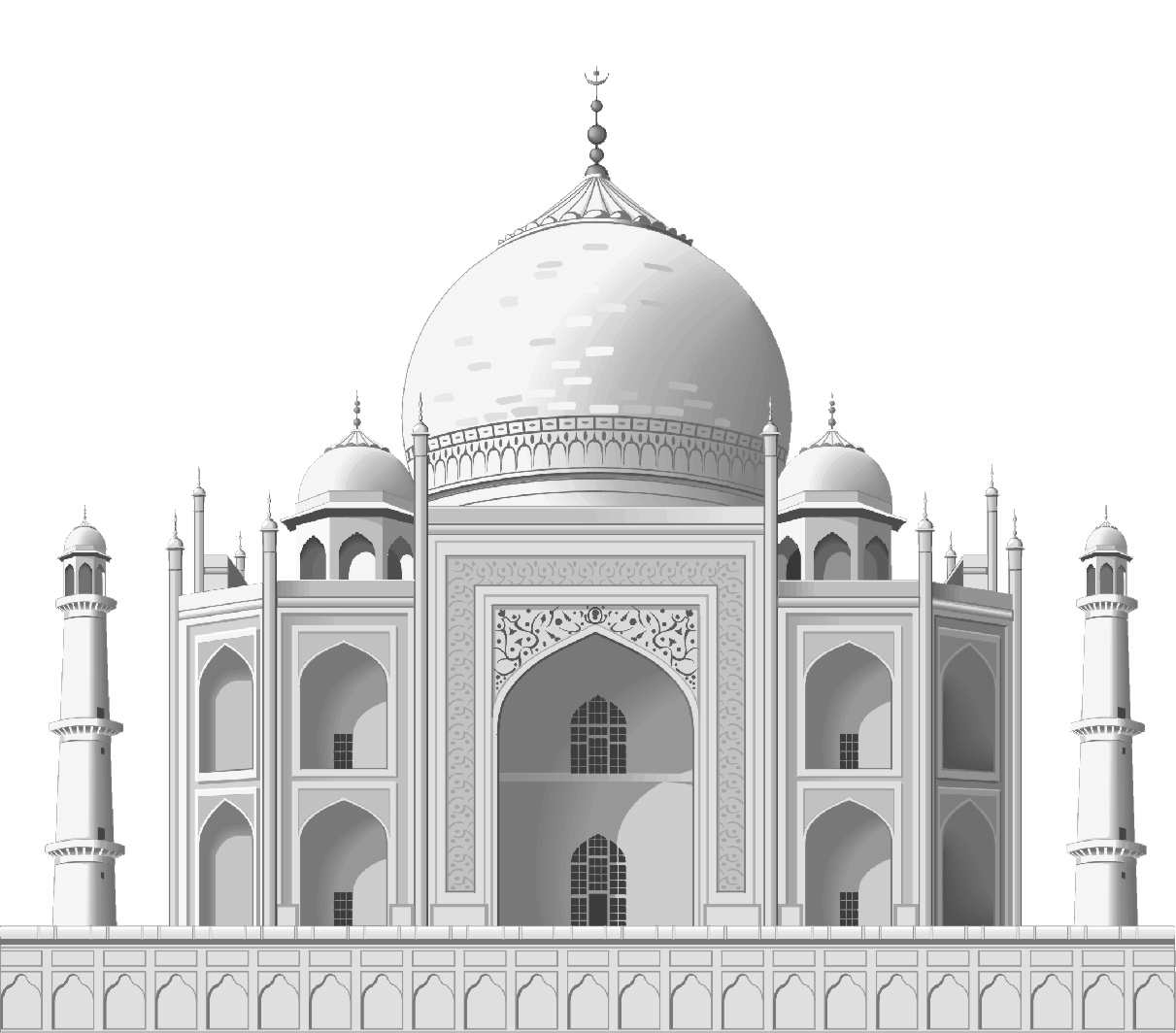 f
the seven Wonders of the Ancient World, two were dedicated to
sentiment in marriage: the Mausoleum, monument of a wife’s
devotion to the memory of her husband; the Hanging Gardens of
Babylon, erected by a husband for the happiness of a favourite wife.
Among the wonders of the modern world, one of the most famous
commemorates a husband’s devotion to a wife.
It is, of course, the incomparable Taj Mahal, the tomb that Shah Jehan created for the beauteous Mumtaz Mahal, at the city of Agra, in India. The French traveler Francois Bernier, who toured the East three centuries ago, was in Agra during the 1660s, saw the building when it had been up for less than twenty years, and wrote in his journal: “Possibly I have acquired an Indian taste, but I am of the opinion that this monument has much more right to be included among the wonders of the world than the pyramids of Egypt”. Some critics have gone beyond him, declaring the Taj Mahal to be the most beautiful edifice ever erected by man. Shah Jehan was one of the Mogul emperors who reigned over India in golden splendour. A Moslem, he practiced the polygamy ordained in the Koran, which permitted four wife not counting the concubines whom it was customary for an Islamic potentate to have in his harem. Mumtaz Mahal, young dainty, and beautiful, was the favourite wife. Taj Mahal, therefore, is a monument to romantic sentiment in the harem, a husband’s devotion in polygamous family life.
The Taj Mahal is the masterpieces of Mohammedan Art. That it arose on Indian soil is explained by history. The Moglus came originally from Central Asia, their name being a variant of the world “Mongol”. They were Moslems, and they conquered India.
The founder of the Mogul Empire was one of the remarkable men of all time. In martial ardor and ability to command, Baber may have been a typical princeling of Iartary, but he was also a man of culture, the author of perhaps best political memoirs ever written by a reigning monarch. In December of 1525 he led his army into India. The battle took place on April 12, 1526, and proved to be one of the decisive conflicts of world history for Baber won the victory, that gave him a permanent foothold in the land that was to be ruled by this descendants.
Baber did not finish the work of integrating an imperial domain. But the Moguls were lucky in the next representative of their dynasty Akbar, known to history as Akbar The Great. He introduced a new system of government, bringing ale the land under