China's population
The continually growing population poses major problems for the government. Faced with difficulties in obtaining an adequate food supply and in combating the generally low standard of living, the authorities sponsored Drive a drive for birth control in 1955-58. A second attempt at for birth population control began in 1962, when advocacy of late control marriages and the use of contraceptives became prominent parts of the program. The outbreak of the Cultural Revolution interrupted this second family-planning drive, but in 1970 a third and much stricter program was initiated. This program attempted to make late marriage and family limitation obligatory, and it culminated in 1979 in efforts to implement a policy of one child per family.
Other developments affected the rate of population growth more than the first two official family-planning campaigns. For example, although family planning had been rejected by Chinese Communist Party Chairman Mao Zedong (Mao Tse-tung) in 1958, the Great Leap Forward that he initiated in that year (see below The economy) caused a massive famine that resulted in more deaths than births and a reduction of population in 1960. By 1963 recovery from the famine produced the highest rate of population increase since 1949, at more than 3 percent, although the second birth-control campaign had already begun.
Since the initiation of the third family-planning program in 1970, however, state efforts have been much more effective. China's population growth rate is now unusually low for a developing country, although the huge size of its population still results in a large annual net population growth.
Below I described the distribution of China’s population by different characteristics.
I. Sex Composition.
Of the people enumerated in the 31 provinces, autonomous regions and municipalities and servicemen of the mainland of China, 653.55 million persons or 51.63 percent were males, while 612.28 million persons or 48.37 percent were females. The sex ratio (female=100) was 106.74.
II. Age Composition.
Of the people enumerated in the 31 provinces, autonomous regions and municipalities and servicemen of the mainland of China, 289.79 million persons were in the age group of 0-14, accounting for 22.89 percent of the total population; 887.93 million persons in the age group of 15-64, accounting for 70.15 percent and 88.11 million persons in the age group of 65 and over, accounting for 6.96 percent. As compared with the results of the 1990 population census, the share of people in the age group of 0-14 was down by 4.80 percentage points, and that for people aged 65 and over was up by 1.39 percentage points.
III. Composition of Nationalities.
Of the people enumerated in the 31 provinces, autonomous regions and municipalities and servicemen of the mainland of China, 1,159.40 million persons or 91.59 percent were of Han nationality, and 106.43 million persons or 8.41 percent were of various national minorities. Compared with the 1990 population census, the population of Han people increased by 116.92 million persons, or 11.22 percent; while the population of various national minorities increased by 15.23 million persons, or 16.70 percent.
IV. Composition of Educational Attainment.
Of the 31 provinces, autonomous regions and municipalities and servicemen of the mainland of China, 45.71 million persons had finished university education (referring to junior college and above); 141.09 million persons had received senior secondary education (including secondary technical school education); 429.89 million persons had received junior secondary education and 451.91 million persons had had primary education (the educated persons included graduates and students in schools).
Compared with the 1990 population census, the following changes had taken place in the number of people with various educational attainments of every 100,000 people: number of people with university education increased to 3,611 from 1,422; number of people with senior secondary education increased to 11,146 from 8,039; number of people with junior secondary education increased from 23,344 to 33,961; and number of people with primary education decreased from 37,057 to 35,701.
Of the people enumerated in the 31 provinces, autonomous regions and municipalities and servicemen of the mainland of China, 85.07 million persons were illiterate (i.e. people over 15 years of age who can not read or can read very little). Compared with the 15.88 percent of illiterate people in the 1990 population census, the proportion had dropped to 6.72 percent, or down by 9.16 percentage points.
V. Urban and Rural Population.
In the 31 provinces, autonomous regions and municipalities of the mainland of China, there were 455.94 million urban residents, accounting for 36.09 percent of the total population; and that of rural residents stood at 807.39 million, accounting for 63.91 percent. Compared with the 1990 population census, the proportion of urban residents rose by 9.86 percentage points.
POPULATION DISTRIBUTION
Following are the results from the advance tabulation on the geographic distribution of population from the fifth national population census of China:
|
Region |
Population (million) |
| Beijing Municipality | 13.82 |
| Tianjin Municipality | 10.01 |
| Hebei Province | 67.44 |
| Shanxi Province | 32.97 |
| Inner Mongolia Autonomous Region | 23.76 |
| Liaoning Province | 42.38 |
| Jilin Province | 27.28 |
| Heilongjiang Province | 36.89 |
| Shanghai Municipality | 16.74 |
| Jiangsu Province | 74.38 |
| Zhejiang Province | 46.77 |
| Anhui Province | 59.86 |
|
Fujian Province (excluding the population in Jinmen and Mazu and a few other islands) |
34.71 |
| Jiangxi Province | 41.40 |
| Shandong Province | 90.79 |
| Henan Province | 92.56 |
| Hubei Province | 60.28 |
| Hunan Province | 64.40 |
| Guangdong Province | 86.42 |
| Guangxi Zhuang Autonomous Region | 44.89 |
| Hainan Province | 7.87 |
| Chongqing Municipality | 30.90 |
| Sichuan Province | 83.29 |
| Guizhou Province | 35.25 |
| Yunnan Province | 42.88 |
| Tibet Autonomous Region | 2.62 |
| Shaanxi Province | 36.05 |
| Gansu Province | 25.62 |
| Qinghai Province | 5.18 |
| Ningxia Hui Autonomous Region | 5.62 |
| Xinjiang Uygur Autonomous Region | 19.25 |
| Hongkong Special Administrative Region | 6.78 |
| Macao Special Administrative Region | 0.44 |
| Taiwan Province and Jinmen, Mazu and a few other islands of Fujian Province | 22.28 |
| Servicemen | 2.50 |
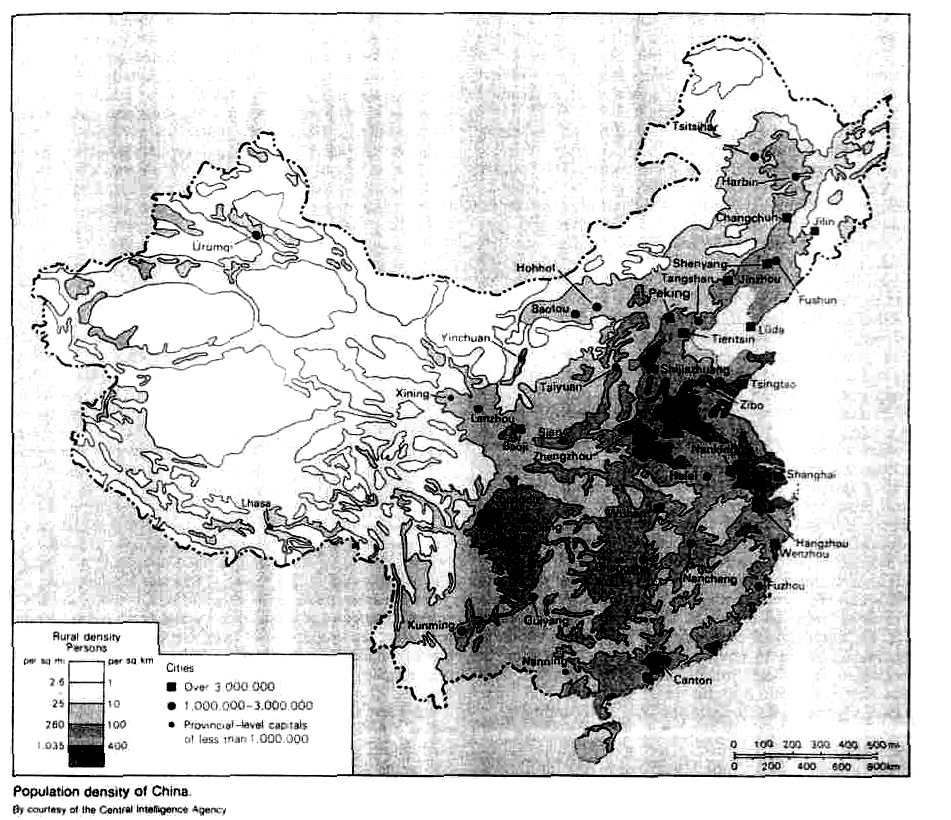
Because of complex natural conditions, the population of China is quite unevenly distributed. Population density varies strikingly, with the greatest contrast occurring between the eastern half of China and the lands of the west and the north-west. Exceptionally high population densities occur in the Yangtze Delta, in the Pearl River Delta, and on the Ch'eng-tu Plain of the western Szechwan Basin. Most of the high-density areas are coterminous with the alluvial plains on which intensive agriculture is centred.
In contrast, the isolated, extensive western and frontier regions, which are much larger than any European nation, are sparsely populated. Extensive uninhabited areas include the extremely high northern part of Tibet, the sandy wastes of the central Tarim and eastern Dzungarian basins in Sinkiang, and the barren desert and mountains east of Lop Nor.
In the 1950s the government became increasingly aware of the importance of the frontier regions and initiated a drive for former members of the military and young intellectuals to settle there. Consequently, the population has increased, following the construction of new railways and highways that traverse the wasteland; a number of small mining and industrial towns have also sprung up.
INTERNAL MIGRATION
Migrations have occurred often throughout the history of China. Sometimes they took place because a famine or political disturbance would cause the depopulation of an area already intensively cultivated, after which people in adjacent crowded regions would move in to occupy the deserted land. Sometime between 1640 and 1646 a peasant rebellion broke out in Szechwan, and there was a great loss of life. People from Hupeh and Shensi then entered Szechwan to fill the vacuum, and the movement continued until the 19th century. Again, during the middle of the 19th century, the Taiping Rebellion caused another large-scale disruption of population. Many people in the Lower Yangtze were massacred by the opposing armies, and the survivors suffered from starvation. After the defeat of the rebellion, people from Hupeh, Hunan, and Honan moved into the depopulated areas of Kiangsu. Anhwei. and Chekiang, where farmland was lying uncultivated for want of labour. Similar examples are provided by the Nien Rebellion in the Huai River region in the 1850s and '60s, the Muslim rebellions in Shensi and Kansu in the 1860s and '70s, and the great Shensi and Shansi famine of 1877-78.
In modern history the domestic movement of the Han to Manchuria (now known as the Northeast) is the most Migration significant. Even before the establishment of the Ch'ing to dynasty in 1644, Manchu soldiers launched raids into Manchuria North China and captured Han labourers, who were then obliged to settle in Manchuria. In 1668 the area was closed to further Han migration by an Imperial decree, but this ban was never effectively enforced. By 1850. Han settlers had secured a position of dominance in their colonisation of Manchuria. The ban was later partially' lifted, partly because the Manchu rulers were harassed by disturbances among the teeming population of China proper and partly because the Russian Empire time and again tried to invade sparsely populated and thus weakly defended Manchuria. The ban was finally removed altogether in 1878, but settlement was encouraged only after 1900. The influx of people into Manchuria was especially pronounced after 1923, and incoming farmers rapidly brought a vast area of virgin prairie under cultivation. About two-thirds of the immigrants entered Manchuria by sea, and one-third came overland. Because of the severity of the winter weather, migration in the early stage was highly seasonal, usually starting in February and continuing through the spring. After the autumn harvest a large proportion of the farmers returned south. As Manchuria developed into the principal industrial region of China, however, large urban centres arose, and the nature of the migration changed. No longer was the movement primarily one of agricultural resettlement; instead it became essentially a rural-to-urban movement of interregional magnitude. After 1949 the new government's efforts to foster planned migration into interior and border regions produced noticeable results. Although the total number of people involved in such migrations is not known, it has been estimated that by 1980 about 25 to 35 percent of the population of such regions and provinces as Inner Mongolia, Sinkiang, Heilungkiang. and Tsinghai consisted of recent migrants, and migration had raised the percentage of Han in Sinkiang from about 10 to 40 percent of the total. Efforts to control the growth of large cities led to the resettlement of 20,000,000 urbanites in the countryside after the failure of the Great Leap Forward and of 17,-000,000 urban-educated youths in the decade after 1968. Within the next decade, however, the majority of these "rusticated youths" were allowed to return to the cities, and new migration from rural areas pushed urban population totals upward once again.
China Sticks to Population Control Policy in New Century
China will continue its efforts to control the growth of the population in the 21 century, said Zhang Weiqing, minister of the State Family Planning Commission on November 2, 2000.
At the annual board meeting of the Partners in Population and Development by South-South Cooperation, which opened Thursday in Beijing, Zhang said that keeping a low birth rate is the key task of China' s family planning program in the coming decade.
He said that China has made it a goal to keep the population below 1.4 billion until 2010 on the basis of scientific feasibility study.
In order to realise the goal, China is persisting in popularisation and education about family planning and contraception, and it will make efforts to build a perfect population control system suitable for China's situation, said Zhang.
According to Zhang, population will continue to be a pressing issue for China in the 21st century. The annual net population growth will be more than 10 million at the start of the new century. The population will not decline until it reaches a peak of 1.6 billion in the middle of the 21st century, Zhang said.
At present, China has a large work-age population, which puts a heavy burden on employment. The work-age population will peak at 900 million in the coming decades.
In addition, Zhang predicts that the number of senior citizens over the age of 60 in China will reach 130 million at the end of this year, and will exceed 357 million in 2030, and 439 million in 2050, or a quarter of the total population.
Zhang said that China will stick to family planning policy for a long time depending on future population situation.
President on Population Control, Resources and Environmental Protection
Population control, resources and environmental protection will be three crucial issues in China's march toward becoming a great power in the new century, President Jiang Zemin told a seminar held by the Communist Party of China Central Committee Sunday.
Jiang said that governmental decisions concerning the country's population control, resources and environmental protection demand concerted efforts and cooperation from all walks of life.
Jiang warned that although marked progress had been made during the 1996-2000 period, China is still facing many problems and challenges concerning population, resources and environmental protection in the coming years.
"These issues are directly related to the country's overall development. Failure in handling them may postpone the achievement of China's set goals in terms of social and economic development," said Jiang.
Jiang said that the next few years will be a crucial stage for China to stabilise its birth rate at the current low level and improve population quality.
When dealing with population issues, governments at all levels should better serve the people's needs, and turn the country's birth control efforts into a cause benefiting China's huge populace, Jiang remarked.
Jiang also said that resource-related works should better serve the country's sustainable development. Protection and rational utilisation of resources