История развития компьютеров (Silicon Valley, its history the best companies)
Cooperation with IBM in the 1980s
Intel's measures in the late 1970s as a reaction to increasing competition from other chip manufacturers paid off greatly and resulted in a remarkable technological lead against its competitors. The most significant consequence, which was a landmark in the company's development, was IBM's decision to rely on the Intel 8088 microprocessor for its PCs in 1980.
IBM (short for International Business Machines) has been the world's leading company in the big mainframe computers since the 1950s. Due to its dominance, it was often compared with a giant and referred to as "Big Blue." Surprisingly, it was not before 198 1 (the PC revolution had already been on for a few years) that IBM introduced its own Personal Computer.
Because of IBM's dominance and worldwide reputation, its PCs soon became industry standard and penetrated the office market: other established computer companies followed and introduced their own PCs - the so-called "clones" - which were compatible to IBM' s models. To maintain compatibility, all these manufacturers were forced to rely on Intel's microprocessors, which thus were bootstrapped to industry standard, too.
As well as for Intel, the CPU manufacturer, IBM's decision has been crucial for a company in the software field: Microsoft's (Redmond, Washington) MS-DOS was chosen as the IBM PC's operating system and became industry standard. It is essential to every IBM compatible PC. Microsoft, a small company in 1980, grew explosively, and is today's superior software giant.
At the beginning of the 1980s, IBM was concerned about Intel's ability to keep investing in R&D and therefore decided to support Intel by buying $250 million (=12%) of the company's stock. This endorsed Intel's position, and, in 1987, IBM sold the last of its shares in a strong Intel.
Intel today
Annual
report 2000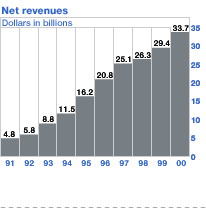
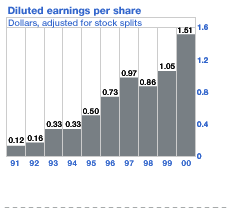
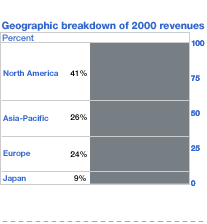
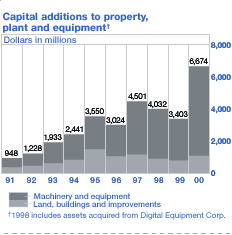
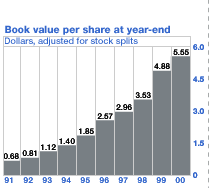
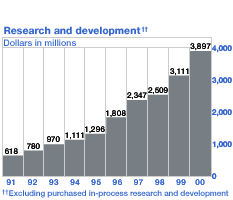
Today, Intel supplies the computing and communications industries with chips, boards and systems building blocks that are the "ingredients" of computers, servers, and networking and communications products. Industry members to create advanced computing and communications systems use these products. Intel's mission is to be the preeminent building block supplier to the worldwide Internet economy.

Intel®
Architecture platform products Microprocessors,
also called central processing units (CPUs) or chips, are frequently
described as the "brains" of a computer, because they
control the central processing of data in personal computers (PCs),
servers, workstations and other computers. Intel offers
microprocessors optimized for each segment of the computing market:
Intel® Pentium® III Xeon™ processors for mid-range to high-end servers and workstations
Intel® Pentium® 4 and Pentium® III processors for entry-level servers and workstations and performance desktop PCs
Intel® Celeron™ processors for value PC systems
Mobile Pentium® III processors for performance in mobile PC systems
Chipsets perform essential logic functions surrounding the CPU in computers, and support and extend the graphics, video and other capabilities of many Intel processor-based systems.
Motherboards combine Intel microprocessors and chipsets to form the basic subsystem of a PC or server.
e-Business solutions enable services and channel programs to accelerate integration and deployment of Intel Architecture-based systems and products.
 Wireless
communications and computing products
These
products are component-level
hardware and software focusing on digital cellular communications and
other applications needing both low-power processing and high
performance. These products are used in mobile phones, handheld
devices, two-way pagers and many other products. For these markets,
Intel offers Intel® Flash memory, application processors based on
the Intel® StrongARM processor core, and base band chipsets for
cellular phones and other wireless devices.
Networking and communications products
Communications
building blocks for
next-generation networks and Internet data centers are offered at
various levels of integration. These products are used in
communications servers, network appliances and computer telephony
integration equipment.
Component-level building blocks include communications silicon such as network processors and other board-level components, software and embedded control chips. These products are integrated in communications hardware such as hubs, routers, switches and servers for local and wide area networking applications. Embedded control chips are also used in laser printers, imaging, automotive systems and other applications.
New business products
These products and services include e-Commerce data center services
as well as connected peripherals.

Intel's major customers include:
Original equipment manufacturers
(OEMs) of computer systems, cellular phone and handheld computing
devices, telecommunications and networking communications equipment,
and peripherals.
Users of PC and network communications
products
including individuals, large and small businesses, and Internet
service providers—who buy Intel's PC enhancements, business
communications products and networking products through reseller,
retail, e-Business and OEM channels.
Other manufacturers
including makers of a wide range of industrial and communications
equipment.
The emergence of the PC industry
Until the early 1970s, computers were huge machines - from the largest ones, the supercomputers, to mainframes and minicomputers - and were mainly used for scientific research in universities and in military institutions, and for business calculations in major companies. Surprisingly, when the first microprocessors appeared, none of the established companies such as IBM, DEC or HP had the idea to build small, personal computers. They just did not see any market for them and could not imagine what those machines should be needed for. None of these large companies anticipated the possibilities of PCs, which are today used in almost every office, in the home, in the school, on airplanes, etc. and can act as typewriters, calculators, accounting systems, telecommunications instruments, libraries, tutors, toys and many the like.
So, it was the hobbyists, single electronics wizards who liked tinkering with electronic devices that constructed their own computers as the first PCs. These "computer nuts" ignited the "fire in the valley;") they launched the personal computer revolution in Silicon Valley "out of their own fascination with the technology. The personal computer arose from a spirit of sharing "hard-won technical information" with other computer freaks who developed their devices for the fun of tinkering around in this fascinating field of electronics. Some of these frequently young hobbyists found themselves almost overnight as millionaires, after they had sold their devices in a newly founded firm.
Before dealing with the story of Apple, which is typical of Silicon Valley and responsible for the breakthrough of the personal computer, some information about the first PC and the emergence of the PC industry shall be given.
Altair - the first PC
Altair is often regarded as the first personal computer, although it was one of those switches and lights computers - programming is done by arranging a set of switches in a special order, and the results appear as different combinations of lights. In other words, such a machine is a genuine computer, but absolutely useless, as Steve Wozniak, one of the PC pioneers, put it.)
After the first microprocessors had come onto the market, Ed Roberts, an engineer at MITS, a small calculator company in Texas, decided to build a kit computer, which he intended to sell to hobbyists. He chose Intel's 8080 as the CPU for his computer, since this chip was the most advanced and powerful at the time. As Roberts wanted to sell his computer for less than $500 and the official price for the 8080 was already at $360, he contacted Intel and could finally receive the chip for only $75 apiece.
By the end of 1974, Roberts finished his computer, which was named Altair. When the Altair was introduced on the cover of the January 1975 issue of Popular Electronics as the first personal computer, which would go for $397 only, the market response was in credible. The low price was the actual sensation, because it was largely known that the price for the Intel 8080 CPU powering the Altair was already at $360. So many hobbyists, engineers and programmers who had keenly waited for their own personal computer, which they could experiment on at home, welcomed the new product and ordered "their" Altair on the spot.
Roberts had never expected such a great response and his small firm was flooded by those immediate orders (more than 4000). He boosted up the production, but still could not meet the huge demand. The Altair was a success at first, and Roberts sold many of them.
However, he had increased production at the expense of quality and further refinement of his computer, so the Altair brought along a lot of trouble and was finally supplanted by other computers, which were superior.
Nevertheless, the Altair as the first successful microcomputer, contributed a lot to the PC revolution, since it encouraged other people to build personal computers (e.g. IMSAI, Apple).
The first computer shops
During this time, the mid-1970s, the first computer shops came into existence. Pioneering in this field was Paul Terrell who came to the idea of running such a shop, after the Altair had been put onto the market. His first Byte Shop opened in Mountain View (located in the heart of Silicon Valley) by the end of 1975.
Initially, Terrell sold the Altair and accessory products such as additional memory boards and other devices, which came onto the market. With the arising microcomputer industry, he could offer his customers - mainly hobbyists and engineers - more and more products, and his shop became a success. Other Byte Shops were opened and Terrell's computer shop chain expanded beyond the Silicon Valley. The computer shops provided its customers with a variety of devices around the computer and also with service and help.
The Altair was shipped as a kit computer and was to be assembled first, and then it was still not difficult to work with it. The hobbyists helped each other with advice. It was this spirit of sharing solutions and the common interest in microcomputers that led to the foundation of the first computer club.
Homebrew Computer Club
The legendary Homebrew Computer Club was the first of its kind, and provided an early impetus for the development of the microcomputer industry in Silicon Valley. Its first meeting in March 1975 was held in one of its members' garage in Menlo Park in Santa Clara County. The Homebrew members were engineers and computer enthusiasts who discussed about the Altair and other technical topics. The club attracted many hobbyists and was attended by nearly 750 people one year after its foundation. The Homebrew Computer Club had its own philosophy. People meet, because they were interested in computers and liked tinkering with them, but not for commercial reasons - at least in its early times. Its members "exchanged information about all aspects of micro computing technology") and talked about devices they had designed. From its ranks came the founders of many microcomputer companies - for example Bob Marsh, Adam Osborne, or Steve Jobs and Steven Wozniak - the famous Apple founders.
The Homebrew Computer Club is the place where the roots of many Silicon Valley microcomputer companies are located. It has "spawned a revolution in micro processing") and represents an "important step in the development of a multi-billion dollar industry.
The Apple Story
Apple provides one of Silicon Valley's most famous stories. It shows features that are typical for most start-up firms in the valley, however, it is unique and its early success and its contribution to the personal computer are unmatched.
"Woz" and Jobs - the two "Steves"
Apple's history starts with the story of two young and exceptional people who began building a computer in their garage and "launched the microcomputer revolution,") changing our daily life in many respects.
The Apple story is the story of the two "Steves". Stephen G. Wozniak was a typical Silicon Valley child. Born in 1950, he had grown up with the electronics industry in Silicon Valley, and had been intrigued by electronics from the start, since his father w as an electronics engineer. Wozniak, known to his friends as "Woz", was bright and was an electronics genius. At the age of 13, he won the highest award at a local science fair for his addition-subtraction machine. His electronics teacher at Homestead High School recognized Woz's outstanding talent and arranged a job for him at a local company, where Steve could work with computers once a week. It was there that Wozniak saw the capabilities of a computer (it was the DEC PDP-8 minicomputer) and studying the manual, it became his dream to have a computer of his own one-day. He designed computers on paper. Many other students who grew up in Silicon Valley shared this dream.
In 1971, Wozniak built his first computer with