Корни персонажей Д.Р.Р.Толкиена
In the same year Tolkien visits Cornwall [NOTE: This is the location for the Sea in The Hobbit and LOTR] " 'Nothing I could say . . . could describe it to you. The sun beats down on you and a huge Atlantic swell smashes and spouts over the snags and reefs. The sea has carved weird wind-holes and spouts into the cliffs which blow with trumpety noises or spout foam like a whale, and everywhere you see black and red rock and white foam against violet and transparent seagreen.'." [Carpenter 70]
Tolkien begins to create works with Quentya (language of the high-elves): "He had been working for some time at the language that was influenced by Finish, and by 1915 he had developed it to a degree of some complexity. He felt that it was 'a mad hobby', and he scarcely expected to find an audience for it. But he sometimes wrote poems n it, and the more he worked at it the more he felt that it needed a 'history' to support it. In other words, you cannot have a language without a race of people to speak it. He was perfecting the language; now he had to decide to whom it belonged." [Carpenter 75]
T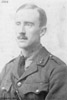 olkien
creates Valinor [Land of the Gods in the Silmarillion] "This, he
decided, was the language by the fairies or elves whom Earendel saw
during his strange voyage. He began work on a 'Lay of Earendel' that
described the mariner's journeying across the world before his ship
became a star. The Lay was to be divided into several poems, and the
first of these, 'The shores of Faery', tells of the mysterious land
of Valinor, where Two Trees grow, one bearing golden sun-apples and
the other silver moon-apples." [Carpenter 76]
1
Ronald in army
916 - Tolkien marries Edith, continues war, and gets to know soldiers [Tolkien is an officer]. All of Tolkien's friends die [except C.S. Lewis]Tolkien after World War II
Continuing the last wishes of the T.B.C.S (the society he had founded with his friends at St. Edwards), Tolkien decides to create a whole society.
[ Founding
precepts of the LOTR] " 'I [Tolkien] had a mind to make a body
of more or less connected legend, ranging from the large and
cosmogonic to the level of romantic fairy-story - the larger founded
on the lesser in contact with the earth, the lesser drawing splendor
from the vast backcloths - which I could dedicate simply: to England;
to my country. It could possess the tone and quality that I desired,
somewhat cool and clear, be redolent of our 'air' (the clime and soil
of the North West, meaning Britain and the hither parts of Europe;
not Italy or the Aegean, still less the East), and, while possessing
(if I could achieve it) the fair elusive beauty that some call Celtic
(though it is rarely found in genuine ancient Celtic things), it
should be 'high', purged of the gross, and fit for the more adult
mind of a land long steeped in poetry, I would draw some of the great
tales in fullness, and leave many only placed in the scheme, and
sketched. The cycles should be linked to a majestic whole, and yet
leave scope for other minds and hands, wielding paint and music and
drama" [Carpenter 90] [Researching, not inventing] "When he
wrote The Silmarillion Tolkien believed that in one sense he was
writing the truth. He did not suppose that precisely such peoples as
he described, 'elves', 'dwarves', and malevolent 'orcs', had walked
the earth and done the deeds that he recorded. But he did feel, or
hope, that his stories were in some sense an embodiment of a profound
truth . . . Tolkien believed that he was doing more than inventing a
story. He wrote of the tales that make up the book: 'They arose in my
mind as 'given' things, and as they came, separately, so too the
links grew . . . yet always I had the sense of recording what was
already 'there', somewhere: not of 'inventing'." [Carpenter
91-2]
I
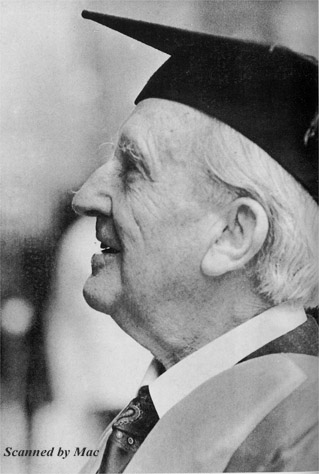
Prosessor J.R.R.Tolkien
nfluences from language: "As to the names of persons and places in 'The Fall of Gondolin' and the other stories in The Silmarillion, they were constructed from Tolkien's invented languages. Since the existence of these languages was a raison d'кtre for the whole mythology, it is not surprising that he devoted a good deal of attention to the business of making up names from them"Tolkien creates Sindarin, precursor to Quentya
[Development of 'what is real?'] "As the years went by he came more and more to regard his own invented languages and stories as 'real' languages and historical chronicles that needed to be elucidated. In other words, when in this mood he did not say of an apparent contradiction in the narrative or an unsatisfactory name: 'This is not as I wish it to be; I must change it.' Instead he would approach the problem with the attitude: 'What does this mean? I must find about." [Carpenter 94]
On the 16 of November 1917 Tolkien gets a son and writes story of Luthien & Beren
1918 - Tolkien gets job in the OED (Oxford English Dictionary)
1920 - Tolkien gets a professorship at Leeds University
In October of 1920 Tolkien gets second son.
Tolkien writes poems: "Another, 'The Dragon's Visits', describes the ravages of a dragon who arrives at Bimble Bay and encounters 'Miss Biggins'. A third, 'Glip', tells of a strange slimy creature who lives beneath the floor of a cave and has pale luminous eyes" [Carpenter 106] : Dragon ~ Smaug, Miss Biggins ~ Bilbo Baggins, Glip ~ Gollum
1924 - Tolkien gets a third son Christopher.
1925 - Tolkien becomes a professor of Anglo-Saxon at Oxford
1929 - Tolkien gets a daughter
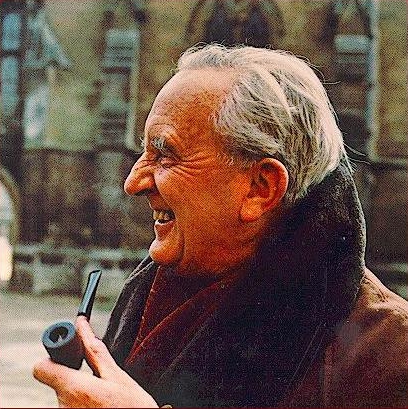
Tolkien now
 [Tolkien's
Workplace] "The shelves are crammed with dictionaries, works on
etymology and philology, and editions of texts in many languages,
predominant among which are Old and Middle English and Old Norse; but
there is also a section devoted to translations of The Lord of the
Rings into Polish, Dutch, Danish, Swedish, and Japanese; and the map
of his invented 'Middle-Earth' is pinned to the window - ledge."
(Carpenter 4) [Tolkien's view of The Lord of the Rings] "He
explains it all in great detail, talking about his book not as a work
of fiction but as a chronicle of actual events; he seems to see
himself not as an author who has made a slight error that must now be
corrected or explained away, but as a historian who must cast light
on an obscurity in an historical document." [Tolkien's Voice]
"He has a strange voice, deep but without resonance, entirely
English but with some quality in it I cannot define, as if he had
come from another age or civilization" (Carpenter 5)
The roots of some Tolkien characters
Gandalf
W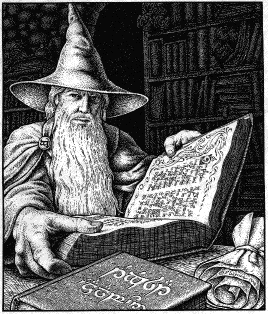
Gandalf the Grey
hile reading “The Hobbit” and “The Lord Of The Rings” you will meat such character as Gandalf. He is a magician (or Istary in the “The Silmarillion”). And like all magicians he wears a long, thick, grey (or white) beard, a big cone-shaped hat with wide fields and a wide grey raincoat. This character owes with his existence to Tolkien’s trip to Switzerland, where in the shop among the mountans he bought a postcard. It was a reproduction of a picture of a german painter Madlenner, which was called “Der Berggeist” (it could be translated as “The spirit of the mountans”). There was an old man with white long beard and cone-shaped hat with wide fields, who was seating under the tree. Many years later Tolkien wrote on the other side of this postcard the following: “The prototype of Gandalf”…
Sam Gamgee
Sam Gamgee is a hobbit (It tells us many things). He is the best friend of Frodo and besides that, he is Frodo’s gardener. He is very brave, bonhomous, kind, but careless and light-hearted, and, as all hobbits, he likes to eat very much. It is very interesting, that the word “gamgee” can be translated from one of the English dialects as cotton wool and besides that, it was a surname of a doctor, who had invented 'gamgee-tissue', a surgical dressing made from cotton wool. But the real character of Sam was copied from the character of the mere english soldier of the war of 1914. You already now from the biographical sketch that Tolkien took part in that war. He battled on the front line in France. And he knows, what the war is. Later in one of his letters he wrote: “My Sam Gamgee is indeed a reflection of the English soldier, of the privates and batmen I knew in the 1914 war, and recognized as so far superior to myself”.
Hobbits
H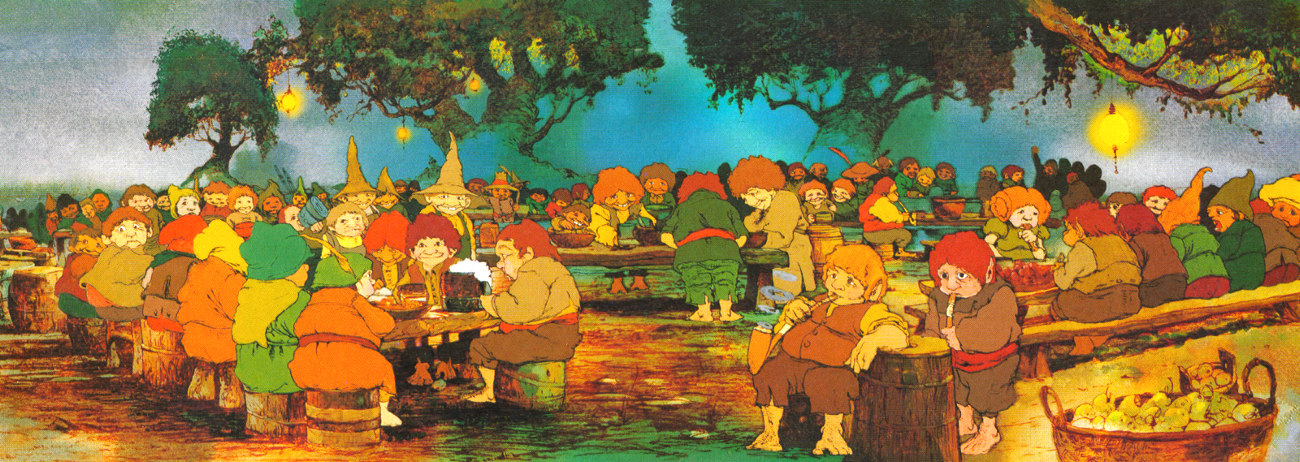 obbits
is a people of Halflings. They live in holes. They are very short,
practical, strait-laced
and they like tasty food most of all things in the world.
These
creatures were created by J.R.R.Tolkien. He was the first, who used
them in his books. There are two versions about the origin of the
word “hobbit”. V.A. Muravjov keeps one of them. He wrote
in his entrance
to “The Lord Of The Rings”,
that the world “hobbit” is a mixture of latin word
“homo”, which means “human” and english word
“rabbit”. But Humphrey Carpenter explained the origin of
this word in a different way. In his “The biography of
J.R.R.Tolkien” he wrote, that in his youth Tolkien read the
book “Babbit” by Sincler Luis and it influensed him very
much. Carpenter shows us the resemblance
of the personality of Babbit and Bilbo Baggins, the main character of
Tolkien’s book “The hobbit or there and back again”.
Tolkien himself told in one of his interview, that his hobbits have
no even a hint on rabbits. That is why I can say, that the second
version about the origin of the word “hobbit” is more
correct.
The Shire
T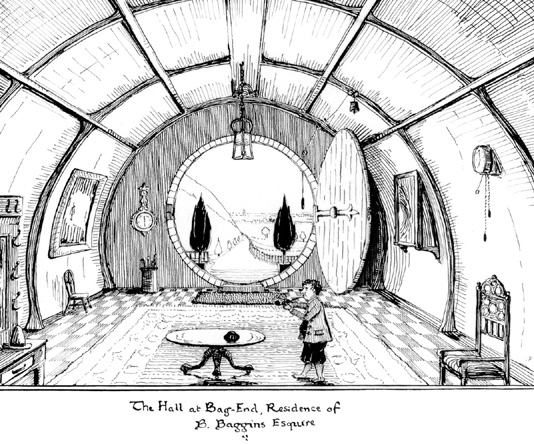
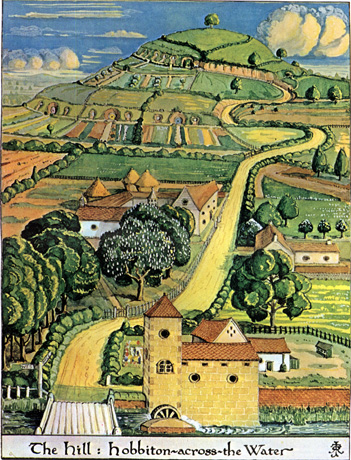
The Shire
Hobbits hole inside
he Shire is a country of hobbits. But it also has its roots. From the biographical sketch we know, that four best years of his childhood Tolkien spent in the village of Sarehole. And wile reading Tolkien’s description of the Shire I realized, that it is very close to the Carpenter’s description of Sarehole. The same water-mill, the same pretty flower-beds, the roads paved with stones of different colors. We can see the festive tree, which was decorated by hobbits every holiday. And we know, that in Sarehole there was a tree, that Tolkien remembered all his life. The first his wise tree. In hobbits-halflings we can see the same efficient, plain and stiff english peasants so much loved by Tolkien.Trees and ents
A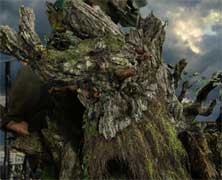
Ent Treebeard
ll his life Tolkien loved trees. In his childhood he dreamed, they could have mind, speak to each other and even move. And his dream came true as we can see it in his works (mostly in “The Silmarillion” and “The Lord Of The Rings”). When professor created reasonable trees, he desided to creat someone, who will look after them. That is how ents appeared. Ents look like trees, but they more reasonable, more movable and of course they are immortal. They are not fidgety, but very wise. Their speech is very slow and calm. Its manner (“Hrum, Hoom”) was copied with the deep bass of Luis, the best friend of J.R.R.Tolkien.The elves
T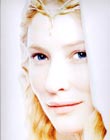
The elven virgo Galadriel
he elves in their appearance, whom we can see in the books of Tolkien were also mostly created by him. The roots of these characters are very ramified. Professor read a lot of information about all kinds of elves and finding something general tried to create something new. Finally he got immortal creatures, who can be killed only with a sword or they can pine away to death. They are tall, have perfect eyesight, bright hair and brave harts. They are wise, because of the memory they keep in their immortal mind. But elves themselves estimate their immortality