Enrico Fermi and his discovery
During the last years of his life Fermi occupied himself with the problem of the mysterious origin of cosmic rays, thereby developing a theory, according to which a universal magnetic field - acting as a giant accelerator - would account for the fantastic energies present in the cosmic ray particles.
Professor Fermi was the author of numerous papers both in theoretical and experimental physics. Several papers published in Rend. Accad. Naz. Lincei, 1927-28, deal with the statistical model of the atom (Thomas-Fermi atom model) and give a semiquantitative method for the calculation of atomic properties. 1934.
The Nobel Prize for Physics was awarded to Fermi for his work on the artificial radioactivity produced by neutrons, and for nuclear reactions brought about by slow neutrons. The first paper on this subject was published by him in 1934. Fermi was member of several academies and learned societies in Italy and abroad. As lecturer he was always in great demand (he has also given several courses at the University of Michigan and Stanford University, Calif.). He was the first recipient of a special award of $50,000 - which now bears his name - for work on the atom.
Post-War Work
Fermi was widely regarded as the only physicist of the twentieth century who excelled both theoretically and experimentally. The well-known historian of physics, C. P. Snow, says about him, "If Fermi had been born a few years earlier, one could well imagine him discovering Rutherford's atomic nucleus, and then developing Bohr's theory of the hydrogen atom. Fermi's ability and success stemmed as much from his appraisal of the art of the possible, as from his innate skill and intelligence. He disliked complicated theories, and while he had great mathematical ability, he would never use it when the job could be done much more simply. He was famous for getting quick and accurate answers to problems which would stump other people. An instance of this was seen during the first atomic bomb test in New Mexico on July 16, 1945. He estimated that the blast was greater than 10 kilotons of TNT.Later on, this method of getting approximate and quick answers through back of the envelope calculations became informally known as the 'Fermi method'.
After the war, Fermi served for a short time on the General Advisory Committee of the Atomic Energy Commission, a scientific committee chaired by Robert Oppenheimer. After the detonation of the first Soviet fission bomb in August 1949, he, along with Isidor Rabi, wrote a strongly worded report for the committee which opposed the development of a hydrogen bomb on moral and technical grounds. But Fermi also participated in preliminary work on the hydrogen bomb at Los Alamos as a consultant, and along with Stanislaw Ulam, calculated that the amount of tritium needed for Edward Teller's model of a thermonuclear weapon would be prohibitive.
In his later years, Fermi did important work in particle physics, especially related to pions and muons. He was also known to be an inspiring teacher at the University of Chicago, and was known for his attention to detail, simplicity, and careful preparation for a lecture. On November 28, 1954, Fermi died at the age of 53 of stomach cancer in Chicago, Illinois and was interred there in Oak Woods Cemetery. As Eugene Wigner wrote: "Ten days before Fermi had died he told me, 'I hope it won't take long".
A recent poll by Time magazine listed Fermi among the top twenty scientists of the century.
The Fermilab particle accelerator and physics lab in Batavia, Illinois, is named after him in loving memory from the physics community.
Fermi 1 & Fermi 2 nuclear power plants in Newport, Michigan are also named after him.
In 1952, element 100 on the periodic table of elements was isolated from the debris of a nuclear test. In honor of Fermi's contributions to the scientific community, it was named fermium after him.
Personal life
In 1928, Fermi married Laura Capon and later had a son Giulio Fermi (1936-1997) and a daughter Nella Fermi Weiner (1931-1995). His son later worked with the Nobel laureate Max Perutz on the structure of hemoglobin.
Chapter 2. Fermi's golden rule
In quantum physics, Fermi's golden rule is a way to calculate the transition rate (probability of transition per unit time) from one energy eigenstate of a quantum system into a continuum of energy eigenstates, due to a perturbation.
We consider the system to begin in an
eigenstate
 of
a given Hamiltonian H0.
We consider the effect of a perturbing Hamiltonian H'.
If H'
is time-independent, the system goes only into those states in the
continuum that have the same energy as the initial state. If H'
is oscillating as a function of time with an angular
frequency
 ,
the transition is into states with energy that differs by
 from
the energy of the initial state. In both cases, the one-to-many
transition probability per unit of time from the state
to
a set of final states
 is
given, to first order in the perturbation, by:
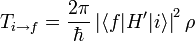
where ρ is the density of final states, and < f | H' | i > is the matrix element of the perturbation, H', between the final and initial states.
Fermi's golden rule is valid when the initial state has not been significantly depleted by scattering into the final states.
The most common way to derive the equation is to start with time-dependent perturbation theory and to take the limit for absorption under the assumption that the time of the measurement is much larger than the time needed for the transition.
Although named after Fermi, most of the work leading to the Golden Rule was done by Dirac who formulated an almost identical equation, including the three components of a constant, the matrix element of the perturbation and an energy difference.
Chapter 3. Discovery of fermium.
Facts:
Atomic Mass 257.1
Protons/Electrons 100
Nuetrons 157
Type Solid
Class Transitional metal
Group Actinide
Melting Temp. 2781
| Oxidation State: | +3 | |
| Electron Shell Configuration: |
1s2 2s2 2p6 3s2 3p6 3d10 4s2 4p6 4d10 4f14 5s2 5p6 5d10 5f12 6s2 6p6 7s2 |
History:
Fermium-525 was discovered in 1952 in the debris field of a hydrogen bomb explosion in the Pacific Ocean. It was discovered by Ghiorso and co-workers and is the eight discovered transuranium element of the actinide series. The longest lived fermium isotope lived a half life of 82 days.
Discovered by: Workers at Argonne, Los Alamos, USA, and the University of California at Berkeley, USA.
Discovered at: USA
Discovered when: 1952
Fermium (after Enrico Fermi) was first discovered by a team led by Albert Ghiorso in 1952. The team found 255Fm in the debris of the first hydrogen bomb explosion. That isotope was created when 238U combined with 17 neutrons in the intense temperature and pressure of the explosion (eight beta decays also occurred to create the element). The work was overseen by the University of California Radiation Laboratory, Argonne National Laboratory, and Los Alamos Scientific Laboratory whose team members included Ghiorso, Stanley G. Thompson, Gary H. Higgins, Glenn T. Seaborg, Martin H. Studier, P.R. Fields, Sherman M. Fried, H. Diamond, J.F. Mech, and so on. Samples of sea coral impacted from the first thermonuclear explosion of November 1952 were used. All these findings were kept secret until 1955 due to Cold War tensions. In late 1953 and early 1954 a team from the Nobel Institute of Physics in Stockholm bombarded a 238U target with 16O ions, producing an alpha-emitter with an atomic weight of ~250 and with 100 protons (in other words, element 250100). The Nobel team did not claim discovery but the isotope they produced was later positively identified as 250Fm.
Binary Compounds
This section lists some binary compounds with halogens (known as halides), oxygen (known as oxides), hydrogen (known as hydrides), and some other compounds of fermium. For each compound, a formal oxidation number for fermium is given, but the usefulness of this number is limited for p-block elements in particular. Based upon that oxidation number, an electronic configuration is also given but note that for more exotic compounds you should view this as a guide only. The term hydride is used in a generic sense to indicate compounds of the type MxHy. In compounds of fermium (where known), the most common oxidation numbers of fermium are: 3. Chlorides - FmCl2: fermium (II) chloride
Basic Facts:
There are eighteen known isotopes and all of them are radio active. Fermium is made by subjecting elements like uranium and plotomium to intense nuetron bombardment.
Isotope:
17 radioisotopes of fermium have been characterized, with the most stable being 257Fm with a half-life of 100.5 days, 253Fm with a half-life of 3 days, 252Fm with a half-life of 25.39 hours, and 255Fm with a half-life of 20.07 hours. All of the remaining radioactive isotopes have half-lives that are less than 5.4 hours, and the majority of these have half-lives that are less than 3 minutes. This element also has 1 meta state, 250mFm (tЅ 1.8 seconds). The isotopes of fermium range in atomic weight from 242.073 amu (242Fm) to 259.101 amu (259Fm).
Notable characteristics:
Only small amounts of fermium have ever been produced or isolated. Thus relatively little is known about its chemical properties. Only the (III) oxidation state of the element appears to exist in aqueous solution. Fm and heavier [[isotope]]s can be synthesized by intense neutron bombardment of lighter elements especially uranium and plutonium.
«С фермием в вашей крови вы будете жить долго!»
Глава 1. Биография
Физика в Риме
Энрико Ферми родился в Риме, Италии. Его отцом был Альберто Ферми, Старший инспектор Министерства Коммуникаций, и его матерью была Ида де Гаттис. Молодой мальчик он любил изучать физику и математику и разделил свои интересы с братом Джульо. Когда Джульо неожиданно умер от нарыва горла в 1915, Энрико был в обезумевшем состоянии, и с головой погрузился в научное исследование, чтобы отвлечь себя. Позже, Энрико оказывал поддержку студенту по имени Энрико Персико, и они оба были заняты в научных проектах, таких как построения гироскопов, и измерения магнитного поля земли. Он посещал местную среднюю школу и его ранняя способность к математике и физике была признана и поощрена коллегами его отца, среди которых был Амидей. В 1918 году он получил место в Скуоле Нормейле Супериоре. Он провел четыре года в Университете В Пизе и в 1922 году получил докторскую степень по физике.
Советником доктора философии Ферми был Луиджи Пуссианти. В 1924 ферми провел семестр в Геттингене, и затем остался на несколько месяцев в Лейдене с Полом Эхренфестом. С января 1925 до осени 1926 он находился в Университете Флоренции.
В 1926 году Ферми открыл статистические законы, в настоящее время известные как «Статистика Ферми».
Когда ему было только 24 года, Ферми стал профессором в Риме (первой атомной физики в Италии, созданной для него профессором Орсо Марио Корбино, директором Института Физики). Корбино помог Ферми подобрать ему команду, к которой вскоре присоединились такие известные ученые как Эдуардо Амальди, Бруно Понтекорво, Франко Разетти и Эмильо Сегре.
В течение этого времени в Риме, Ферми и его группа сделали важные вклады во многие практические и теоретические аспекты физики. Некоторые из них включают теорию бета распада, и открытия медленных нейтронов, которые были основой для работы ядерных реакторов. Его группа также систематически бомбардировала элементы нейтронами, и в течение их экспериментов с ураном, наблюдалось ядерное расщепление. В то время считали расщепление не невозможны. В то время люди считали, что элементы с более высоким атомным числом образуются нейтронной бомбардировкой более легких элементов, никто не ожидал, что нейтроны имеют достаточно энергии чтобы разложить более тяжелый атом на два легких элемента. Однако, химик Ида Ноддак раскритиковал работу Ферми и предположил, что некоторые из его экспериментов, могли произвести более легкие элементы. В то время, Ферми отклонил эту возможность на основе вычислений.
Ферми был известен за его простоту в решении проблем. Когда бы ни было возможно, он избегал усложненной математики и получал быстрые результаты, основанные на оценках порядка величины. Это