Substance abuse: Alcohol Consumption and alcohol dependence among the youth (Социологическое исследование проблемы алкоголизма среди студентов)
Long- term effects of alcohol.
Frequent and prolonged use of alcohol has many detrimental effects on the body. Heavy drinkers develop a tolerance for alcohol, which means that larger amounts of alcohol are needed to get the desired effect. A drinker is physically dependent if withdrawal symptoms are experienced when alcohol use is discontinued abruptly. Symptoms vary but include delirium tremors (the "DTs"), cramps, vomiting, elevated blood pressure, sweating, dilated pupils, sleep problems, irritability and convulsions. Most of these symptoms will subside in two to three days, though irritability and insomnia may last two to three weeks. Psychological dependence occurs when the drinker becomes so preoccupied with alcohol that it is difficult to do without it. Short-term memory loss and blackouts are common among heavy drinkers. A blackout, which is an amnesia-like period often confused with passing out or losing consciousness, results when the drinker appears normal and may function normally; however, the person has no memory of what has taken place. Research indicates that blackouts are associated with advanced stages of alcoholism, and there is a correlation between the extent and duration of alcohol consumption during any given drinking episode and the occurrence of blackouts.
Treating
alcoholism.
The sooner alcoholism is detected, the better the chances of recovery. There are several effective treatment methods for alcoholism, and what works for one person may not work for another. Many options should be explored when seeking help. Local or state health organisations can be contacted to find out what treatment alternatives exist in each community.
Sociological research.
Reasons for choosing the questionnaire as a method of my survey and a sample design.
I chose a questionnaire as a method of a data collection primarily because of the lack of ability (mostly time) to try to conduct an interview. Secondary, I consider the interview to be the inappropriate type of a survey in the case of such a delicate problem as alcoholism. An interview, no matter formal or informal, might provide a large bias I the data, thus in the analysis, because many people may consider it to be undesirable for them to let others know the bare truth about their lives. Moreover, an interview can not be anonymous (at least the interviewer would be initiated in your problems). I also did not manage to avoid an overt participant observation…
As this sociological research is of a small scale (a sample of 36 persons) and was held among the students from one university (HSE), it did not include such complicated (and unnecessary in this case) methods of data collection as a telephone survey or mail survey, the refusals problem was eliminated. Though, just because of the same circumstances, it has a bias of representing only the smallest part of the Russian youth: Moscow students and my research would be more descriptive than analysing.
The multistage sample was conducted in the following way: 4 out 5 specialities were observed (I did not have the access to jurisprudence) and the representatives were chosen by a random sampling (using the table of random digits and student lists) according to a proportion of number of students on each speciality. Thus I have got 14 representatives of the economic speciality, 10- of management, 8- of sociological and 4- of the ICEF.
Considering the fact that I dealt with students, I was not afraid of personal questions. Students, as young and open class of population, are far from being embarrassed when they are asked such.
The list of questions.
1. Your sex:
M___ F____
3. Your speciality?
A) Economics B) Management C) Sociology D) ICEF
2. Your attitude to the alcohol ?
А) Negative
B) Simply do not like, when there is someone drunk beside me.
C) Neutral
D) Positive
3. Do you drink alcohol?
А) Yes C) Did not ever try.
B) No
4. If not, why? ______________________________________________
5. If yes, in what age did you try it the first time (approximately)?
A) 5-10 years D) 15-17 years
B) 10-13 years E) 17 and over
C) 13-15 years
6. How often do you drink alcohol?
А) Almost every day B) Less than three times a week
C) Less than two times a month
7. Do your parents drink (in general)?
А) No C) Yes, only mother
B) Yes, only father D) Both
8. With whom do you usually drink (the most often case)?
А) With friends from the university B) With other friend/buddies
C) With parents
9. Can you drink alone?
А) Yes, happened to be B) No
10. Do you drink to overcome a hangover?
А) Yes B) Yes, but not in the morning
C) Never
11. Do you need some reason for drinking alcohol like Birthday or another holiday?
А) Yes, always B) Not necessarily.
12. How can you classify your alcoholic consumption?
А) I have no dependency
B) I have some warnings about my dependency
C) Only psychological dependency
D) Physical dependency.
13. Do you care about the amount of alcohol you drink per day? (Several answers are possible)
А) Yes
B) No
C) No, if there is no my girlfriend/boyfriend beside me.
D) No, if my parents wouldn’t see/know.
E) No, if it is a big holiday (I can allow myself)
14. What alcohol beverage do you drink in the most often case?
А) Beer
B) Cocktails (Gin-Tonic , etc.)
C) Wine, Aperitifs (Martini, Karelia ,etc.) or champaign
D) Strong alcoholic drinks (Vodka, Cognac, Scotch and etc.)
15. Have you ever tried to give up drinking?
А) Yes B) No
16. Have you ever tried to reduce the amount of alcohol consumed?
А) Yes, it worked B) Yes, it did not work
C) No
17. Would you drink less, if parents set up more strict requirements to your behaviour?
А) Yes B) No
18. Would you drink less, if they ceased to give you pocket money?
А) Yes
B) No, I would take a loan, but will drink/somebody would treat. C) No, I earn money myself.
19. Comparing with the previous year, do you drink:
А) Less/less frequent C) As much/with the same frequency
B) More/more often
20. Did alcohol affect your study results, from your point of view?
А) No B) Yes, they become better C) Yes, they become worse.
21. How did you pass the previous exams/entry exams?
A) Excellent B) Well
C) Satisfactory D) Failed
22. Why do you drink alcohol? (Several answers are possible)
А) To remove stress
B) To raise the mood
C) To support to company
D) To celebrate some holiday
E) Your variant of answer_________________________________
23. Do you care, what others think, when they see you drunken? (Except people, who know you)
А) No, if they are not policemen B) Yes
24. Have you ever had extrinsic behavioural manifestations (aggressiveness/depression) connected with the consumption of alcohol?
А) Yes B) No
25. Did you have blackouts (of a non- traumatic nature)?
А) Yes, once/sometimes B) No
26. Do you smoke?
А) Yes
B) No
27. Do you take drugs, even the weakest ones?
А) Yes, have tried once C) Yes
B) Yes, but very- very rarely D) No
The analysis of a data received.
I have got 21 male and 15 female respondents. Among these people there are only 1 men and 1 women who do not drink alcohol at all.
The attitude towards the alcohol is distributed as following: 39% - positive (among them: 13- men and only 1 woman); 39%- neutral (among them: 6 men and 8 women); 22%- simply do not like, when there is someone drunk beside them (among them: 2 men and 6 women) and none of the respondents said that their attitude is negative.
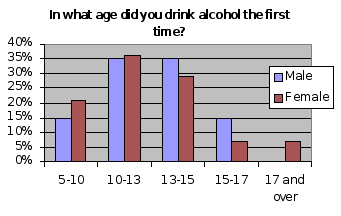
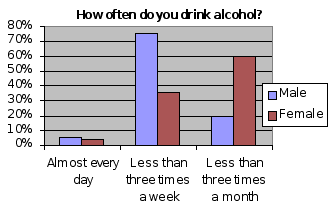
29% of male and 27% of female
respondents have parents who do not drink at all. 4% of male and 13%
of female students have only father who drinks (in general) and 4%
and 6% respectively- only mother. The percentage of both parents
drinking (in general) is 62 for men and 53 for women. This way the
difference between the current and the next generation (the youth)
can be shown. As we see from this data, the percentage of
non-drinking parents is far from 1/21 and 1/15 (5% and 7%) of their
offsprings. Most of the men drink with their friends from the
university (55%) and the largest part of female responses to this
question fall on the answer B)-with other friends/buddies (50%).
The next few questions I consider to be rather interesting, because they primarily deal with the alcoholic dependency and its stages. The question about drinking alone as one of a symptom of alcoholism brought up the results of 50% of male students who could do this, and only 29% of female who have also chosen this answer. Drinking to overcome a hangover is normal for 55% of men and 14% of women. Doing the same thing at any time except mornings is suitable for 15% and 7% of students respectively. And only 30% of men and 79% of women consider this to be “not their style”. Unfortunately, as much as 85% of men and 64% of women do not need a normal reason for drinking like celebrating some party, etc. Two out of 20 male respondents and two out of 14 female have doubts about their dependency and 2 men consider themselves to be psychologically dependent already.
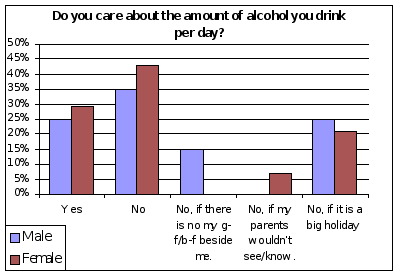
From the graph above we can
see the following interesting fact: none of the women do not care
about the presence of the their boyfriends while they are drinking
and male respondents do not take their parents into consideration
deciding haw many drinks to have.
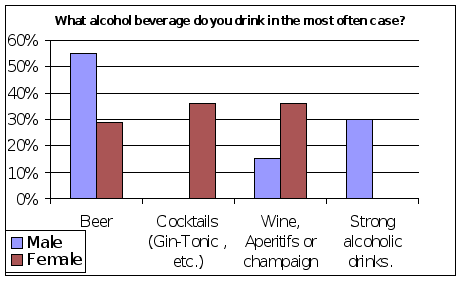
Here we can see the tendency of male students usually drinking beer or strong alcoholic drinks, and females usually drinking cocktails of aperitifs.
The question concerned ever trying to give up drinking and never following though was aimed to reveal one of the symptoms of the first stage of alcohol dependency. The results were: 30% of men and 14 % of women tried to do so. 25% of men and no females tried to reduce the amount of alcohol consumed and succeeded and 5% and 7% respectively tried but did not succeed in reducing it.
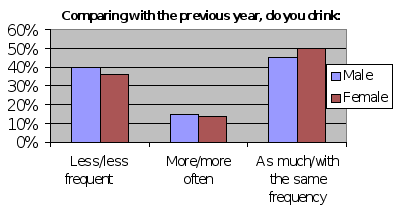
Only 30% of males and 7% of
the females would reduce the amount consumed if their parents were
stricter about their behaviour. But if they cease to give them pocket
money 40% of male respondents and 43%