Comparison of nouns in English and Russian languages
William. Croft,1993. "A noun is a noun is a noun - or is it? Some reflections on the universality of semantics." Proceedings of the Nineteenth Annual Meeting of the Berkeley Linguistics Society, ed. Joshua S. Guenter, Barbara A. Kaiser and Cheryl C. Zoll,. Berkeley: Berkeley Linguistics Society.
Блох. М. Я. Теоретическая грамматика английского языка. М., 1983; стр
В. Н. Жигадло, И. П. Иванова, Л. Л. Иофик. Современный английский язык. М., 1956,
Иванова, Л. Л. Иофик. Современный английский язык. М.— Л., 1956;
О. Jespersen. A Modern English Grammar on Historical Principles. London-Copenhagen, 1965;
Смирницкий.И. Лексикология английского языка. М., 1956;
Щepба. Л. В. О частях речи в русском языке. В сб.: "Русская речь", 1928, р. 6;
Ярцева. Проблема парадигмы в языке аналитического строя. В сб.: "Вопросы германского языкознания". M.— Л., 1961, p. 229;
Ярцева. B. H. Историческая морфология английского языка. M.— Л., 1960;
Ярцева В. H.. Исторический синтаксис английского языка. М.— Л., 1961;
www. answers/topic/agreement –linguistics
www.alpha /rusgrammar/time.
Literary work
Bronte, E. "Jane Eyre",
Frank Herbert "Dune"
Galsworthy "Saga of Forsytes"
Holt Tom "Who is afraid of Beowulf"
Michael Judith "A Certain Smile",
Rice Anna "Savant of bones"
Shakespeare William, "The remarkable rocket".
Tolkien J.R.R. "The return of thinking"
Брюсов , Сочинение в двух томах. Том 1
Лермонтов "Русская литература"
Пушкин А.С. Сочинение в трех томах. Том 2
Тютчев "Изучение лирики в школе"
Фет "Русская литература"
Appendix
Oppositional relations between different parts of speech may be thus shown as follows:
| Autosemantic | Synsemantic | |
| noun, verb, adjective, adverb, pronoun, numeral | preposition, conjunction, particle, auxiliary verb, copula | |
| Function Words | ||
| Syntactic Functions | Morphological Functions | |
| preposition, conjunction, particle, copula | article, auxiliary verb | |
Collective Nouns, Company Names, Family Names, Sports Teams
There are, further, so called collective nouns, which are singular when we think of them as groups and plural when we think of the individuals acting within the whole (which happens sometimes, but not often).
|
audience band class committee crowd dozen |
family flock group heap herd jury |
kind lot (the) number public staff team |
Nouns that can be Countable and Uncountable
Sometimes, the same noun can be countable and uncountable, often with a change of meaning.
| Countable | Uncountable | ||
| There are two hairs in my coffee! | hair | I don't have much hair. | |
| There are two lights in our bedroom. | light | Close the curtain. There's too much light! | |
| Shhhhh! I thought I heard a noise. | noise | It's difficult to work when there is too much noise. | |
| Have you got a paper to read? (= newspaper) | paper | I want to draw a picture. Have you got some paper? | |
| Our house has seven rooms. | room | Is there room for me to sit here? | |
| We had a great time at the party. | time | Have you got time for a coffee? | |
| Macbeth is one of Shakespeare's greatest works. | work | I have no money. I need work! |
Uncountable Nouns
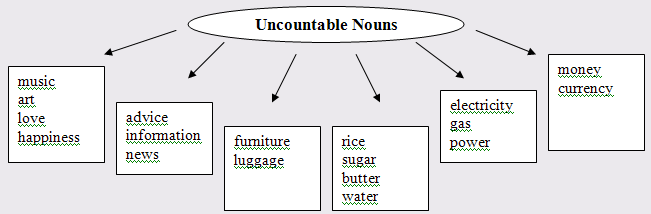
Uncountable nouns are substances, concepts etc that we cannot divide into separate elements. We cannot "count" them. For example, we cannot count "milk". We can count "bottles of milk" or "litres of milk", but we cannot count "milk" itself. Here are some more uncountable nouns:
Countable Nouns
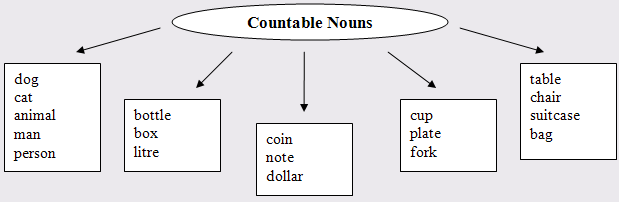
Countable nouns are easy to recognize. They are things that we can count. For example: "pen". We can count pens. We can have one, two, three or more pens. Here are some more countable nouns:
| RUSSIAN CASE FUNCTIONS IN BRIEF | |
| 1. Nominative The Subject case |
Subject of the sentence Extra-linguistic usage (dictionary entries, signs, etc.) Prepositions: за '(what) kind of?' Что он за человек? What kind of person is he? в: 'join the ranks of* (PI. only) вступить в коммунисты Join the communists. |
| 2. Accusative The Object case |
Direct Object Prepositions indicating motion в, на, за, под plus others: про, через, сквоз, о, с Time expressions (Imperfectives) каждую ночь, всю ночь (Perfective) в тот же день, в пятницу |
| 3. Genitive The of case |
Possession Numbers 2,3,4 (Only when Nom/Acc—GenSg) Numbers above 5 & Quantifiers (Only when Nom/Acc—Gen Pl) Negated Verbs (which take Acc. D.O.'s) to indicate total absence Time expressions Prepositions: без, вместо, возле, вокруг, впереди, для, до, из, из-за, кроме, мимо, около, после, против, среди, у, близ, вдоль, вне, внутри, чего-то + Genitive Verbs: боя-ся, жда-, иска- Adjectives: полный + Genitive |
| 4. Dative The to/for case |
Indirect Object Impersonal Constructions Мне холодно. Auxialiaries: нужно, надо, можно/нельзя Prepositions по, к, (согласно, благодаря) Time expressions (Iterative) по средам = каждую среду Age Мне двадцать два года, пять лет Verbs: вери-, помог-, совет(ова), звони-, удиви-ся + Dative |
| 5. Prepositional The Place case |
Prepositions of place в and на Two other prepositions: о, при (This case is used only with prepositions) |
| 6. Instrumental The by/with case |
Means by which action is carried out: Он писал письмо карандашом. Durational time expressions (groups of 4): летом, etc.; утром, etc. Logical subject of passive sentences: Письмо написано Иваном. Verbs: интерес(ова)ся, польз(ова)ся, занимай-ся + Instrumental Predicates of connective verbs (быть, стать, остаться, казаться, оказаться): Он был студентом. Second Direct Objects Его считают студентом. Prepositions of position: за, перед, над, под, между, с Adjectives: довольный чем-то |
Number
English plurals end in -s. In Russian, there are more endings to make plurals. They are all summed up in the table:
| Noun type | Ending for plural | Example |
| masculine ending in a hard consonant; feminine ending in -a | -ы | стол - столы |
| any nouns ending in -ь, -й, -я | -и | двeрь - двери |
| masculine and feminine ending in -k, -г, -x, -ч, -щ, -ж, -ш, | -и | нога - ноги |
| neuter ending in -o | -a | окно - окнa |
| neuter ending in -e | -я | мoре - моря |
There are some plurals which have been borrowed from foreign nouns:
| Singular | Plural |
| Latin | |
| agendum | agenda |
| datum | data |
| dictum | dicta |
| erratum | errata |
| memorandum | memoranda |
| medium | media |
| stratum | strata |
| focus | foci |
| formula | formulae |
| fungus | fungi |
| genus | genera |
| axis | axes |
| appendix | appendices |
| series | series |
| species | species |
| Singular | Plural |
| Greek | |
| analysis | analyses |
| basis | bases |
| crisis | crises |
| hypothesis | hypotheses |
| parenthesis | parentheses |
| thesis | theses |
| phenomenon | phenomena |
| criterion | criteria |
| Singular | Plural |
| French | |
| beau | beaux (or beaus) |
| bureau | bureaux |
| monsieur | messieurs |
| madame | mesdames |
Modality plays a great role in the person’s speech, as it expresses speaker’s attitudes to actions of other people. In our diploma paper we analyzed modality as expressions of social power, morphological and semantic features of modal verbs as they express modality.
We have proposed to view the core meanings of the modal verbs as determined by the power structure of the speech act situation where they are used. We have found that the different participants’ expectations about each other’s attitudes combined with the social power structure largely determine the usage, and there by the semantics of modals. Our general semantic approach should, however, be applicable to all languages with modal verbs.
Modal verbs take a special place in grammar, but they are also examined by semantic science. That’s why disagreement appeared between grammar and semantic sciences. Now modal verbs are the subject of grammar, which consider not only the structural characteristics, but also studies semantic loading of modal verbs.
The category of modal verbs include request, order, imperative, command, approval, disapproval, reproach, an opportunity, skill, a duty, a prediction, the assumption and etc.
In our diploma paper we also analyzed semantic features of modal verbs. We have found out that modal verbs are concerned defective as many modal verbs have no form of future time, they have the equivalents among nominal verbs. In this connection, equivalents of modal verbs in our work have involved in the separate semantic analysis.
Drawing conclusion of our work, we can tell, that each modal verb and its equivalents have several values. These values frequently coincide with values of other modal verbs, but have the own special characteristic, each of characteristics proves to be true from examples in colloquial and literary speech.
Размещено на