Некоторые неопубликованные скульптуры из собрания Государственного Эрмитажа
|
Наушебти титул - «верховный сановник» (TAtj). Надругих ушебти встречаются титулы-жрец Птаха, жрец Нейт, жрец Уаджит, жрец Гора сдвумя уреями, т.е. жрец Буто1. Бакенренеф происходил изжреческой семьи. Его отец был жрецом Амона. Онжил при Псамметике I. Брат Бакенренефа - Бахтхоремемхеб, сын Неффенейт, был царским докладчиком. Был ли Бакенренеф тоже ее сыном или сыном другой жены Падинейта, неустановлено2. Гробница Бакенренефа - в Саккаре3.
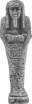
Два ушебти (инв.№940 и19134, выc.18,8 и12см) (рис.11) принадлежат Паабумеху. Его полное имя pA-Abw-mhrnf-nfr-pSmTk-snb. Вотличие от обычного упоминания наушебти имени матери уПаабумеха написано только имя отца Ааха. Оба ушебти отличаются великолепной работой. Наушебти написан текст шестой главы Книги мертвых. Имя, соединенное сцарским именем вкартуше, характерно для правления ПсамметикаII, при котором жил Паабумех. Его титулы - «знакомый царя» и«хранитель царской печати»4.
Ушебти синв.№6713 (выc.1361см) (рис.12) принадлежало Падинейту, сыну Тадибастет. Имена обоих определенно указывают наих происхождение из Саиса. Падинейт, занимал высокую придворную должность - онбыл главным правителем хозяйства царской дочери Аменердис, почитательницы бога. Обер упоминает несколько ушебти Падинейта, ноэрмитажный ему небыл известен, так как онневошел винвентарь, Голенищева инебыл опубликован. Впервые ушебти Падинейта были найдены Л.А.Кристофом5. Два ушебти опубликовал Гардинер6. Падинейт жил при ПсамметикеIII. Его карьера началась раньше, при Априесе. Полный титул Падинейта - imj-rAprnan-nS-nfr-ibra. Наодном из погребальных конусов Падинейта стоит титул rpthAtj. После смерти Падинейта его должность ититулы наследовал его сын Шешонк. Завоевание Египта Камбизом в525г. дон.э. положило конец карьере Шешонка7 Гробница Падинейта находится вФиванском некрополе за. Все ушебти саисского периода сделаны изфаянса голубоватых или зеленоватых цветов. Они имеют форму запеленатой мумии, большей частью сорудиями вруках и корзинкой залевым плечом. Бородка ипарик - либо гладкие, либо с рельефными полосами, бородка может быть заплетена косичкой. Сзади обычно прямой столб, как устатуи. SHAWABTI IN THE HERMITAGE WITH UNUSUAL R.I.RubinshteinThe shawabti in the Hermitage collection are very numerous and all but a few have remained unpublished. Golenishchev's inventory, which covers Nos. 833-1060, cannot be regarded, as publication. In it the texts of the inscriptions are not given in full and the titles are translated into French; many of the inscriptions are not deciphered, although they can be. Moreover the Hermitage acquired most of its collection after 1891, the year in which the inventory was compiled, and only a very few of the items in it were published. Because Golenishchev did not give the inscriptions on the shawabti of Padepep in full (Nos.992, 993, 1010, 1012), J.Aubert wrongly identified these shawabti with Padipep son of Padiptah and Bastetirdies. There is such a shawabti in the Hermitage, but Aubert could not have known it since that monument was acquired much later than the date of Golenishchev's inventory. Several of the published shawabti have rare inscriptions. Such is the statuette of Ata: in front are 9 lines of the customary inscription from the 6th chapter of the Book of the Dead, on the back a dedication by her son, «the son has done it for the revival of her name - the gatekeeper Amonmes». [Most unusual is the inscription on the shawabti of Samut: «the mighty priest of Ptah, to Samut». O.D.Berlev's translation of this text completely supersedes that of I.M.Luria. Another rare example is the figurine of Hnumhotep son of Ichet, dated in the Middle Kingdom. It came to the museum trom B.A.Turayev's collection, after his death, and was dated by him. The rest come from theXVIIIdynasty. A shawabti of Amenemhet, a contemporary of TutmoseIII and AmcnhotpeII. Amenemhet is well known for his many inscriptions. Having begun his career modestly, he later held high posts. Another shawabti belongs to Kenamun, half-brother (on the mother's side) of the king. He held many administrative and honorary offices, among them that of inspector of the royal gardens, a post which was abolished after his time. Shawabti from theXIX and XXI dynasties have been published by the present author in VDI1980,3. Also interesting are the shawabti of Padiptah, priest of Ra-Setau and Bastet, and his son Padipep,. Who put up a stele in the Serapium on which are
mentioned his father Padiptah and mother Bastetirdies. From the same period comes the shawabti of Bakenrennef and Paabumeh. The thcophoric name Paabumeh
indicates a date in the reign of PsammetichusII (Paabumeh-renef-nefer-Psammetik-seneb); instead of the mother's name the
father's is given - Aaha. Finally there is the shawabti of Padineitu, head of the house of Amenerdis, worshipper of the god. Padineitu's son was the last
ruler of the house, since Cambyses conquered Egypt in his time. |
|||
| Примечания: Aubert J. F., Aubert L. Statuettes..., p. 220, fig. Jelenkova Е. Nomenclature.- ASAE, 1959, № 56, p. 5, 9, 10. Р. М. V. III, p. 171. Aubert J. F., Aubert L. Statuettes..., p. 220. Cristophe L. A. Les trois derniers grands majordomes de la XXVI0 dynastie. - ASAE, 1957, №54, p. 83-100. Aubert J. F., Aubert L. Statuettes.., p. 233; Griffith F. L. A Tourist Collection of Fifty Years Ago.-JEA, 1916, № 3, p. 193-198. Р. М. V. I, № 97. | |||

Литература
Материал взят ссайта kemet/articles/articles.htm