Tourism in Germany
Successfully: the mobile party attracts en-vogue DJs and an enthusiastic crowd.
Some facts: In 2000, the loveparade's busiest year to date, 250 DJs on 53 wagons partied together with over a million guests.
Recently, Austria, Israel, South Africa and Mexico have joined the craze and organised their own love parades.
C) Frankfurt's Bookfair
Frankfurt
is a big player in global trade fair business. An annual
average of 80 fairs and exhibitions attract numerous visitors from
all over the world.
One of the highlights is Frankfurt's book
fair. The biggest book fair worldwide dates back to the 15th century.
Its popularity has increased ever since.
Today, more than 250,000 annual visitors flood the fair.
The aim:
information on a selection of the almost 400,000 books which are
being presented. Readings, talks, interviews and other side events
offer additional incentives for an interested public. Book industry,
publishers, critics, readers and writers alike are under the spell of
the biggest book fair world wide.
D) Carnival in Germany
In Germany Mardi Gras ('Fasching') is also
referred to as the fifth and foolish season ('die nдrrische
Zeit'). It is a time of elaborate parades, masks, balls and election
of Carnival king and queen and official madness.
The exact time
of celebration and the traditions vary from county to county, but it
generally takes place in early spring. Munich, Cologne, Mainz are
strongholds of Mardi Gras celebrations.
Switzerland and Austria,
too, join the party with enthusiasm following their own
traditions.
E) Munich's 'Oktoberfest'
Even though it is called 'Oktoberfest', the festival actually takes
place in September, as Bavarian autumn can be tricky and surprise
with early cold and snow. Today, the 'Oktoberfest' is the largest
festival worldwide attracting a multitude of visitors. Apart from
beer tents the festival offers amusements as diverse as roller
coasters, circus appearances, festive parades and live brass
bands.
The ceremonial opening happens at noon. The mayor arrives
in a festive coach followed by a decorated horse-drawn brewer's cart.
Guests, staff and the numerous brass bands are all wearing
traditional costumes (lederhosen and dirndls) for the occasion. At
the end of the parade the major taps the first keg of beer and
shouts, "o'zapft is!" (The keg is tapped).
It takes
good nerves and a solid stomach to survive the festivals 16 days of
intensive partying. However, the festival is a huge success: Apart
from attracting a multitude of visitors the festivals brand name
'Oktoberfest' has been exported all over the world.
4.2. National Parks
A)
The Jasmund National Park

The Jasmund National Park offers many different landscapes within a very small area. Come and visit a cretaceous landscape with numerous bogs, wet grasslands and dry meadows. The most renowned attraction are the chalk cliffs surrounding the Kцnigsstuhl which have been captured in paintings by the famous artist Caspar David Friedrich.
Apart from the Kцnigsstuhl, the highest point on the chalk coastline, the whole length of the chalk coastline is impressive. It stretches over a length of 10 km, reaches a height of 117 m and consists of both active and inactive cliffs, illustrating the dynamics of an active steep coastline.
The national park offers a wide range of activities, such as hiking and bicycle tours, excursions and seminars which give the opportunity to explore the most beautiful hiking trails through the regionґs forested landscapes.
The Stubnitz area is not just worth a visit because of its
magical chalk landscape, it is also the home of mythical figures.
On
guided tours, organised on a regular basis by the national park
administration, you will find out everything about Hertha, a Germanic
goddess, and Stцrtebecker, a pirate who is said to have buried
treasure somewhere in this area.
Highlights:
- Cape Arkona with the little town of Vitt
-
the fishing port of Sassnitz with its fishing museum
-
"Piratenschlucht" (pirateґs gorge) in Sassnitz
-
Greifswald's museum with an exhibition of paintings by Caspar David
Friedrich
- historic craftsmen's dwellings in Gingst
- Grьmbke
lookout tower near Neuenkirchen
Activities:
Jasmund offers a wide range of guided tours
(daily tours take place from April - September, both from the parking
lot in Hagen to the Kцnigsstuhl and from Sassnitz to the bizarre
rock formations of "Wissower Klinken").
Furthermore, you
can visit numerous exhibitions (at the national park visitorsґ
center at the Kцnigsstuhl and also at the Granitz hunting lodge
near Sellin).
The biosphere reserve "South East Rьgen"
organises further hiking and bicycle tours, as well as
excursions.
B)
The Wadden Sea of Hamburg National Park
The Wadden Sea of Hamburg National Park, which is the smallest of
three mud-flats national parks, is characterized by three
islands:
"Neuwerk", widely covered with meadows and with
a population of 40, "Scharhцrn", with its sand dunes,
and "Nigehцrn" which has been created artificially.
The island group is located directly at the mouth of the river Elbe
near Cuxhaven in northern Germany and protects a landscape of
approximately 12,000 hectares of wadden sea.
On guided tours you not only have the opportunity to learn about the
regionґs landscape but also about the islandsґ historical
background.
On the way from Neuwerk to Scharhцrn you will
walk along trails leading across seemingly endless mud-flats.
Scharhцrn, which used to be a sandbank, is a tourist attraction
mainly for its sea bird colonies. On a visit to the ornithological
station you will see one of the largest colonies of sea swallows.
Highlights:
- carriage ride across mud-flats from
Sahlenburg to the island of Neuwerk
- voyage with the MS "Flipper"
from Cuxhaven to the island of Neuwerk
- guided walks across the
Wadden sea
- guided tours to the bird colonies, salt marshes and
wadden sea of Neuwerk
- guided tours to Scharhцrn, the bird
sanctuary
- searching for amber on the "Kleiner Vogelsand"
-
amber exhibition on the island of Neuwerk
Activities:
We recommend national park visitors on day
trips to take a walk along the main dyke, from which you can see the
foreshore with its bird colonies but also the islandґs
interior. Cars are banned on the islands. For this reason tours, for
example, to the fortified tower of the island of Neuwerk, through the
salt marshes of the foreshore with their abundance of flora and
fauna, or to the "Ostschleuse" lock, can either be made on
foot or by horse-drawn carriage.
C) The Wadden Sea of Lower Saxony National Park
Make a
trip to one of the most impressive wadden sea landscapes. High up, in
northern Germany, at the North Sea coast of Lower Saxony, the Wadden
Sea of Lower Saxony National Park is located. It protects the wadden
seas landscape between the river Ems and the river Elbe, including
the offshore East Frisian Islands. The national park offers amazing
natural spectacles and various landscapes, such as salt-marshes,
which are typical of this region, the steep coast near Dangast and
the "swimming bog" near Sehestedt, Germany's only remaining
bog landscape located outside the country's dykes
Highlights:
- Wadden Sea House in Wilhelmshaven
-
Norddeich seal station
- Lightship and whale-bone fence on the
island of Borkum
- Fisherman's House Museum on the island of
Norderney
- Dornumsiel Castle, surrounded by water
- German
Shipping Museum in Bremerhaven
- Old lighthouse on the island of
Wangerooge
Activities:
The surrounding area offers a wide range of
sightseeing opportunities, such as the East Frisian islands of Juist
and Norderney. Whether you want to go swimming and enjoy the broad
beaches, take a ride in a carriage across the island or a walk
through the salt-marshes, the national parkґs recreation and
leisure program will guarantee a lot of fun and relaxation.
D) The Wadden Sea of Schleswig-Holstein National Park
Welcome to the Wadden Sea of Schleswig-Holstein National Park, the largest national park in central Europe. One third of Schleswig-Holstein belongs to the worldґs largest uninterrupted wadden sea landscape, which reaches from the North Sea coast of the Netherlands up to Denmark. The wadden sea, a stretch of land affected by tides, are flooded by sea water during high tide and remain dry during low tide, a unique phenomenon worldwide. Experience an oceanic landscape as near to nature as it can be, with dunes, beaches, salt-marshes and "Halligen", small islands which are not protected by dykes and therefore become flooded whenever there is a spring tide or a heavy storm.
Experienced guides will show the amazing spectacle of low and high tide. You can watch how, after six hours of low tide, the wadden sea become flooded again and the deep, artificially constructed furrows - called 'Priele' - fill with water. Whether you go swimming in the sea, take a walk along the beach or over the mud-flats, join a boat tour or watch the birds in the salt-marshes - your holiday in the Wadden Sea of Schleswig-Holstein National Park will definitely be relaxing, for both body and soul.
Highlights:
- Multimar
Wattforum in Tцnning, a national park center
- Husum, with
its old river port and museums
- ride in a carriage to the Sьdfall
Hallig
- guided hiking tour across the mud-flats
- Nordstrand
tourist information center with its aquarium
- Friedrichskoog seal
station
Activities:
One of many possible sightseeing opportunities
is a trip to the small fishing villages which belong to the national
park. You can also go on a boat tour to the seal banks and observe a
unique and fascinating animal spectacle.
4.3. Routs in Germany.
Germany’s first “Vacation Routes” and “Scenic Routes” date back to 1927, each carving a path dedicated to a particular cultural or scenic theme. Today, some 150 such routes exist, and millions of people travel them annually. Discover Germany along the “German Castle Road,” “German Fairytale Road,” or the most famous, the “Romantic Road.” Whatever your interest, our Scenic Routes will guide you on a fun and exciting vacation.
The “Romantic Road.”
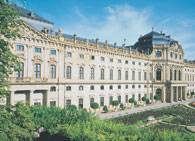
Wuerzburg Residence Palace
In every traveler's life, there are never-to-be-forgotten moments. One of them is the transformation that begins at the exit from the A-7 Autobahn, where you enter the Romantic Road. One of the most famous of the German Vacation Routes wends its way from Wuerzburg to Fuessen.
The Romantic Road is a 220-mile journey from the River Main to the Alps that offers the traveler what is simply one of the most beautiful and most engaging melange of scenery, cuisine and ambience Germany can offer.
It's all gorgeous - the stunning Wuerzburg Residence Palace, the centuries-old panorama and magical atmosphere of Rothenburg-ob-der-Tauber and Dinkelsbьhl, the Roman remains in Augsburg, Bavarian King Ludwig II's unforgettable dream- castle of Neuschwanstein.
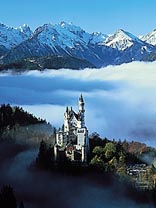
Castle of Neuschwanshtein
Wherever travellers find themselves on the Romantic Road, exceptional cuisine, delicious wines, glorious land- and city-scapes, castles, churches and fortresses inspire the appetite and the soul. Here, in one of the most charming and beautiful sections of Germany, even the most cynical and unromantic traveler cannot help but be seduced.
B) The Classic route.
Whether
we pass through Erfurt, Weimar, Jena or Gotha, names such as Goethe,
Schiller, Wagner and Strauss always linger on any trip through the
"green heart of Germany".
The town of Eisenach is
known as the home of the "Wartburg", the castle once
inhabited by the famous Martin Luther. It is also, however, the city
of minstrels and birthplace of Johann Sebastian Bach, whose history
can be traced in the local "Bach House" museum. Eisenach is
a medieval town which both Goethe and Wagner liked to visit, and it
is a joy to wander through the splendid forest landscapes of this
area.
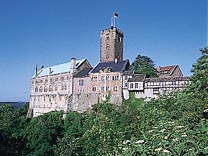
Wartburg castle
Along
the classic route, Gotha is also worth a visit. The "Friedenstein
Palace" and annual events such as the "Ekhof Festival"
all contribute to give the town a unique touch. In Arnstadt, we reach
"the gateway to the Forest of Thuringia ".
Excursions to
the "Wachsenburg Fortress", "Gleichen Castle Ruins"
and "Mьhlburg Ruins" are highly recommended.
Next stop is Weimar, "European Cultural City 1999", which
links to Goethe and Schiller. Besides "Goethe's residence",
his "summer-house on the Ilm" and the "German National
Theater", the "Goethe National Museum" represents a
special attraction in the city. Not far from Weimar is a town called
Jena, known foremost for the work and life of Friedrich Schiller and
which has therefore become a popular destination.
С)
The Castle Road
Historical places and charming countryside with many romantic
fortresses and fairy tale castles make the 975 km long castle route
from Mannheim to Prague a varied route. The glory of time's past
still has an effect today on many towns and villages.
The countryside is as varied as the history. The river
Neckar winds its way through the Odenwald, the Hohenloher Ebene seems
to stretch endlessly into the distance, next the rolling Frankenhцhe
and then the northern part of so-called Franconian Switzerland. The
legacy of the artloving Electors of the Palatinate can still be
admired in towns such as Mannheim, Heidelberg or Schwetzingen.
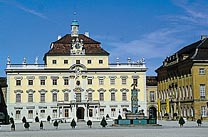
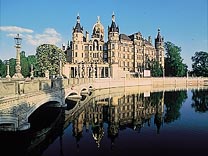
Ludwigsburg Castle Schwerin
Castle
On the tracks of the Palatinate Earls,
Mosbach, Neckarzimmern or Bad Wimpfen are certainly well worth a
visit, with their picturesque old town centres and romantic
halftimbered houses. Near Heilbronn the route passes