Business at work
Personal Finance In 1997, Tesco decided to extend its customer offer to include personal financial services. In partnership with the Royal Bank of Scotland, Tesco is providing new ways of banking and other services to its customers.
C 3.
The impact of ICT on internal and external communications
Importance of ICT
IT is vital to Tesco because every aspect of its operation is controlled or monitored by IT - stock, distribution, payroll, accounts, and so on. For example, when an item has its barcode read at the checkout, the system not only logs the price onto the till, but also logs the financial transaction between Tesco and the customer and the fact that the stock has been reduced by one item. On the distribution side, instructions from the mainframe computer are sent directly to fork-lift truck operators at depots by radio links.
All stores are connected to the mainframes at Head Office via the Tesco Network. There are a large number of different applications that stores use both independently and via the mainframe connection. For example there are Personnel and Scheduling systems in-store, and access to electronic mail via the mainframe.
IT capacity
Tesco has a three-level architecture with mainframe, middle system servers and PC clients. Their main frame has a 6 million Mb storage capacity (equivalent to 6 million 500-page books!). Their private digital network to 600 stores has a capacity of 11.5 Mb. They use some 100 Tesco-written computer applications and over 200 PC packages.
How
much does Tesco spend on IT each year?
Last year, Tesco spent about Ј133 million on IT, that is about 1.4% of turnover.
How
does that compare with other companies?
A recent independent survey of Europe's leading 500 companies in all commercial and industrial sectors placed Tesco 112th overall in Europe in terms of IT spending, but 3rd in the list of European supermarkets, and 1st amongst British supermarkets. [Source: Information Week 19-20/12/97].
How many on-line card
authorisation requests does Tesco receive each day?
Over one million on-line card authorisation requests are dealt with every day.
Internet site
The Internet site
receives 250,000 hits per week and was used to launch Tesco’s
home shopping service and the Tesconet Inertrnet Service provider.
The internet site has proved to be a great success, with the
introduction of Tesco Direct, the home ordering and delivery service.
Such “home shopping” is becoming increasingly important
as more and more customers gain access to the internet via home PCs.
Sainsbury’s, one of Tesco’s great rivals, has also now
launched its own home delivery service via the internet.
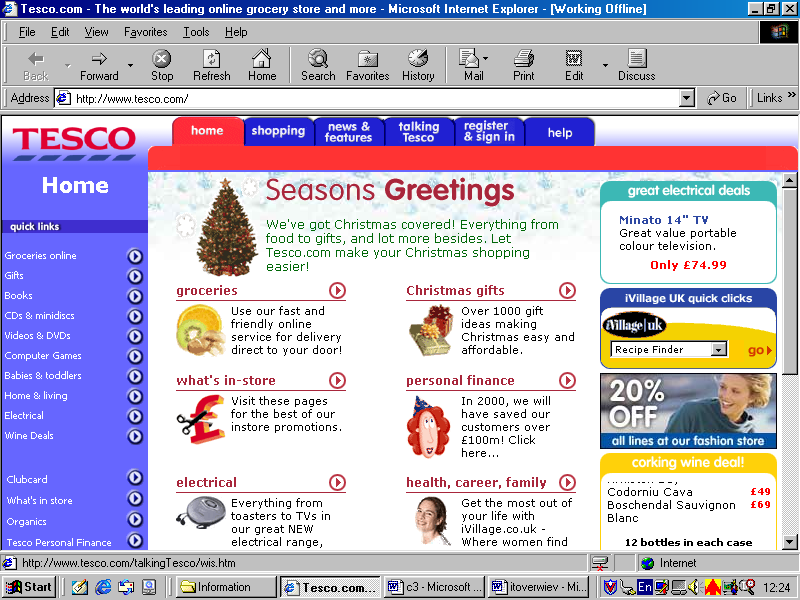
Tesco own Internet site. Home page.
ICT systems used by Distribution Department
IT has revolutionised all aspects of the selling, ordering, distribution and analysis of Tesco products. The operation of Tesco large distribution centres is a highly complex business. In recent years new computer systems have revolutionised distribution operations, allowing more effective stock control procedures, increasing productivity and making the best use of time, space and labour.
The base system used to control the distribution operation was purchased from Dallas Systems and customised to Tesco requirements. There are two particularly important sub-systems, known by the acronyms DCOTA and DCAMS.
DCOTA (Distribution Centre On-board Terminal Access) is a system which sends information by radio directly to the special terminals in the trucks of the fork-lift truck
drivers at the distribution centres. The system controls the movement of stock and trucks in order to make the most efficient use of time and space, automatically matching up locations and trucks. As soon as one assignment is finished, the next brief will be transmitted to the truck-mounted terminal, showing the driver where to go next. Every warehouse location has a check number prominently displayed on the racks; this number is entered by the driver each time he visits a location, enabling the computer to check that each pallet has been placed in the correct slot.
DCAMS (Distribution Centre Assignment Monitoring System) is the system that monitors how far each job has progressed, and the deployment of staff. It is available to supervisory staff via hand-held radio frequency terminals, enabling them to predict and pre-empt problems by re-deploying staff and, if necessary, changing work priorities.
Radio frequency communications are also used in the checking in of goods.
Ordering by stores now relies heavily on IT, using Sales Based Ordering. Data is received by the distribution centre from the Head Office mainframe system, and then passed to the warehouse systems described above.
These
mainframe computers are among the largest in Britain. The mainframes
are either IBM or compatible (Amdahl), running IBM operating systems.
There are mainframes situated in two separate locations.
The loss of a whole mainframe would have serious effects, and for this reason company has two mainframes to provide backup capacity. In the event of a disaster which involved the complete destruction of one of the computer centres, the other could re-establish these vital systems within 48 hours. The backup procedure is tested regularly each year.
The backup systems for the distribution depots include specialist routines that allow depots to switch between computer sites, and are at the leading edge of data processing technology. If a complete computer centre were lost, IT communication with all affected depots would be re-established within six hours at the most.
Goods are now ordered from suppliers using a system called Electronic Data Interchange (EDI). Orders for goods are transferred to the suppliers electronically using a service called INS-TRADANET. The use of EDI keeps suppliers precisely informed of Tesco requirements for company’s stores. It allows Tesco to run the business more effectively and efficiently because of its speed and accuracy. It is both quicker and more cost-effective than telephone, post or fax, and eliminates errors due to loss, or to wrongly printed orders.
EDI is also used for:
sending sales forecasts so that suppliers can anticipate demand and reduce lead-times for stock to reach the stores
securing the best payment terms and discounts for Tesco
simplifying the invoicing process, so that invoices are generated automatically and postage and paperwork are eliminated
working internationally, to eliminate time and language differences.
ICT systems used in Management.
Management Information is data stored electronically for use by business executives at all levels to support their decision making. This type of information is typically historical, and needs human interpretation before a decision is made. Tesco is planning to introduce a new system, called Data Warehouse, which will give much greater analysis and flexibility, and will further enhance the ability of managers to make informed decisions.
The
sections below describe Tesco’s current Management Information
environment, and the planned Data Warehouse, broken down into four
topics: Business use, Technology, Data and Analytical tools.
A)
Business use
Current Management Information
Access to summarised data at pre-defined levels
Most decisions made at a macro (e.g. regional level)
Planned Data Warehouse
Access to in-depth information for informed decisions
Decision made at micro level, e.g. in store
Use of balanced score carding for suppliers, stores, etc. with supporting details
Use shopper behaviour to influence new lines, promotions, and product ranging.
B)
Technology
Current Management Information
Mainframe, text-based reporting and analysis
Downloaded to local PCs for in-depth analysis and graphics
Planned Data Warehouse
Specialised hardware and software to manage data (the 'Information Warehouse')
Information from the Information Warehouse to be accessible from anywhere within Tesco and available also to designated outside users, e.g. suppliers, agencies
Cost of computer hardware and software is "scaleable", i.e. Tesco can add processing power and storage capacity at reasonable cost and in manageable chunks to keep pace with the information needs
Dedicated NCR machine and peripherals.
C)
Data
Over 10 million customers, over 60,000 products and 586 stores
Current Management Information
Data held on mainframe, PC or on paper
Internal data analysed using SAR reports and MAS analysis tool (see below)
External data received by EDI or on paper
Planned Data Warehouse
Data collected from Tesco operational systems and external sources, and stored centrally to provide one consistent source of information
Data is stored on customer behaviour, product performance, branch performance supplier performance, depot performance
Data held at lowest level to enable ad hoc groupings,
e.g. salt sales in stores by the seaside last Easter.
D)
Analytical tools
Current Management Information
Mainframe based
FOCUS - report generator
SAR - report viewer
MAS - Tesco-written multi-dimensional analysis tool
PC Lotus suite - spreadsheet and database applications
Planned Data Warehouse
A simple interface with the information using the score card concept, with top level measures and capability to "drill" to the level of information required to support decisions
IT populate the Information Warehouse and users control their reporting requirements
Logical access to information, with user choice of level, groupings, stores, products, measures, and other parameters
ICT systems used in store operations.
IT is essential to the running of a modern store. It is used for planning, monitoring and auditing store operations. In fact, the logistics of running a major store would be severely hampered without IT, and the expansion to Superstores and Hypermarkets would have been difficult without modern IT developments.
Tesco stores vary greatly in size, from small Express stores covering 2,500 square feet to giant hypermarkets covering 120,000 square feet. The product range depends on the size of the store, and varies from 2,000 lines in a small store up to about 40,000 lines in the biggest. Computerised Store Merchandising and Planning systems ensure that Tesco get the right products to the right store, and get the right amount of space on each shelf within a store. This allows Tesco to get optimum sales for the space allocated to the product, and gives the customer the most appropriate range of products.
A
store can monitor what has been sold through the scanning operation
at the checkout. The introduction of barcodes and scanners not only
allows items to be checked out more easily, but it provides
information that is constantly fed back to the store's computer for
the monitoring of sales, both in terms of stock depletion and money
taken.
Barcodes
and scanners provide several benefits to company’s customers:
As purchases are no longer entered manually into a cash register, accurate pricing is guaranteed.
The scanning till is faster, reducing the time for which customers have to queue by about 15%.
Produce is now weighed at checkouts, removing the need to queue twice (once for weighing and once at the checkout) as used to happen.
Improved promotions may be offered, such as Multisavers.
The customer gets an itemised till receipt giving details of the product purchased, price, weight (if weighed), total cost and method of payment. It also shows the store telephone number, plus details which will trace the sale quickly if a customer has an enquiry.
Tesco
benefits as much as the customer from the new systems. Notably:
Improved transaction accuracy: operator error is removed; fraud is limited as there is no opportunity to enter a lower price on the keyboard.
Improved customer service - customers are important!
Improved productivity. There is no need to label each item with its price, which can now be displayed on the shelf edge near to the product. Removing separate weighing stations removes the need for a manned point in the produce department; customers move through the checkout faster.
Selective promotions can be initiated.
Stock levels can be reduced as the exact quantity held is always known and re-ordering can be made more accurate
Wastage of perishable goods is reduced, as they too can be ordered more accurately.
Monitoring sales analysis and the effectiveness of promotions provides valuable information for Tesco buyers and also the company's suppliers.
Every
product has a unique number, the European Article Number or EAN.