Business at work
customers and clients
suppliers of materials, parts, machinery, other physical inputs and business services
local, national and European authorities that deal with matters such as taxation, planning permission, environmental protection, competition law, investment grants, trading standards, and health and safety
pressure groups concerned with issues such as consumer protection, animal welfare, environmental matters and the welfare of law paid workers
the media and the general public on matters that can either damage or enhance the company’s public image.
Organisation must ensure that the quality of their external communications is as high as possible and select the most effective media for communicating information. It is obviously important that organisations maintain effective communications with their customers, and most businesses invest heavily in market research promotion to attract and keep customers.
Many companies now recognise the importance of providing a communication channel which allows customers easy access to the company. Some companies advertise a customer care telephone number or an E-mail address on their packaging or promotional literature. The customer care section will be stuffed by people trained in the kinds of communications skills needed to deal with customers making complains. Larger companies may employ specialists press officers and public relations officers to handle dealings with the media, pressure groups and the general public.
Organisations relying on other companies for materials and components can find themselves in financial difficulties of their external communications lets them down and orders are not placed at the right time. This may led to shortages of parts and materials, and production may be held up. Relations with suppliers may also be affected by poor verbal communications skills which can cause confusion of the exact nature and delivery of an order. It is for this reason that any changes to an order made verbally should be supported by some form of written or electronic confirmation.
Opened and restricted channel of communications
In most organisations, some internal channels and communication media are open to all employees; stuff at all levels can access the information. Organisations want to provide some information to all their employees. This would include, for example, information on health and safety regulations, environmental management policies, incentive chemist and any response to resent adverse publicity. This downward information flow from the top of the hierarchy would be open to all.
The content of much downward and upward information flow sis fairly routine, and organisation are not too concerned about people beyond the sender and recipient being aware of what is being communicated. However, access to some information and channels of communications may be restricted. Some information is sensitive – and if it becomes known to people other than the intended recipients, it could create either internal or external problems.
Information and communication technology
Both internal and external channels of communication are increasingly supported by information technology, with computers generating and managing information flows. A computer-based information management system provides the mean to communicate, collect, store, summarise, analyse and present information in a way that best suits the controlling and decision making needs of different managers. Inform received by one department or section can be further processed before it passed onto other departments through the organisations computer network.
Computer systems can help organisations:
react changes in the business environment
process complex information
provides administrative support
increase job certification
collect information at source
communicate via the internet.
The Data Protection Act 1984
The Data Protection Act was introduced to ensure that organisations structured and managed the data held on their computers in a responsible way. These are its main provisions.
Organisations must register the kind of information it keeps on individuals with The Data Protection Agency (DPA).
Data must be obtained and processed fairly. People should know if the information they give to organisations will be kept on computer and why it is needed.
Organisations can only collect the kind if information that they have registered with the DPA, and the data must not be used outside of the purpose for which it has been registered.
The information held on individuals must be accurate and, where necessary, up to date and it must not be kept longer than necessary.
Organisations must take precautions against unauthorised access to the information they hold on individuals.
Individuals are allowed access to the personal data held by organisations and, where necessary they can correct mistakes.
In March 2000 the Data Protection Art was extended to cover records kept on a paper as well as information stored on computers and to provide additional protection for the individual. The protection includes new rights to know who holds information on you. It provides a statutory right to know the identity of the person in a business responsible for data protection issues, right to have a photocopy of personal information held by organisations and greater rights to object to anyone holding personal data.
There are also new rules to prevent organisations sending data to a country outside the European Union in an attempt to avoid complying with legislation on data protection. There are new provisions which can lead to individuals being held personally responsible for not abiding by the rules.
C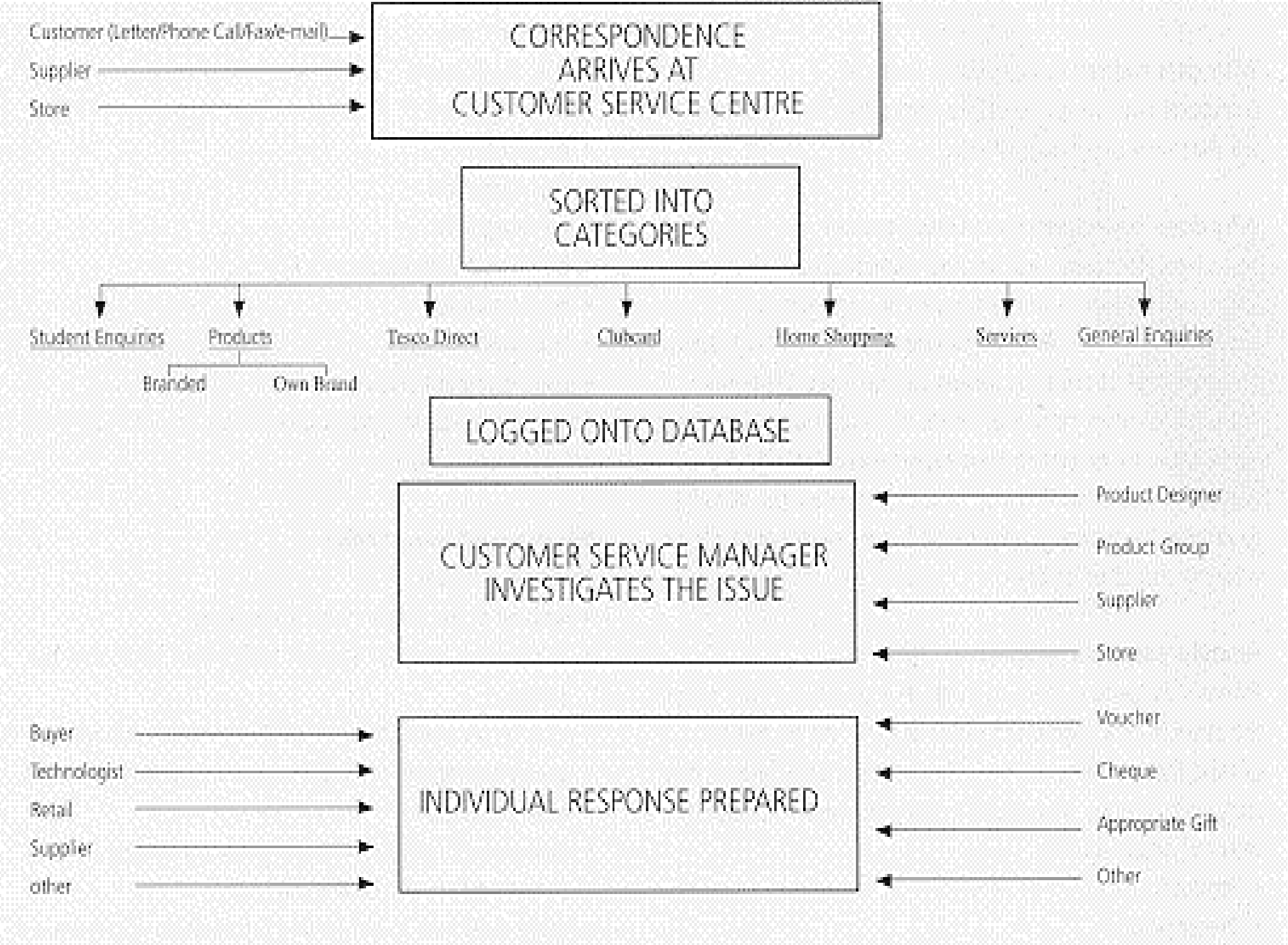
ommunication
within Tesco plc.
An illustration of communication within Tesco plc.
Board of directors





Marketing Department
Retail
Department
Distribution Department


Employees in Marketing Department
Employees in Retail Department
Employees in Distribution Department
Figure 2.0: Example of vertical and lateral communication within Tesco.
I have analysed the communication within Tesco plc. and now I can say that Tesco uses relevant and accurate information to plan and manage efficient development, marketing, distribution and cost control. Information, vertical and lateral, communicated within Tesco very efficiently at the all levels. Every single person who works in Tesco is sure about from whom he should receive information and instructions.
But apart of internal communications Tesco has very good external communications as well. The company communicates with customers and suppliers very well. The quality of Tesco’s external information is very high. Tesco has many communication channels which allow customers easy access to the company, for example, Tesco advertises a customer care free telephone number and e-mail address on its packaging literature.
E6
Production.
Production involves activities, which combine inputs in order to bring about the physical changes that eventually produce the desired output – the product. The product may be goods for consumers and households or parts and machinery for other producers and manufacturers. Production can create a physical change through:
Processing
Manufacturing
Assembly
Craft-based processes.
Value added
A common feature of all forms of production is that they are the means by which organisations add value to their operations. Put simply, all organisations add value to the externally sourced materials and other inputs that contribute to their output. Value added is the difference between the value of an organisation’s output, as measured by sales revenue, and the costs of its inputs bought in from outside which contribute to output.
The relative importance of the input costs incurred by a producer depend upon the nature of the business. Most businesses generally consume a combination of:
Raw materials
Parts and components
Energy
Business services.
Quality
Quality has always been an important competitive factor in some markets, but during the 1980s an increasing number of UK producers began to devote more attention to quality improvement. The rise in the spending power of the average household meant that consumers’ choice of goods and services was no longer so dependent on price. At the same time, consumers were being offered a wider choice obliged producers to improve and complete on quality. Because firms producing consumer goods and services sought to raise quality, their suppliers – companies producing materials, parts, machinery and business services – were also forced to improve quality.
A growing number of organizations now operate in markets where product differentiation is rapidly decreasing. For example, advances in technology mean that there is now very little difference between personal computers offered by the different manufacturers in particular price range. A PC producer must therefore strive to gain a competitive advantage by establishing a reputation as a company with high quality and good customer care. Consider training shoes as another example. Manufactures of trainers periodically introduce new features into their shoes in an effort to create a greater degree of product differentiation, but they all remain essentially the same design and product. If the identifying logos are removed, the average buyer might find it difficult to distinguish between brands.
Producers of both consumer goods and consumer durables must therefore place more emphasis on quality when marketing their products.
The increasing importance of quality can also be seen in the market for consumer services. The main features of services provided by airlines, banks and fast food chains are often virtually identical, and product differentiation can only really be achieved by improvements in quality.
Another factor in changing business attitudes to quality was the success of Japanese manufacturing companies. It was perceived that quality played an important role in helping Japanese companies succeed in European and US markets. By the end of the Second World War very little manufacturing capacity remained in Japan, and in the immediate post-war period Japanese products generally had a reputation as being cheap but inferior quality versions of products manufactured by US and European producers. However by the early 1980s Japanese companies had become closely associated with high-quality products for which they were able to charge premium prices. In the early 1980s, Japan had 18 per cent of the world trade in the manufactured goods, substantially more than the UK’s 5 per cent share.
Quality control
Quality control involves an organisation using some kin of inspection system for identifying materials, parts, components and finished products which do not meet the company’s specifications. Inspection or testing may be carried out at various stages of production to ensure that faulty items do not remain in the production chain.
The operative or inspection department may check every item or just a sample of production. Processing industries, such as the brewing and chemical industries, also test regular samples of their products. Quality inspection is supported by highly sophisticated monitoring, measuring and testing equipment. This allows organisations to make adjustments to machine settings and control devices to improve quality.
There are some drawbacks to a quality inspection system. Using an inspection system to control quality encourages employees to take it for granted that some output is bound to be defective. Less attention is paid to preventing errors and defects in the first place as they will be picked up later by the inspection system.
A quality control system must ensure that there is regular contact between those departments that have a particular interest in quality matters. The marketing department, for example, may identify issues raised by customers, while the design research and development departments should work with production on developing the product so that current defects are eliminated when work is being processed.
Quality assurance schemes
A quality assurance scheme is the means by which an organisation implements its commitment to quality. It helps firms to do the job properly the first time, because the scheme is designed to prevent failures rather than detecting errors once they have occurred. In this way a quality assurance scheme (QAS) differs radically from quality control systems which involve inspection procedures at various stages of production. The design of a QAS recognises that defects do not just happen; they are caused by people.
Assuring quality
Once an organisation has identified the reasons why people are responsible for defects and errors, it can develop a system which eliminates the causes of defects. In this way, quality is assured. There is no single format for a QAS, and an organisation chooses a system which is most appropriate to its particular product or service. What it must do is to insure that every stage of production (or in the provision of a service) that materials, equipment, methods and procedures are used in exactly the same way, every single time.
All employees should be aware of what is expected of them, and should know how their own particular performance has to meet certain clearly identified requirements.
Product Evaluation and Quality Assurance within Tesco plc.
What product evaluation and quality assurance in Tesco plc.
Tesco
products are continually monitored and tested for their quality and
customer acceptability; this is product evaluation. Tesco staff and
management procedures are also monitored to ensure