Физические законы, переменные, принципы
The question is, what is the state of the cat after that onehour has elapsed? The intuitive answer is that the cat is eitheralive or dead, but you don't know which until you look. But it is one of them. Quantum mechanics, on the other hands, saysthat the wavefunction describing the cat is in a superposition ofstates: the cat is, in fact, fifty per cent alive and fifty percent dead; it is both. Not until one looks and "collapses thewavefunction" is the Universe forced to choose either a live cator a dead cat and not something in between.
This indicates that observation also seems to be an importantpart of the scientific process -- quite a departure from theabsolutely objective, deterministic way things used to be withNewton.
Schwarzchild radius
The radius that a spherical mass must be compressed to in order totransform it into a black hole; that is, the radius of compressionwhere the escape velocity at the surface would reach lightspeed.
Snell's law; law of refraction
A relation which relates the change in incidence angle of awavefront due to refraction between two different media.
Speed of light in vacuo
One of the postulates of A. Einstein's special theory ofrelativity, which puts forth that the speed of light in vacuum --often written c, and which has the value 299 792 458 m/s -- ismeasured as the same speed to all observers, regardless of theirrelative motion. That is, if I'm travelling at 0.9 c away fromyou, and fire a beam of light in that direction, both you and Iwill independently measure the speed of that beam as c. One of the results of this postulate (one of the predictionsof special relativity is that no massive particle can beaccelerated to (or beyond) lightspeed, and thus the speed of lightalso represents the ultimate cosmic speed limit. Only masslessparticles (photons, gravitons, and possibly neutrinos, should theyindeed prove to be massless) travel at lightspeed, and all otherparticles must travel at slower speeds.
Spin-orbit effect
An effect that causes atomic energy levels to be split becauseelectrons have intrinsic angular momentum (spin) in addition totheir extrinsic orbital angular momentum.
Static limit
The distance from a rotating black hole where no observer canpossibly remain at rest (with respect to the distant stars)because of inertial frame dragging.
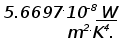
Stefan-Boltzmann constant; sigma (Stefan, L. Boltzmann)
The constant of proportionality present in the Stefan-Boltzmannlaw. It is equal to
Stefan-Boltzmann law (Stefan, L. Boltzmann)
The radiated power (rate of emission of electromagnetic energy) ofa hot body is proportional to the emissivity, an efficiencyrating, the radiating surface area, and the fourth power of thethermodynamic temperature. The constant of proportionality is theStefan-Boltzmann constant.
Stern-Gerlach experiment (O. Stern, W. Gerlach; 1922)
An experiment that demonstrates the features of spin (intrinsicangular momentum) as a distinct entity apart from orbital angularmomentum.
Superconductivity
The phenomena by which, at sufficiently low temperatures, aconductor can conduct charge with zero resistance.
Superfluidity
The phenomena by which, at sufficiently low temperatures, a fluidcan flow with zero viscosity.
Superposition principle of forces
The net force on a body is equal to the sum of the forcesimpressed upon it.
Superposition principle of states
The resultant quantum mechnical wavefunction due to two or moreindividual wavefunctions is the sum of the individualwavefunctions.
Superposition principle of waves
The resultant wave function due to two or more individual wavefunctions is the sum of the individual wave functions.
Thomson experiment; Kelvin effect (Sir W. Thomson [later Lord Kelvin])
When an electric current flows through a conductor whose ends aremaintained at different temperatures, heat is released at a rateapproximately proportional to the product of the current and thetemperature gradient.
Twin paradox
One of the most famous "paradoxes" in history, predicted by A.Einstein's special theory of relativity. Take two twins, born onthe same date on Earth. One, Albert, leaves home for a triparound the Universe at very high speeds (very close to that oflight), while the other, Henrik, stays at home at rests. Specialrelativity predicts that when Albert returns, he will find himselfmuch younger than Henrik. That is actually not the paradox. The paradox stems fromattempting to naively analyze the situation to figure out why.From Henrik's point of view (and from everyone else on Earth),Albert seems to speed off for a long time, linger around, and thenreturn. Thus he should be the younger one, which is what we see.But from Albert's point of view, it's Henrik (and the whole of the Earth) that are travelling, not he. According to specialrelativity, if Henrik is moving relative to Albert, then Albertshould measure his clock as ticking slower -- and thus Henrik isthe one who should be younger. But this is not what happens.
So what's wrong with our analysis? The key point here is thatthe symmetry was broken. Albert did something that Henrik didnot -- Albert accelerated in turning around. Henrik did noaccelerating, as he and all the other people on the Earth canattest to (neglecting gravity). So Albert broke the symmetry, andwhen he returns, he is the younger one.
Ultraviolet catastrophe
A shortcoming of the Rayleigh-Jeans formula, which attempted todescribe the radiancy of a blackbody at various frequencies of theelectromagnetic spectrum. It was clearly wrong because as thefrequency increased, the radiancy increased without bound;something quite not observed; this was dubbed the "ultravioletcatastrophe." It was later reconciled and explained by theintroduction of Planck's radiation law.
Universal constant of gravitation; G
The constant of proportionality in Newton's law of universalgravitation and which plays an analogous role in A. Einstein'sgeneral relativity. It is equal to 6.664.10-11 N.m2/kg2.
Van der Waals force (J.D. van der Waals)
Forces responsible for the non-ideal behavior of gases, and forthe lattice energy of molecular crystals. There are three causes:dipole-dipole interaction; dipole-induced dipole moments; anddispersion forces arising because of small instantaneous dipolesin atoms.
Wave-particle duality
The principle of quantum mechanics which implies that light (and,indeed, all other subatomic particles) sometimes act like a wave,and sometime act like a particle, depending on the experiment youare performing. For instance, low frequency electromagneticradiation tends to act more like a wave than a particle; highfrequency electromagnetic radiation tends to act more like aparticle than a wave.
Widenmann-Franz law
The ratio of the thermal conductivity of any pure metal to itselectrical conductivity is approximately constant for any giventemperature. This law holds fairly well except at lowtemperatures.
Wien's displacement law
For a blackbody, the product of the wavelength corresponding tothe maximum radiancy and the thermodynamic temperature is aconstant. As a result, as the temperature rises, the maximum ofthe radiant energy shifts toward the shorter wavelength (higherfrequency and energy) end of the spectrum.
Woodward-Hoffmann rules
Rules governing the formation of products during certain types oforganic reactions.
Young's experiment; double-slit experiment (T. Young; 1801)
A famous experiment which shows the wave nature of light (andindeed of other particles). Light is passed from a small sourceonto an opaque screen with two thin slits. The light is refractedthrough these slits and develops an interference pattern on theother side of the screen.
Zeeman effect; Zeeman line splitting (P. Zeeman; 1896)
The splitting of the lines in a spectrum when the source is exposed to a magnetic field.
Used Literature.
«Basic Postulats» by Gabrele O’Hara
«Elementary Physic For Students» by Bill Strong
«Atomic Physic» by Steve Grevesone
«Optica» by Steve Grevesone
«Thermodynamic’s Laws» by Kay Fedos