Australia
1978 It was decided that a new parliament building was needed to replace the temporary building which had been used for over fifty years.
1988 The new Parliament House was opened by Queen Elizabeth 2.
Coober Pedy
The
name Coober Pedy is derived from the Aboriginal
words "kupa piti", which means "white man's burrow".
The description is apt because most people live and work
underground.
Coober Pedy is located 836 kilometres (510 miles) north of Adelaide and about 300 kilometres south of Uluru.
It is a desolate landscape devoid of vegetation and water. It is an extremely hot place too. The entire landscape is pockmarked by the telltale tailing of countless opal mines.
In 1915 a young boy named Willie Hutchison, who was out with his father prospecting for gold, discovered the first opal there. Since then the town has grown to about 2500 people.
Coober Pedy produces about 90% of the world's opals.
Because of the extreme heat during the summer almost all buildings are located underground.
Great Barrier Reef
The Great Barrier Reef stretches along the east coast of Queensland in Australia. It is the world's largest coral reef . It is over 2000km (1250 miles) long! It is not a single reef at all. It is made up of over 2900 individual reefs very close to each other
WHAT IS A CORAL REEF?
A
coral
is a tiny marine polyp. It is the living part of the coral
reef. There are many different kinds of corals. T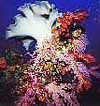 hese
are what gives the coral reef its colourful appearance. Corals feed
mostly on plankton. Coral grows in warm climates where there is clear
salt water and sunlight. They don't like pollution.
A coral reef is a natural barrier made of the bodies of living and dead coral. It is normally just below the surface of the water.
It is made of two parts the:
w
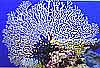 hite
part is made from the bodies of zillions and zillions of polyps
which have died over hundreds and thousands of years.
colourful part is the living part of the coral reef. It is made up of living polyps.
WHO LIVES HERE?
1500 species of fish
400 different types of coral
4,00 molluscs (like clams and the sea slug)
500 species of seaweed
215 species of birds
16 species of sea snake
6 species of sea turtle
Whales visit during winter
New South Wales
New South Wales is the fourth largest state in Australia. It is 801,600 sq km in size.
About 6 million people live in New South Wales. One in three Australians lives in New South Wales.
SYDNEY
Sydney is the capital of the state of New South Wales. It is Australia's oldest and largest city. The defining symbols of Sydney are its Opera House and "coat hanger bridge".
Sydney is the commercial capital of Australia.
About 3.8 million people live in the greater Sydney area.
THE BEACH
Bondi and Manly are some of the famous beaches along the New South Wales coast a short distance from Sydney
THE BLUE MOUNTAINS
The Blue Mountains rise from the coastal plains about 65 kilometres west of Sydney. They are composed of sandstone deposited over 170 million years ago that was then pushed up to form a plateau which was subsequently eroded by wind, rain and water leaving spectacular gorges, pinnacles and cliffs. The highest point is about 1100 meters above sea level.
The towering cliffs of these mountains presented a seemly impassable barrier to early european settlers. Even today most parts are only accessible to experienced bushwalkers.
WHY ARE THEY SO BLUE?
The Blue Mountains are covered with eucalyptus trees which constantly release very fine droplets of oil into the atmosphere. These droplets cause the blue light-rays from the sun to be scattered more effectively (knows as Rayliegh Scattering) making the whole area look bluer.
Strine - Australian Slang
Australian Strine consists of words and phrases which:
have different meanings from other English (like American English or British English),
we have made up ourselves or
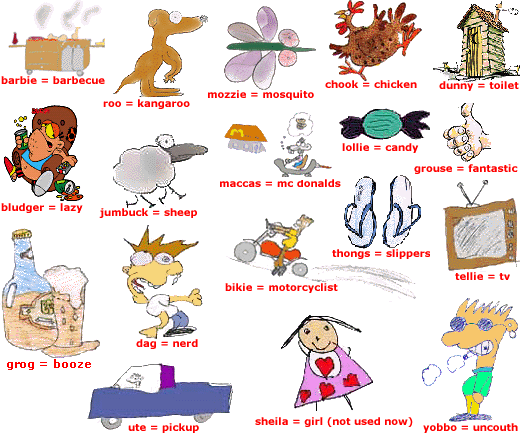 we have borrowed from Aborigine words or from
slang used by early settlers.
The Dandenongs
The Dandenong Ranges are located approximately 40 kilometers from Melbourne, Victoria, Australia.
HEALESVILLE SANCTUARY
The Healesville Sanctuary is a place where you can see Australian native animals in natural bushland surroundings. The sanctuary also carries out research and breeding programs for many endangered animals.
There is a real cool Koala enclosure, platypus tank and snake pit too.
Here
is the official web site for the Healesville
Sanctuary
The
Exhibits page is very good.
PUFFING BILLY RAILWAY
It is great fun riding the Puffing Billy Railway as it weaves its way up the mountains. We even get to sit on the windowsills and dangle our legs out the windows. If you look closely you can see some people doing just that. Because its a stream train you get coal dust in your eyes and on your clothes.
When the weather is really dry and there is a danger of bushfires the Puffing Billy 's steam engine isn't used. That's because a spark from its steam engine could start a bushfire. They use a diesel engine instead.
Here is the official web site for the Puffing Billy Railway .
TULIP FESTIVAL
Every year thousands of visitors come to see the tulips at the Tesselaar Tulip farm in Silvan.
There are many other gardens in the Dandenongs too.
UPPER BEACONSFIELD
Upper Beaconsfield is located 53 kms (33 miles) south-east of Melbourne in the Dandenong Ranges on the southern foothills of the Great Dividing Range.
Upper Beaconsfield retains much of its rural heritage and atmosphere with tree lined streets, varied eucalyptus forests, wet-lands, fern gullies and secluded creeks.
THE GREAT OCEAN ROAD
The Great Ocean Road starts at Torquay (about 100kms from Melbourne) and winds its way for 180 kms along the south-western coast of Victoria , Australia.
It is one of the most spectacular coastal drives in the world. It winds its ways around ragged cliffs, windswept beaches, and tall buffs and passes through lush mountain rainforest and towering eucalyptus.
The Great Ocean Road was started in 1918 and completed during the Great Depression as a public works project to give returned soldiers and unemployed people work.
Some of the sights along the way are:
Bells Beach - a great place to go surfing and where the Bells Surfing Classic is held each Easter.
Shipwreck Coast - where the wrecks of over 80 ships lie on the ocean floor. Many ships carrying immigrants to the gold fields of Victoria floundered in the treacherous seas.
Lorne - a popular sea side resort in Apollo Bay.
Port Campbell National Park - One of the most photographed sections of the road where shear golden limestone cliffs and rock formations withstand the buffeting of fierce seas.
Twelve Apostles -
(there are only 10 left!)London Bridge
(This is what it looked like before one of its spans collapsed)Loch Ard Gorge - where in 1878 the clipper Loch Ard was driven into rocks during a storm with the loss of 52 lives.
Otway National Park
Port Fairy - a well preserved fishing village which was settled by sealers and whalers back in the 1820s.
THE LOCH ARD DISASTER
The 18 passengers and 36 crew on the iron-hulled clipper Loch Ard had a party on the night of March 31, 1878, to celebrate their arrival in Melbourne the next day after a three month voyage from England. But Captain Gibb stayed on deck all night, worried by the thick mist that obscured the horizon and Cape Otway light. At 4am the mist lifted and the lookout cried: "Breakers ahead." Despite desperate attempts to turn the ship away -- and then to hold it with its anchors -- it struck rocks. water flooded in, the masts flailed against the high cliff face before crashing down and waves swept across the decks, hampering attempts to get the lifeboats into the water. Only two survived -- ship's apprentice Tom Pearce and Eva Carmichael, both aged 18. Eva's parents and five siblings were lost. Tom drifted into the gorge where he saw passenger Eva clinging to a mast -- he swam out, pulled her into a cave and found some brandy in the wreckage to revive her. He climbed out of the gorge and came upon two stockmen, and a rescue party was organised. But only four bodies -- including Eva's mother and sister, were able to be recovered from the treacherous seas and most of the ship's valuable cargo was lost or looted. Tom Pearce became a national hero for his rescue of Eva, who soon returned to Ireland.
A few days after the disaster a packing case washed up in the gorge. It contained a life-sized Minton pottery peacock destined for the Melbourne Great Exhibition of 1880
The Outback is the arid sparsely populated interior of Australia.
It makes up almost 85% of Australian landmass. Very few humans live out there.
It is also sometimes called "Beyond the Black Stump".
The Australian Outback is both harsh and breathtakingly beautiful. It's like nothing else anywhere else in the world.
A ROAD TO NEVER-NEVER
In the outback you can travel for days without meeting anyone. This is why it is sometimes called the Never-Never: the never ending landscape; the never ending horizon.
The land is unforgiving to the careless and foolhardy. You can die of dehydration within hours if you are not careful.
A STATION
Yes people actually do live in the outback.
Cattle and sheep are grazed on huge tracts of land called Stations (what might be called a ranch in the USA). There are Stations in the outback that occupy more land than some countries. Helicopters and small planes are usually used to round up stock (the sheep and cattle) and to check fences (dingo and rabbit fences).
A
person who rounds up stock is called a Stockman.
A person who
works at a Station is called a Stationhand.
The owner is called a
Station-Manager
THE PEOPLE
The vast distances have forced people to adapt to their isolation (some people being more than a day's drive from their nearest neighbor). A two-way radio and an airstrip are vital to any outback station.
Because of the great distances some children in the outback cannot attend regular school. They learn from the School of the Air which is a special school where the teacher and student interact via a two-way radio.
Here is a fascinating school in the outback run by the Mupuru aboriginal community . Its really worth a visit: The Mapuru Homeland Leaning Centre
The Royal Flying Doctor Service operates a fleet of airplanes outfitted as flying ambulances and clinics. They visit these remote locations to provide medical services. They also provides advice over the two-way radio.
ULURU
Uluru: Is a huge rock (called a monolith) that sticks out in the middle of the flat desert. From a distance it looks like an impregnable fortress built eons ago by some mythical warlord.
Uluru is over nine kilometres (6 miles) around and over 348 metres (1000ft) high. It is believed to be about 600 million years old and was once part of a huge mountain range. The mountain range has long since disappeared - eroded away by rain and wind.
With each passing hour as the sun moves across the sky the rock changes colour - changing from delicate mauve, blues, pinks, browns to fiery red.
It is a sacred place to the Pitjanjara Aboriginal tribe.
DEVILS MARBLES
Devils Marbles: These massive boulders are scattered along the Stuart Highway near Alice Springs. They glow red in the sunset. Aborigines believe they were left by the Rainbow Serpent of the Dreamtime.
WAVE ROCK
Wave Rock: Is a huge granite rock that looks like a huge wave that has been frozen in time and turned into stone. It has been made this way by the wind and rain water running down its sides.
KATHERINE GORGE
Katherine Gorge: Is one of 13 gorges in Nitmiluk National Park. They began forming about 23 million years ago as torrents of water flowing through tiny cracks in the earth slowly eroded away the earth and rock creating these huge gorges.
It is rich in Aboriginal art, with rock paintings representing the spiritual 'dreaming' of the Jawoyn people, the traditional owners of the land.
Apart from boat rides through the Gorge, with its sheer towering walls, there are also over 100 kilometres of walking tracks and numerous aboriginal rock paintings to visit
THE OLGAS
The Olgas: Are enormous domes of red rock located about 32 kms from Uluru. You can walk into valleys and gorges between the 36 rock domes and feel the eerie mystery around you. The Aborigines call it 'Kata Tjuta'. It has great spiritual significance to them.
T he
Peoples of Australia
We came from all over the world.
Australians are a very friendly open sort of people. We love our sports, our family barbecues and the beach. We are very urbanised - most of us living in the larger cities along the coast. Almost 94% of the population are of European decent and as a result we have a western outlook and culture. In general Australians are very tolerant of other people and their customs.
WORK
Australians are one of the most urbanised societies in the world. Almost 80% of the workforce are employed in service industries such as: offices, banks, etc in the major cities.
About 16% work in manufacturing
About 3% are farmers or graziers.
Wool is one of Australia's major exports. Wool shearing is hard work.
Australia is rich in mineral