Australia
About 1% work in the mining industry
SPORTS
During winter we play Australian Rules Football which is played with an oval ball on an oval field with eighteen players on each team. We also play Rugby.
In the summer we play cricket. Cricket is played with a flat bat and a round leather covered ball. Each team has 11 players. The objective of the game is to hit the ball as far as possible without getting "caught out" or without having the ball come in contact with your body or hitting the stumps (3 short poles behind the batsman). The next Olympic games will be held in Sydney Australia in the year 2000.
LEISURE
Almost 85% of Australians live within a few hours drive of the coast
Most major cities have bicycle tracks.
We love to race almost anything: horses, camels, goats, cockroaches and even earth worms.
Australia has lots of wide open spaces and parks.
Upper Beaconsfield
Upper Beaconsfield is located 53 kms (33 miles) south-east of Melbourne in the Dandenong Ranges on the southern foothills of the Great Dividing Range. Upper Beaconsfield retains much of its rural heritage and atmosphere with tree lined streets, varied eucalyptus forests, wet-lands, fern gullies and secluded creeks. The large residential blocks blend well with the surrounding environment. There are strict laws protecting the local flora and fauna
STONEY CREEK
We go to Stony Creek on hikes, to catch yabbies and fish. It's lots of fun. It isn't usually misty like in this picture.
There are lots of native ferns and gum trees around the creek.
There are Platypuses in the creek but they are very shy and hide when us kids come by.
ASH WEDNESDAY BUSHFIRE
There was a terrible bushfire in Upper Beaconsfield in 1983.
We didn't live here then. The fire burned right through the land on which our house is now. We can still see the burn marks on some of the trees in our garden. Lots of houses burnt down and lots of animals and some people died too. We are all more careful now.
ELEPHANT ROCK
Elephant Rock is located on the Beaconsfield-Emerald Road . Kids paint it in all sorts of colours. There is a good lookout from where you can see Cardinia Dam. There are also good walking tracks there.
Waltzing Matilda
Waltzing
Matilda is an Australian icon.
It is quite likely that more
Australians know the words to this song than the national anthem.
There is probably no other song that is more easily recognised by
a populace: young or old: ocker or a newly arrived immigrant.
|
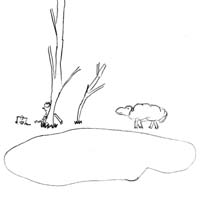
Once a jolly swagman camped by a billabong, Under the shade of a coolibah tree, And he sang as he watched and waited 'til his billy boiled "Who'll come a-waltzing, Matilda, with me?" Waltzing Matilda, Waltzing Matilda Who'll come a-waltzing, Matilda, with me And he sang as he watched and waited 'til his billy boiled, "Who'll come a-waltzing, Matilda, with me?" |
|
Swagman - a drifter, a hobo, an itinerant shearer who carried all his belongings wrapped up in a blanket or cloth called a swag. Billabong - a waterhole near a river Coolibah - a eucalyptus tree Billy- a tin can with a wire handle used to boil water in |
Along came a jumbuck to drink at the billabong, Up jumped the swagman and grabbed him with glee, And he sang as he stowed that jumbuck in his tucker bag, "You'll come a-waltzing, Matilda, with me". Waltzing Matilda, Waltzing Matilda Who'll come a-waltzing, Matilda, with me And he sang as he watched and waited 'til his billy boiled, "Who'll come a-waltzing, Matilda, with me?". |
|
Jumbuck - a sheep Tucker Bag - a bag for keeping food in |
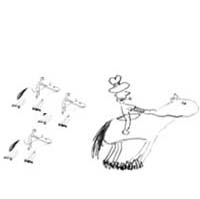
Up rode the squatter, mounted on his thoroughbred, Down came the troopers, one, two, three, "Whose is that jumbuck you've got in your tucker bag?" "You'll come a-waltzing, Matilda, with me". Waltzing Matilda, Waltzing Matilda Who'll come a-waltzing, Matilda, with me And he sang as he watched and waited 'til his billy boiled, "Who'll come a-waltzing, Matilda, with me?". |
|
Squatter - a wealthy landowner. Trooper - a policeman, a mounted militia-man. |
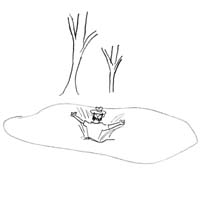
Up jumped the swagman, leapt into the billabong, "You'll never catch me alive," said he, And his ghost may be heard as you pass by the billabong, "Who'll come a-waltzing, Matilda, with me". Waltzing Matilda, Waltzing Matilda Who'll come a-waltzing, Matilda, with me And he sang as he watched and waited 'til his billy boiled, "Who'll come a-waltzing, Matilda, with me?" |
|
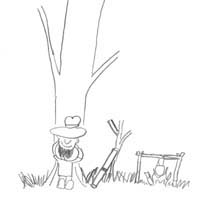
What does Waltzing Matilda mean?
The phrase Waltzing Matilda is believed to have originated with German immigrants who settled in Australia.
Waltzing is derived from the German term auf der walz which meant to travel while learning a trade. Young apprentices in those days travelled the country working under a master craftsman earning their living as they went - sleeping where they could.
Matilda has Teutonic origins and means Mighty Battle Maiden. It is believed to have been given to female camp followers who accompanied soldiers during the Thirty Year wars in Europe. This came to mean "to be kept warm at night" and later to mean the great army coats or blankets that soldiers wrapped themselves with. These were rolled into a swag tossed over their shoulder while marching.
So the phrase Waltzing Matilda came to mean: to travel from place to place in search of work with all one's belongings on one's back wrapped in a blanket or cloth. This is what Swagmen did in outback Australia.
How Did the Song Originate?
A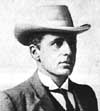 ndrew
Barton (Banjo) Patterson [1864-1941] was a solicitor (lawyer) by
profession and lived and worked in Sydney,
Australia.
In 1895 Banjo and his fiancee, Sarah Riley, visited the Dagworth Homestead a station in outback Queensland. This station was owned by the family of one of Sarah's school friends: Christina Macpherson. While at the station Banjo heard Christina play a tune called the "Craigeelee" on an autoharp. Banjo liked the "whimsicality and dreaminess" of the tune and thought it would be nice to set some words to it.
During his stay Bob Macpherson took Banjo around the station where they stopped at the Combo Waterhole where they found the skin of a newly killed sheep. Obviously someone had made a meal of it. Bob Macpherson may also have told Banjo of the sheep shearers strike of September 1894 when shearers had set fire to the Dagworth woolshed killing over a hundred sheep. Macpherson and three policeman had given chase and one of them, a man named Hoffmeister, shot and killed himself rather than be captured.
So it appears that Banjo linked up all these events to conjure up "Waltzing Matilda. Christina wrote up the score. It was first sung publicly at a banquet for the Premier of Queensland and was an instant hit. The song was then picked up by the "Billy Tea" company to advertise their product. Paterson sold the rights to Waltzing Matilda and "some other pieces" to Angus & Robertson Publishers for "five quid".
By World War 1 it was Australia's favorite song and has been ever since.
Some great poems by Banjo Patterson:
Mulga's Bill's Bicycle Kids and adults alike will love it.
The Man from Snowy River acclaimed as Australia's greatest poem.
Clancy of The Overflow a city folk's yearning for the wide open spaces
Melbourne
Melbourne is the capital of the state of Victoria in Australia. It is the second largest city in Australia.
It was voted the worlds' most livable city in 1994.
And the least polluted for a city of its size.
THE CITY
Melbourne is renowned for its parks, fickle weather, clanging trams, upside-down river, football and its cosmopolitan outlook. It is also the financial capital of Australia.
It is a relatively safe city with a very low crime rate.
About 3.2 million people live in the greater Melbourne area.
The people of Melbourne came from all over the world.
YARRA RIVER
The Yarra River flows right by the city. It is sometimes called "the river that flows upside down" because of its muddy colour. The reason for this colour is because mud particles stay suspended in the water and don't settle to the bottom like in most rivers. It is a very clean river (now).
During the warmer months people like to walk along the river, visit the parks and sunbathe (ouch) along the banks.
The Moomba festival also has a lot of events on the river. I love the birdman competition where they try to see who can fly the furthest after jumping off a bridge. Its very funny.
TRAMS
M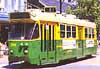 elbourne
loves its electric trams. It is the only city in Australia which
still has them as part of its public transport system. We paint some
of them with interesting designs and motifs. There is even a tram
restaurant where you can dine while trundling past interesting city
sites. Trams have right of way on our roads and also make us do
unusual right hand turns at city intersections.
ARTS CENTRE
The Arts Centre is a short walk across Princes Bridge on St Kilda Road and is now a part of the larger Southgate entertainment complex.
It consists of the:
National Gallery of Victoria with its large collection of works by local and overseas artists.
Melbourne Concert Hall which can seat 2600 people and has fantastic acoustics.
State Theaters home of the Australian Ballet and Opera Companies.
The Art Centre's lattice work spire glows a light purple colour at night and can be seen from miles around.
The water wall at the museum is very popular with young kids.
BOTANICAL GARDENS
Melbourne has many public parks and gardens within walking distance of the city centre: Botanical Gardens was created in the English landscape tradition and extends for 36 hectares along the Yarra River.
Flagstaff Gardens the city's first public gardens.
Fitzroy Gardens has Captain Cooks Cottage, the Fairy Tree carved with tiny figures and a model Tudor village.
Treasury Gardens is close to the state government offices.
Carlton Gardens where the Exhibition Buildings are situated.
Kings Domain contains the Shrine of Remembrance, La Trobe's Cottage and the Myer Music Bowl
GOVERNMENT HOUSE
Government House is the official residence of the Governor of Victoria. It is located in the precincts of the Botanical Gardens. This is where the Queen of England stays when she visits Melbourne.
It is said to be the grandest house in Victoria (some say even all of Australia) It was built during the gold rush when Melbourne was flush with money and was intent on outdoing everyone else.
LUNA PARK
Luna Park has lots of entertainment for kids and adults alike. It is located in St Kilda not far from the city.
WESTGATE BRIDGE
The Westgate Bridge is the longest bridge in Australia. It is over 2.6 kms long and soars over the Yarra River and the harbour. It offers a panoramic view of the harbour and the city.
This is a view of Melbourne taken from across the bay at Williamstown. Yes these Black Swans really do live there.
HISTORY OF MELBOURNE
Melbourne was founded in 1835 by John Batman and a group of businessmen who bought land from the local Aborigines for some trinkets.
It was named, in 1837, after the British Prime Minister at the time: Lord Melbourne.
Sydney
THE CITY
Sydney is Australia's oldest and largest city. About 3.8 million people live in the greater Sydney area. The defining symbols of Sydney are its Opera House and "coat hanger bridge".
Sydney is the commercial capital of Australia.
The people of Sydney came from all over the world.
OPERA HOUSE
The Opera House, situated at Bennelong Point, is an absolutely exquisite building. Its roof-line is meant to symbolise the bellowing "sails" of sailing ships of a bygone era and the spinnakers of the racing yachts that ply the harbour today.
The Sydney Opera House:
Took 14 years to build and cost $102,000,0000 when completed in 1973.
Was designed by the Danish architect Jorn Utzon.
Covers 1.8 hectares (4.5 acres).
Is 185 metres (611 feet) long, 120 metres (380 feet) wide and the tip of its highest arch is 67 metres (221 feet) above sea level.
Roofs are made up of 2,194 pre-cast concert sections held together by 350 kilometres (217 miles) of steel cable.
Roofs are covered with over 1,056,000 tiles.
Hosts over 3000 events each year with audiences of around 2 million people.
Has nearly 200,000 visitors on guided tours each year.
THE HARBOUR BRIDGE
The Sydney Harbour Bridge took seven years to build and was opened in 1932.
The steel used for the bridge weights over 52,800 tonnes.
There are over 6 million steel rivets in the bridge.
It took till 1988 to finally pay off the cost of building the bridge.
It takes 30,00 0 lifers of paint to paint the bridge.
HISTORY OF SYDNEY
The Aboriginal people lived around the area that is now Sydney for thousands of years before the first european settlers arrived in the 1770's.
The area that is now Sydney was named Port Jackson by captain James Cook when he visited the east coast of Australia in 1770. Port Jackson was selected by Captain Arthur Phillip as the most suitable site for the first european settlement in Australia in 1788. He named the place after the British Prime Minister at the time: Lord Sydney.
The colony faced many hardships and near starvation trying to grow crops in this new land. After the initial difficulties however the colony grew rapidly as new migrates arrived in larger numbers.