The history of Old English and its development
Masc.
Fem.
Neut.
Sg.
N nama (name) cwene (woman) йage (eye)
G
naman
cwenan
йagan
D naman
cwenan
йagan
A naman
cwenan
йage
Pl.
N naman
cwenan
йagan
G namena
cwenena
йagena
D namum
cwenum
йagum
A naman
cwenan
йagan
Examples: masc. - guma (a man), wita (a wizard), steorra (a star), mуna (the Moon), dйma (a judge); fem. - eorюe (Earth), heorte (a heart), sunne (Sun); neut. - йare (an ear).
And now the last one which is interesting due to its special Germanic structure. I am speaking about the root-stems which according to Germanic laws of Ablaut, change the root vowel during the declension. In Modern English such words still exist, and we all know them: goose - geese, tooth - teeth, foot - feet, mouse - mice etc. At school they were a nightmare for me, now they are an Old English grammar. Besides, in Old English time they were far more numerous in the language.
Masc.
Fem.
Sg.
N mann fуt (foot)
tую (tooth) | hnutu (nut) bуc (book)
gуs (goose) mъs (mouse) burg (burg)
G
mannes fуtes
tуюes
| hnute
bуce
gуse
mъse
burge
D menn fйt
tйю
| hnyte
bйc
gйs
mэs
byrig
A mann fуt
tую
| hnutu
bуk
gуs
mъs
burg
Pl.
N menn fйt
tйю
| hnyte
bйc
gйs
mэs
byrig
G manna fуta
tуюa
| hnuta
bуca
gуsa
mъsa
burga
D mannum fуtum
tуюum
| hnutum bуcum
gуsum
mъsum
burgum
A menn fйt
tйю
| hnyte
bйc
gйs
mэs
byrig
The general rule is the so-called i-mutation,
which changes the vowel. The conversion table looks as follows and
never fails - it is universally right both for verbs and nouns. The
table of i-mutation
changes remains above.
Examples: fem. - wнfman
(a woman), бc
(an oak), gбt
(a goat), brуc
(breeches), wlуh
(seam), dung
(a dungeon), furh
(a furrow), sulh
(a plough), grut
(gruel), lъs
(a louse), юrul
(a basket), йa
(water), niht
(a night), mж'gю
(a girl), scrъd
(clothes).
There are still some other types of declension, but not too important fro understanding the general image. For example, r-stems denoted the family relatives (dohtor 'a daughter', mуdor 'a mother' and several others), es-stems usually meant children and cubs (cild 'a child', cealf 'a calf'). The most intriguing question that arises from the picture of the Old English declension is "How to define which words is which kind of stems?". I am sure you are always thinking of this question, the same as I thought myself when first studying Old English. The answer is "I don't know"; because of the loss of many endings all genders, all stems and therefore all nouns mixed in the language, and one has just to learn how to decline this or that word. This mixture was the decisive step of the following transfer of English to the analytic language - when endings are not used, people forget genders and cases. In any solid dictionary you will be given a noun with its gender and kind of stem. But in general, the declension is similar for all stems. One of the most stable differences of masculine and feminine is the -es (masc.) or -e in genitive singular of the Strong declension.
Now I am giving another table, the general declension system of Old English nouns. Here '-' means a zero ending.
Strong declension (a, ja, wa, у, jу, wу, i -stems).
| Masculine | Neutral | Feminine | ||||
| Singular | Plural | Singular | Plural | Singular | Plural | |
| Nominative | - | -as | - | -u (-) | - | -a |
| Genitive | -es | -a | -es | -a | -e | -a |
| Dative | -e | -um | -e | -um | -e | -um |
| Accustive | - | -as | - | -u (-) | -e | -a |
|
Weak declension |
u-stems |
|||
| Singular | Plural | Singular | Plural | |
| Nominative |
- |
-an |
- |
-a |
| Genitive |
-an |
-ena |
-a |
-a |
| Dative |
-an |
-um |
-a |
-um |
| Accustive |
-an |
-an |
- |
-a |
The Old English Adjective.
In all historical Indo-European languages adjectives possess practically the same morphological features as the nouns, the the sequence of these two parts of speech is an ordinary thing in Indo-European. However, the Nostratic theory (the one which unites Altaic, Uralic, Semitic, Dravidian and Indo-European language families into one Nostratic super-family, once speaking a common Proto-Nostratic language) represented by Illych-Svitych and many other famous linguists, states that adjectives in this Proto-Nostratic tongue were morphologically closer to the verbs than to the nouns.
This theory is quite interesting, because even in Proto-Indo-European, a language which was spoken much later than Proto-Nostratic, there are some proofs of the former predicative function of the adjectives. In other families of the super-family this function is even more clear. In Altaic languages, and also in Korean and Japanese, which are originally Altaic, the adjective plays the part of the predicate, and in Korean, for example, the majority of adjectives are predicative. It means that though they always denote the quality of the noun, they act the same way as verbs which denote action. Adjective "red" is actually translated from Japanese as "to be red", and the sentence Bara-wa utsukusii will mean "the rose is beautiful", while bara is "a rose", -wa is the nominative marker, and utsukusii is "to be beautiful". So no verb here, and the adjective is a predicate. This structure is typical for many Altaic languages, and probably was normal for Proto-Nostratic as well.
The Proto-Indo-European language gives us some stems which are hard to denote whether they used to mean an adjective or a verb. Some later branches reflect such stems as verbs, but other made them adjectives. So it was the Proto-Indo-European epoch where adjectives as the part of speech began to transform from a verbal one to a nominal one. And all Indo-European branches already show the close similarity of the structure of adjectives and nouns in the language. So does the Old English language, where adjective is one of the nominal parts of speech.
As well as the noun, the adjective can be declined in case, gender and number. Moreover, the instrumental case which was discussed before was preserved in adjectives much stronger than in nouns. Adjectives must follow sequence with nouns which they define - thet is why the same adjective can be masculine, neuter and feminine and therefore be declined in two different types: one for masculine and neuter, the other for feminine nouns. The declension is more or less simple, it looks much like the nominal system of declension, though there are several important differences. Interesting to know that one-syllable adjectives ("monosyllabic") have different declension than two-syllable ones ("disyllabic"). See for yourselves:
Strong
Declension
a, у-stems
Monosyllabic
Sg.
Masc.
Neut. Fem.
N blжc
(black) blжc blacu
G
blaces
blaces blжcre
D blacum
blacum blжcre
A blжcne
blжc blace
I
blace
blace -
Pl.
N blace
blacu blaca
G
blacra blacra
blacra
D blacum blacum
blacum
A blace
blacu blaca
Here "I" means that very instrumental case, answering the question (by what? with whom? with the help of what?).
Disyllabic
Masc. Neut.
Fem.
Sg.
N йadig (happy) йadig
йadigu
G йadiges
йadiges йadigre
D
йadigum
йadigum йadigre
A
йadigne
йadig йadige
I йadige
йadige
Pl.
N йadige
йadigu йadiga
G
йadigra
йadigra йadigra
D
йadigum
йadigum йadigum
A
йadige
йadigu йadigu
So not many new endings: for accusative singular we have -ne, and for genitive plural -ra, which cannot be met in the declension of nouns. The difference between monosyllabic and disyllabic is the accusative plural feminine ending -a / -u. That's all.
ja,
jу-stems (swйte
- sweet)
Sg.
Pl.
Masc.
Neut. Fem.
Masc. Neut.
Fem.
N swйte
swйte swйtu
swйte swйtu
swйta
G swйtes
swйtes swйtre
swйtra swйtra
swйtra
D swйtum
swйtum swйtre swйtum
swйtum swйtum
A swйtne
swйte swйte
swйte swйtu
swйta
I swйte
swйte -
wa,
wу-stems
Sg.
Masc.
Neut.
Fem.
N nearu (narrow) nearu
nearu
G nearwes
nearwes nearore
D
nearwum
nearwum nearore
A
nearone
nearu
nearwe
I nearwe
nearwe
Pl.
N nearwe
nearu
nearwa
G nearora
nearora nearora
D
nearwum nearwum
nearwum
A nearwe
nearu
nearwa
Actually, some can just omit all those examples - the adjectival declension is the same as a whole for all stems, as concerns the strong type. In general, the endings look the following way, with very few varieties (note that "-" means the null ending):
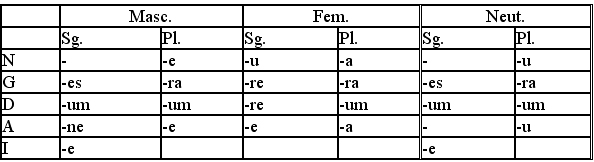
As for weak adjectives, they also exist in the language. The thing is that one need not learn by heart which adjective is which type - strong or weak, as you should do with the nouns. If you have a weak noun as a subject, its attributive adjective will be weak as well. So - a strong adjective for a strong noun, a weak adjective for a weak noun, the rule is as simple as that.
Thus if you say "a black tree" that will be blжc trйow (strong), and "a black eye" will sound blace йage. Here is the weak declension example (blaca - black):
Sg.
Pl.
Masc.
Neut. Fem.
N
blaca blace
blace blacan
G
blacan blacan
blacan blжcra
D
blacan blacan
blacan blacum
A
blacan blace
blacan blacan
Weak declension has a single plural for all genders, which is pleasant for those who don't want to remeber too many forms. In general, the weak declension is much easier.
The last thing to be said about the adjectives is the degrees of comparison. Again, the traditional Indo-European structure is preserved here: three degrees (absolutive, comparative, superlative) - though some languages also had the so-called "equalitative" grade; the special suffices for forming comparatives and absolutives; suppletive stems for several certain adjectives.
The suffices we are used to see in Modern English, those -er and -est in weak, weaker, the weakest, are the direct descendants of the Old English ones. At that time they sounded as -ra and -est. See the examples:
earm
(poor) - earmra - earmost
blжc (black)
- blжcra - blacost
Many adjectives changed the root vowel - another example of the Germanic ablaut:
eald
(old) - ieldra - ieldest
strong - strengra - strengest
long - lengra - lengest
geong
(young) - gingra - gingest
The most widespread and widely used adjectives always had their degrees formed from another stem, which is called "suppletive" in linguistics. Many of them are still seen in today's English:
gуd
(good) -
betera - betst (or sйlra
- sйlest)
yfel
(bad) - wiersa - wierest
micel
(much) - mбra - mбйst
lэtel
(little) - lж'ssa - lж'st
fear
(far) - fierra - fierrest, fyrrest
nйah (near)
- nйarra - nнehst,
nэhst
ж'r
(early) -
ж'rra - ж'rest
fore
(before) - furюra - fyrest
(first)
Now you see what the word "first" means - just the superlative degree from the adjective "before, forward". The same is with nнehst from nйah (near) which is now "next".
Old English affixation for adjectives:
1.
-ede
(group "adjective stem + substantive stem") - micelhйafdede
(large-headed)
2. -ihte
(from substantives with mutation) - юirnihte
(thorny)
3. -ig
(from substantives with mutation) - hбlig
(holy), mistig
(misty)
4. -en, -in
(with mutation) - gylden
(golden), wyllen
(wуllen)
5. -isc
(nationality) - Englisc, Welisc,
mennisc (human)
6. -sum
(from stems of verbs, adjectives, substantives) - sibbsum
(peaceful), hнersum
(obedient)
7. -feald
(from stems of numerals, adjectives) - юrнefeald
(threefold)
8. -full
(from abstract substantive stems) - sorgfull
(sorrowful)
9. -lйбs
(from verbal and nominal stems) - slжplйбs
(sleepless)
10. -lнc
(from substantive and adjective stems) - eorюlнc
(earthly)
11. -weard
(from adjective, substantive, adverb stems) - inneweard
(internal), hбmweard
(homeward)
The Old English Pronoun.
Pronouns were the only part of speech in Old English which preserved the dual number in declension, but only this makes them more archaic than the rest parts of speech. Most of pronouns are declined in numnber, case and gender, in plural the majority have only one form for all genders.
We will touch each group of Old English pronouns and comment on them.
1.Personal
pronouns 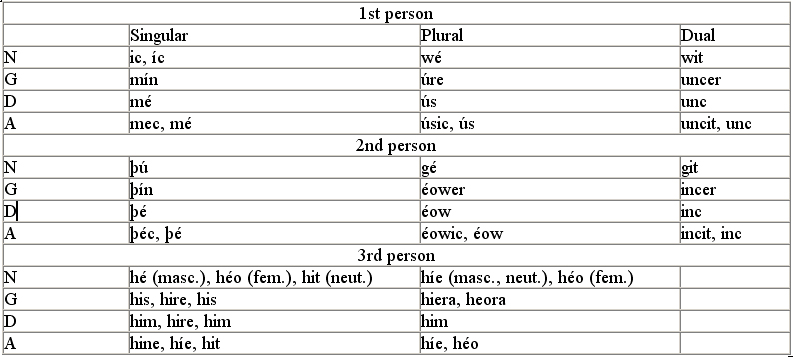
Through the last 1500 years mнn became mine, gй turned into you (ye as a colloquial variant). But changes are still significant: the 2nd person singular pronouns disappeared from the language, remaining only in poetic speech and in some dialects in the north of England. This is really a strange feature - I can hardly recall any other Indo-European language which lacks the special pronoun for the 2nd person singular (French tu, German du, Russian ty etc.). The polite form replaced the colloquial one, maybe due to the English traditional "ladies and gentlemen" customs. Another extreme exists in Irish Gaelic, which has no polite form of personal pronoun, and you turn to your close friend the same way as you spoke with a prime minister - the familiar word, translated into French as tu. It can sound normal for English, but really funny for Slavic, Baltic, German people who make a thorough distinction between speaking to a friend and to a stranger
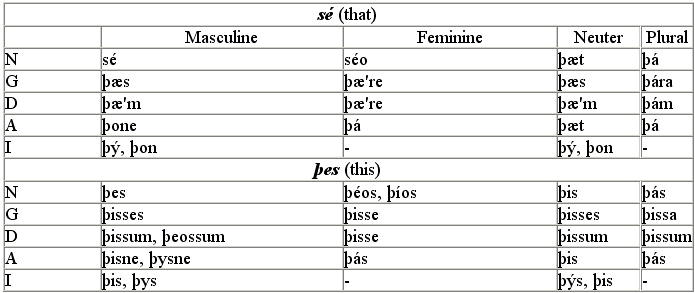
2. Demonstrative pronouns ('I' means the instrumental case)
3. Interrogative pronouns
N hwб
hwжt
G hwжs hwжs
D
hwж'm hwж'm
A hwone hwжt
I -
hwэ, hwн
These pronouns, which actually mean the masculine and the neuter varieties of the same pronoun, derive from Proto-Indo-European *kwis, with *kw becoming hw in Germanic languages. In Gothic the combination hw was considered as one sound which is another proof that the Indo-European the labiovelar sound kw was a single sound with some specific articulation.
Later Germanic languages changed the sound in a different way: in Norwegian it remained as hv, in German turned into w (as in wer 'who', was 'what'), in English finally changed into wh pronounced in most cases [w], but somewhere also like [h] or [hw].
Interesting that the instrumental of the word hwжt, once being a pronoun form, later became the word why in English. So 'why?' is originally an instrumental case of the interrogative pronoun.
Other interrogative pronouns, or adverbs, as they are sometimes called, include the following, all beginning with hw:
hwilc
'which?' - is declined as the strong adjective (see adjectives
above)
hwonne
'when?' - this and following are not declined, naturally
hwж'r
'where?'
hwider
'whither?'
hwonan
'whence?'
4. Other kinds of pronouns
They include definite, indefinite, negative and relative, all typical for Indo-European languages. All of them still exist in Modern English, and all of them are given here:
a)
definite
gehwб
(every) - declined the same way as hwб
gehwilc
(each),
жgюer
(either),
ж'lc
(each),
swilc
(such) - all declined like strong adjectives
sй
ylca (the same) - declined like a
weak adjective
b)
indefinite
sum
(some),
ж'nig
(any) - both behave the same way as strong adjectives
c) negative