The history of Old English and its development
d)
relative
юe
(which, that)
sйюe
(which, that) - they are not declined
In Proto-Indo-European and in many ancient Indo-European languages there was a special kind of declension calleed pronominal, using only by pronouns and opposed to the one used by nouns, adjectives and numerals. Old English lost it, and its pronouns use all the same endings as the nouns and adjectives. Maybe the only inflection which remembers the Proto-language times, is the neuter nominative -t in hwжt and южt, the ancient ending for inanimate (inactive) nouns and pronouns.
The Old English Numeral.
It
is obvious that all Indo-European languages have the general trend of
transformation
from the synthetic (or inflectional) stage to the analytic one. At least for the latest 1,000 years this trend could be observed in all branches of the family. The level of this analitization process in each single language can be estimated by several features, their presence or absence in the language. One of them is for sure the declension of the numerals. In Proto-Indo-European all numerals, both cardinal and ordinal, were declined, as they derived on a very ancient stage from nouns or adjectives, originally being a declined part of speech. There are still language groups within the family with decline their numerals: among them, Slavic and Baltic are the most typical samples. They practically did not suffer any influence of the analytic processes. But all other groups seem to have been influenced somehow. Ancient Italic and Hellenic languages left the declension only for the first four cardinal pronouns (from 1 to 4), the same with ancient Celtic.
The Old English language preserves this system of declension only for three numerals. It is therefore much easier to learn, though not for English speakers I guess - Modern English lacks declension at all.
Here
is the list of the cardinal numerals: 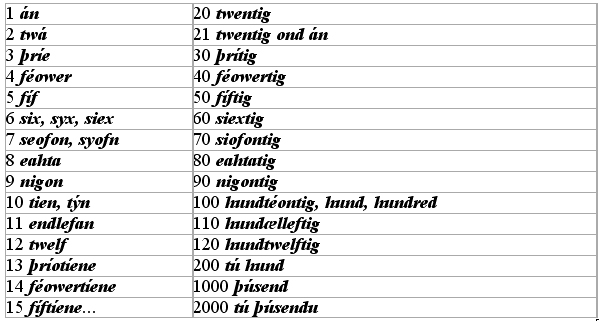
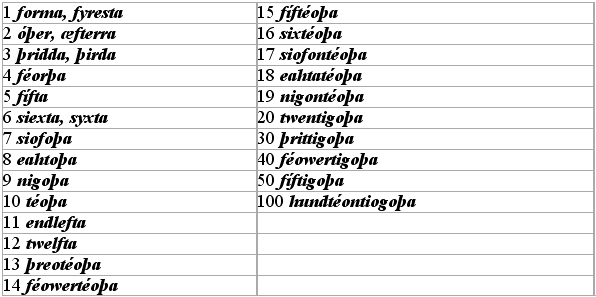
Ordinal numerals use the suffix -ta or -юa, etymologically a common Indo-European one (*-to-).
The Old English Adverb.
Adverbs can be either primary (original adverbs) or derive from the adjectives. In fact, adverbs appeared in the language rather late, and eraly Proto-Indo-European did not use them, but later some auxiliary nouns and pronouns losing their declension started to play the role of adverbial modifiers. That's how thew primary adverbs emerged.
In Old English
the basic primary adverbs were the following ones:
юa
(then)
юonne
(then)
юж'r
(there)
юider
(thither)
nъ
(now)
hйr
(here)
hider
(hither)
heonan
(hence)
sуna
(soon)
oft
(often)
eft
(again)
swб
(so)
hwнlum
(sometimes).
Secondary adverbs originated from the instrumental singular of the neuter adjectives of strong declension. They all add the suffix -e: wide (widely), dйope (deeply), fжste (fast), hearde (hard). Another major sugroup of them used the suffixes -lнc, -lнce from more complexed adjectives: bealdlнce (boldly), freondlнce (in a friendly way).
Adverbs, as well as adjectives, had their degrees of comparison:
wнde
- wнdor - wнdost (widely
- more widely - most widely)
long
- leng (long - longer)
feorr
(far) - fierr
sуfte
(softly) - sйft
йaюe
(easily) - нeю
wel
(well) - betre - best
yfele
(badly) - wiers, wyrs - wierst
micele (much)
- mбre - mж'st
The Old English Verb.
Old English system had strong and weak verbs: the ones which used the ancient Germanic type of conjugation (the Ablaut), and the ones which just added endings to their past and participle forms. Strong verbs make the clear majority. According to the traditional division, which is taken form Gothic and is accepted by modern linguistics, all strong verbs are distinguished between seven classes, each having its peculiarities in conjugation and in the stem structure. It is easy to define which verb is which class, so you will not swear trying to identify the type of conjugation of this or that verb (unlike the situation with the substantives).
Here is the table which is composed for you to see the root vowels of all strong verb classes. Except the VII class, they all have exact stem vowels for all four main forms:

Now let us see what Old English strong verbs of all those seven classes looked like and what were their main four forms. I should mention that besides the vowel changes in the stem, verbal forms also changed stem consonants very often. The rule of such changes is not mentioned practically in any books on the Old English language, though there is some. See for yourselves this little chart where the samples of strong verb classes are given with their four forms:
Infinitive,
Past singular, Past plural, Participle II (or Past Participle)
Class I
wrнtan
(to write), wrбt, writon,
writen
snнpan
(to cut), snбю, snidon,
sniden
Other examples: belнfan
(stay), clнfan
(cling), ygrнpan
(clutch), bнtan
(bite), slнtan
(slit), besmнtan
(dirty), gewнtan
(go), blнcan
(glitter), sнcan
(sigh), stнgan
(mount), scнnan
(shine), бrнsan
(arise), lнюan
(go).
Class II
bйodan
(to offer), bйad, budon,
boden
cйosan
(to choose), cйas,
curon, coren
Other examples: crйopan
(creep), clйofan
(cleave), flйotan
(fleet), gйotan
(pour), grйotan
(weep), nйotan
(enjoy), scйotan
(shoot), lйogan
(lie), brйowan
(brew), drйosan
(fall), frйosan
(freeze), forlйosan
(lose).
Class III
III a) a nasal consonant
drincan
(to drink), dranc, druncon, druncen
Other: swindan
(vanish), onginnan
(begin), sinnan
(reflect), winnan
(work), gelimpan
(happen), swimman
(swim).
III b) l +
a consonant
helpan
(to help), healp, hulpon, holpen
Other: delfan
(delve), swelgan
(swallow), sweltan
(die), bellan
(bark), melcan
(milk).
III c) r, h
+ a consonant
steorfan
(to die), stearf, sturfon, storfen
weorюan (to
become), wearю, wurdon, worden
feohtan (to
fight), feaht, fuhton, fohten
More: ceorfan
(carve), hweorfan
(turn), weorpan
(throw), beorgan
(conceal), beorcan
(bark).
Class IV
stelan
(to steal), stж'l, stж'lon,
stolen
beran
(to bear),
bж'r, bж'ron, boren
More: cwelan
(die), helan
(conceal), teran
(tear), brecan
(break).
Class V
tredan
(to tread), trж'd,
trж'don, treden
cweюan
(to say), cwж'ю,
cwж'don, cweden
More: metan
(measure), swefan
(sleep), wefan
(weave), sprecan
(to speak), wrecan
(persecute), lesan
(gather), etan
(eat), wesan
(be).
Class VI
faran
(to go), fуr, fуron,
faren
More:
galan
(sing), grafan
(dig), hladan
(lade), wadan
(walk), dragan
(drag), gnagan
(gnaw), bacan
(bake), scacan
(shake), wascan
(wash).
Class VII
hбtan
(to call), hйt, hйton,
hбten
feallan
(to fall), feoll,
feollon, feallen
cnйawan
(to know), cnйow, cnйowon,
cnбwen
More: blondan
(blend), ondrж'dan
(fear), lбcan
(jump), scadan
(divide), fealdan
(fold), healdan
(hold), sponnan
(span), bйatan
(beat), blуwan
(flourish), hlуwan
(low), spуwan
(flourish), mбwan
(mow), sбwan
(sow), rбwan
(turn).
So the rule from the table above is observed carefully. The VII class was made especially for those verbs which did not fit into any of the six classes. In fact the verbs of the VII class are irregular and cannot be explained by a certain exact rule, though they are quite numerous in the language.
Examining verbs of Old English comparing to those of Modern English it is easy to catch the point of transformation. Not only the ending -an in the infinitive has dropped, but the stems were subject to many changes some of which are not hard to find. For example, the long н in the stem gives i with an open syllable in the modern language (wrнtan > write, scнnan > shine). The same can be said about a, which nowadays is a in open syllables pronounced [ж] (hladan > lade). The initial combination sc turns to sh; the open e was transformed into ea practically everywhere (sprecan > speak, tredan > tread, etc.). Such laws of transformation which you can gather into a small table help to recreate the Old word from a Modern English one in case you do not have a dictionary in hand, and therefore are important for reconstruction of the languages.
Weak verbs in Old English (today's English regular verbs) were conjugated in a simpler way than the strong ones, and did not use the ablaut interchanges of the vowel stems. Weak verbs are divided into three classes which had only slight differences though. They did have the three forms - the infinitive, the past tense, the participle II. Here is the table.
Class I
Regular verbs
Inf.
Past
PP
dйman
(to judge), dйmde, dйmed
hнeran
(to hear), hнerde, hнered
nerian (to
save), nerede, nered
styrian
(to stir), styrede, styred
fremman
(to commit), fremede, fremed
cnyssan (to
push), cnysede, cnysed
When the suffix is preceded by a voiceless
consonant the ending changes a little bit:
cйpan
(to keep), cйpte, cйpt
/ cйped
grйtan
(to greet), grйtte,
grйt / grйted
If the verb stem ends in consonant plus d or t:
sendan
(to send), sende, send / sended
restan
(to rest), reste, rest / rested
Irregular
sellan
(to give), sealde, seald
tellan
(to tell), tealde, teald
cwellan
(to kill), cwealde, cweald
tж'can
(to teach), tбhte, tбht
rж'can
(to reach), rбhte, rбht
bycgan
(to buy), bohte, boht
sйcan
(to seek), sуhte, sуht
wyrcan (to
work), worhte, worht
юencan (to
think), юуhte, юуht
bringan
(to bring), brуhte, brуht
Other examples of the I class weak verbs just for your interest: berian (beat), derian (harm), erian (plough), ferian (go), herian (praise), gremman (be angry), wennan (accustom), clynnan (sound), dynnan (resound), hlynnan (roar), hrissan (tremble), sceююan (harm), wecgean (move), fйran (go), lж'ran (teach), drжfan (drive), fэsan (hurry), drэgean (dry), hнepan (heap), mйtan (to meet), wэscean (wish), byldan (build), wendan (turn), efstan (hurry). All these are regular.
Class II
macian
(to make), macode, macod
lufian (to
love), lufode, lufod
hopian
(to hope), hopode, hopod
Tis class makes quite a small group of verbs, all of them having -o- before the past endings. Other samples: lofian (praise), stician (pierce), eardian (dwell), scйawian (look), weorюian (honour), wundrian (wonder), fжstnian (fasten), mжrsian (glorify).
Class III
habban
(to have), hжfde, hжfd
libban
(to live), lifde, lifd
secgan (to
say), sжgde, sжgd
hycgan
(to think), hogde, hogod
юrйagan
(to threaten), юrйade,
юrйad
smйagan
(to think), smйade,
smйad
frйogan
(to free), frйode, frйod
fйogan
(to hate), fйode, fйod
Old English verbs are conjugated having two tenses - the Present tense and the Past tense, and three moods - indicative, subjunctive, and imperative. Of these, only the subjunctive mood has disappeared in the English language, acquiring an analytic construction instead of inflections; and the imperative mood has coincided with the infinitive form (to write - write!). In the Old English period they all looked different.
The common table of the verb conjugation is given below. Here you should notice that the Present tense has the conjugation for all three moods, while the Past tense - for only two moods (no imperative in the Past tense, naturally). Some more explanation should be given about the stem types.
In fact all verbal forms were generated in Old English from three verb stems, and each verb had its own three ones: the Infinitive stem, the Past Singular stem, the Past Plural stem. For the verb wrнtan, for example, those three stems are: wrнt- (infinitive without the ending -an), wrбt- (the Past singular), writ- (the Past plural without the ending -on). The table below explains where to use this or that stem.
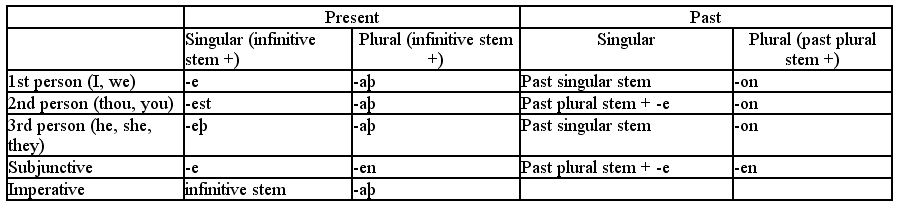
Additionally, the participles (Participle I and Participle II) are formed by the suffix -ende to the Infinitive stem (participle I), or the prefix ge- + the Past Plural stem + the ending -en (Participle II).
Tired of the theory? Here is the preactice. We give several examples of the typical verbs - first strong, then weak, then irregular.
Class I strong - wrнtan
(to write)
Pres.
Past
Ind.
Subj. Imper. ¦
Ind. Subj.
Sg. 1 wrнte
- ¦
wrбt
2 wrнtest
wrнte wrнt
¦ write
} wrнte
3 wrнteю
-
¦ wrбt
Pl. wrнtaю
wrнten 2 wrнtaю ¦
writon writen
Infinitive
Participle
wrнtan
I wrнtende II gewriten
Class II weak - lufian
(to love)
Pres.
Past
Ind.
Subj. Imp.
Ind. Subj.
Sg. 1
lufie
-
lufode
2 lufast }lufie
lufa lufodest
} lufode
3 lufaю
-
lufode
Pl. lufiaю lufien
2 lufiaю lufodon
lufoden
Part.
I lufiende II gelufod
Class III strong - bindan
(to bind)
Pres.
Past
Ind.
Subj. Imp.
Ind.
Subj.
Sg. 1 binde
- ¦ band,
bond
2 bindest } binde
bind ¦ bunde
} bunde
3 bindeю
- ¦ band,
bond
Pl. bindaю binden
bindaю ¦ bundon
bunden
Inf.
Part.
bindan
I bindende II gebunden
Class V strong - sйon
(to see)
Pres.
Past
Ind.
Subj. Imp.
Ind. Subj.
Sg.1 sйo
-
seah
2 sнehst } sйo
seoh sбwe
} sбwe,
3 sнehю
-
seah
sжge
Pl. sйoю
sйon 2 sйoю
sawon sбwen
Participle
I sйonde II gesewen, gesegen
Class VII strong - fуn
(to catch)
Pres.
Past
Ind.
Subj. Imp.
Ind. Subj.
Sg. 1
fу
-
feng
2 fйhst } fу
fуh fenge
} fenge
3 fйhю
-
feng
Pl. fую
fуn 2 fую
fengon fengen
Participle
I fуnde II gefangen, gefongen
Class III weak - secgan
(to say)
Pres.
Past
Ind.
Subj. Imp.
Ind. Subj.
Sg.1
secge
-
sжgde
2 sжgst
}secge sжge
sжgdest }sжgde
3
sжgю
-
sжgde
Pl. secgaю secgen
2 secgaю sжgdon
sжgden
Part.
I secgende II gesжgd
Class III weak - libban
(to live)
Pres.
Past
Ind.
Subj. Imp.
Ind. Subj.
Sg.1
libbe
-
lifde
2 liofast }libbe
liofa lifdest
} lifde
3 liofaю
-
lifde
Pl. libbaю libben
2 libbaю lifdon
lifden
Part.
I
libbende II gelifd
A special group is made by the so-called Present-Preterite verbs, which are conjugated combining two varieties of the usual verb conjugation: strong and weak. These verbs, at all not more than seven, are nowadays called modal verbs in English.
Present-Preterite verbs have their Present tense forms generated from the Strong Past, and the Past tense, instead, looks like the Present Tense of the Weak verbs. The verbs we present here are the following: witan (to know), cunnan (can), юurfan (to need), dearan (to dare), munan (to remember), sculan (shall), magan (may).
Present of witan
(= strong Past)
Ind. Subj.
Imp.
Sg. 1 wбt
-
2 wast
} wite wite
3 wбt
-
Pl. witon 2
witen witaю
Past (= Weak)
Ind.
Subj.
Sg.1 wisse, wiste
2 wissest,
wistest } wisse, wiste
3 wisse,
wiste
Pl. wisson, wiston
wissen, wisten
Participles: I witende, II
witen, gewiten
cunnan
(can)
Pres.
Past
Ind.
Subj. Ind.
Subj.
Sg. 1 cann
cъюe
2 canst
} cunne cъюest }
cъюe
3
cann
cъюe
Pl. cunnon
cunnen cъюon
cъюen
юurfan
(need)
Sg. 1 юearf
юorfte
2 юearft
} юurfe юorftest
} юorfte
3
юearf
юorfte
Pl. юurfon
юurfen юorfton
юorften
magan
(may)
Sg. 1 mжg
meahte mihte, mihten
2 meaht } mжge meahtest
3 mжg
meahte
Pl. magon
mжgen meahton
The main difference of
verbs of this type in modern English is their expressing modality,
i.e. possibility, obligation, necessity. They do not require the
particle to
before the infinitive which follows them. In Old English in general
no verb requires this particle before the infinitive. In fact, this
to before
the infinitive form meant the