The History of Alaska (история Аляски)
 uch
of Alaska is managed by corporations called ANCSA, or native,
corporations, of which there are thirteen regional ones and dozens of
local ones.
Alaska has no counties in the sense used in the rest of the country; however, the state is divided into 27 census areas and boroughs. The difference between boroughs and census areas is that boroughs have an organized area-wide government, while census areas are artificial divisions defined by the United States Census Bureau.
Business.
A laska's
main agriculture output is seafood, although nursery stock, dairy
products, vegetables, and livestock are produced and used internally.
Manufacturing is limited, with most foodstuffs and general goods
imported from elsewhere. Employment is primarily in government and
industries such as natural resource extraction, shipping, and
transportation. There is also a small but growing service and tourism
sector. Its industrial outputs are crude petroleum, natural gas,
coal, gold, precious metals, zinc and other mining, seafood
processing, timber and wood products.
Transport.
Alaska has various transportation options. Some of Alaska is connected by roads (and sometimes a tunnel) to the highways of Canada and of the rest of the United States. These places are "on the road system". Along the Pacific Ocean, many places have freight and passenger service from ocean-going ships. Most places have air service, ranging from jets on tarmac to floatplanes on lakes.
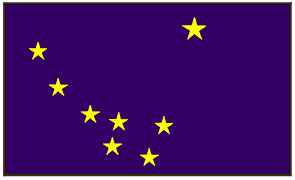
4. The most important dates in the history of Alaska.
August 21
- In 1732, a Russian expedition under
surveyor Mikhail Gvozdev sights
the Alaska mainland at Cape Prince
of Wales.
July 16
- In 1741, Vitus Bering, on St. Elias Day, sights the Alaskan
mainland. In honour of the saint, the most
prominent peak was named; this was the first point
on the northwest coast named by Europeans.
December 8
- In 1741, Vitus Bering died after his ship was wrecked on an
island off the Alaskan coast.
September 25
- In 1745, a Russian fur hunter, Mikhail Nevodchikov, reaches
Attu in his search for sea otters.
May 12
- In 1778, Captain James Cook entered Prince William Sound.
May 26
- In 1778, Captain James Cook entered Cook Inlet.
August 25
- In 1778, Captain James Cook turned back south
July
- In 1786, while charting Lituya Bay, 2 small boats are
swamped by rip tides, and 21 French sailors drown.
July 8
- In 1799, the Russian American Company is formed by Royal
Charter; they were given a 20-year monopoly on
trading on the coast from 55 degrees north.
March
- In 1812, the Russian American Company establishes a post at
Fort Ross, California to grow crops for their Alaska.
September
- In 1848, the Hudson's Bay Company builds Fort Selkirk, at
the confluence of the Pelly and Yukon Rivers.
- In 1852, Fort Selkirk is destroyed by a group of Tlingits who
objected to the Hudson's Bay Company trying to
break the Tlingit monopoly on trade with the
interior tribes.
M arch
30
- In 1867, the United States purchased Alaska for
$7,200,000
July 23
- In 1867, Alaska's first post office is authorized, to
be opened at Sitka.
October 18
- In 1867, official ceremonies at Sitka transferred
Alaska from Russia to the United States.
July 27
- In 1868, the Customs Act is amended to include Alaska.
October 7
- In 1869, the prediction of a total solar eclipse by American
scientist George Davidson so impressed Kohklux,
chief of the Chilkat Indian village of Klukwan, he
drew him an incredibly detailed map of a vast part
of the interior of the Yukon and Alaska.
- In 1871, of the 41 whaling ships hunting in the Bering Sea,
32 are trapped by early ice; all of the 1,200 people
on the ships escaped, but 31 of the ships were
destroyed the following spring.
August
- In 1876, twelve whaling ships are trapped by ice near Point
Barrow; 50 men die attempting to reach safety.
July 2
- In 1882, George Krause becomes the first white man
allowed to cross the Chilkat Pass to the interior.
- In 1894, a resolution of the Privy Council authorizes the
North-West Mounted Police into the Yukon "in
the interests of peace and good government, in
the interests also of the public revenue." By June
26, Inspector Charles Constantine and Staff-
Sergeant Charles Brown were at Juneau, heading
for the goldfields of the British Yukon.
October 2
- In 1895, the North-west Territories was divided into the
Districts of Franklin, Mackenzie, Ungava and
Yukon.
August 17
- In 1896, a party consisting of George Carmack, his wife
Kate, Skookum Jim, Tagish Charlie and Patsy
Henderson stake placer gold claims on Rabbit
Creek, and rename the creek Bonanza Creek.
July 14
- In 1897, the Excelsior reaches San Francisco with the first
large shipment of Klondike gold.
July 17
- In 1897, the Portland reached Seattle with a large shipment
of Klondike, turning the excitement caused by the
Excelsior's arrival at San Francisco into an all-out
gold rush.
- In 1898, gold was discovered near the future site of Nome,
triggering a stampede.
- In 1898, a series of 5 avalanches in the Chilkoot Pass between
2:00 AM and noon killed over 70 people.
June 13
- In 1898, the Yukon Territory is created.
July 29
- In 1900, the White Pass & Yukon Route railroad was
completed, with the Golden Spike driven at
Carcross, Yukon.
- In 1900, Congress authorized a massive telegraph construction
project in Alaska.
July 22
- In 1902, Felice Pedroni ("Felix Pedro") discovered gold in
the Tanana Hills, causing a stampede which
resulted in the founding of Fairbanks.
May
- In 1904, the first commercial wireless communication
facility in the U.S. opened, between Nome and St.
Michael.
May 7
- In 1906, the Alaska Delegate Act was passed by Congress,
giving the territory's 40,000 people the right to elect
a non-voting delegate to Congress.
August 24
- In 1912, the Alaska Territorial Act was passed by Congress.
July 3
- In 1913, the first airplane in Alaska made a demonstration
flight at Fairbanks, piloted by James V. Lilly.
March 12
- In 1914, a bill authorizing the construction of the
government-financed Alaska Railroad was signed by
President Wilson. Construction started in 1915, and
some sections were opened as they were completed,
but the entire line, running from Seward to Fairbanks,
was not completed until July 15, 1923.
October 25
- In 1918, the coastal steamer Princess Sophia sunk near
Juneau, killing 463 people, about 10% of the
Yukon's white population.
- In 1919, the Yukon finally allowed women to vote in Territorial
elections. Manitoba had been the first province to
enfranchise women.
July 10
- In 1919, Louis Beauvette staked the first silver claim at Keno
Hill, in the central Yukon; by 1930 this district was
producing 14% of all the silver mined in Canada.
enfranchisement was passed in May 1918.