Quantization error analysis of the quadrature components of narrowband signals
Finally we get, considering formula (11) and the fact that
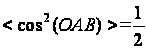

Under the constraint given by formula (12') we get
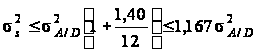 .
The last expression means that the variance of the amplitude error of the signal caused by quantization errors of its quadrature components is practically equal to the variance of the quantization error of the A/D converter.
Phase error analysis of the quantized narrowband signals
The
phase error
 i
of the distorted signal (we measure the phase error by comparing the
input phase with the output phase) can be found from fig. 2.
Actually, from the triangle OBE we get
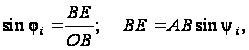 hence
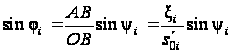 .(17)
Let
us define the limits of the angle
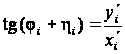
 variation. From the triangle OBF we get
 ,
(18)
and from the triangle OAG we get
 .
(19)
Transforming formula (18) considering the formula (19) we obtain
 . (20)
It
is obvious from formula (20) what the maximum phase error
 will be, provided the value of the inphase component is minimum and
the quantization error
 is maximum, i.e. provided
 .
(21)
Inserting these values into formula (20), we get
 .
(22)
Transforming in the formula (22) the sum of angles [8] we get
 .
(23)
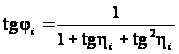
Solving
the equation (23) with respect to
 we get
 .
(24)
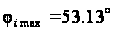
It
is clear that maximum value of the angle
will be, if
 ,
hence
 .(25)
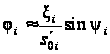
We have found that maximum phase error does not exceed 53°. Therefore we can replace sin in the formula (17) by its argument (with the error less than 10 %)
 .
(26)
The
mean of the phase error
is
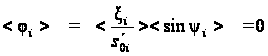 ,
(27)
where
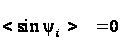 .

The variance of the phase error can be found from formulas (6) and (9)
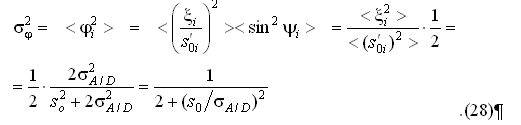
Inserting
the value of
 , given by formula (5) into formula (28), we finally get the phase
variance
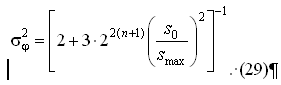
The maximum value of the phase variance will occur if the input signal has the minimum, given by formula (12')
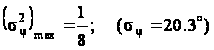 .
Fig.
3 shows a plot of phase variance a against number of A/D converter
bits for various values of ratio
 (solid curves). The computation was carried out in accordance with
formula (29).
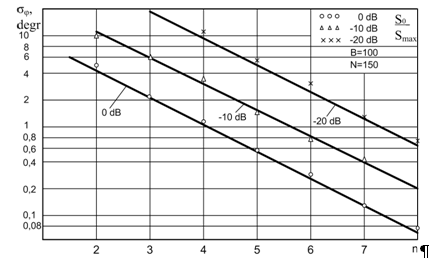
Fig. 3. Standard deviation of the
phase quantization error for different rations
as a function of code word length
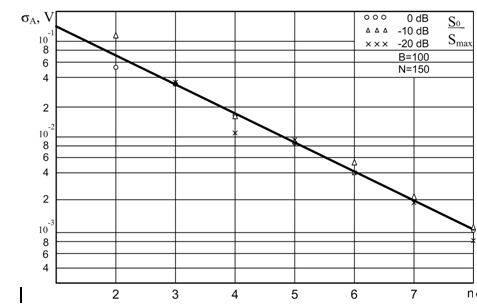
Fig. 4. Standard deviation of the amplitude quantization error as a function of code word length
Сomputer simulation of the roundoff errors of the quadrature components. The computer simulation of the quantizing errors of the quadrature components of the narrowband signal was carried out with the intention to check the validity of the obtained formulas (16) and (29).
The LFM signal with time-compression ratio 100 was chosen as a narrowband signal. Quantization of the inphase and quadrature components was made in accordance with formulas
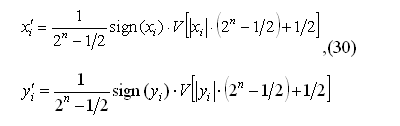
where
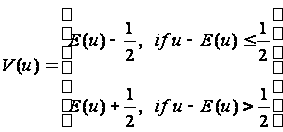 –
operator of quantization.
 is an integer part
of variable u, n is a number of A/D converter bits.
For each sample of the input signal the quantizing values of inphase and quadrature components were defined and then amplitude and phase of the distorted signal were determined according to formulas
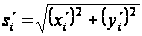 ,
 .
(31)
At the same time the phase of the input signal was computed
 .
The
phase error was then founded as the difference between
 and
 .
These operations were made for 150 samples of the input signal. Then
mean and variance of the amplitude error were defined as well as the
same parameters of the phase error. The achieved results show that
the mean of the amplitude is very close to the amplitude of the input
signal (within 3 %), the mean of phase error is close to zero (in all
cases the mean was less than ± 0,1
 ).
The plots of the phase standard deviation against the number of bits
of the A/D converter are shown in fig. 3 for different rations
s0/smax by points. The plots of the amplitude standard deviation
against number of bits n are shown in fig. The coincidence between
theoretical and simulation results are rather good, which shows the
validity of our assumptions.
Probability
distribution laws of the amplitude and phase errors have also been
evaluated by the means of computer simulation. For this purpose a LFM
signal with time-compression ratio 6 400 was used. Statistical
distributions were estimated with usage of 9 600 samples for inphase
and 9 600 samples for quadrature components. Thirteen points of these
statistical distributions were chosen. The plot of the statistical
distribution law
 of the phase error values is shown in fig. 5 for various numbers of
the A/D converters bits. fig. 6 shows the amplitude error
distribution
 computed for the same case
.
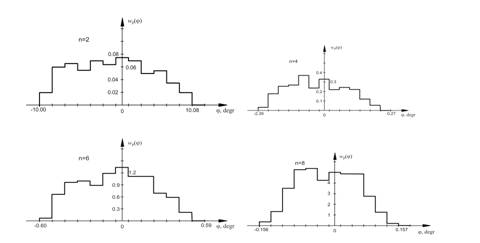
Fig.
5. Probability distribution laws of the phase error for different
word length,

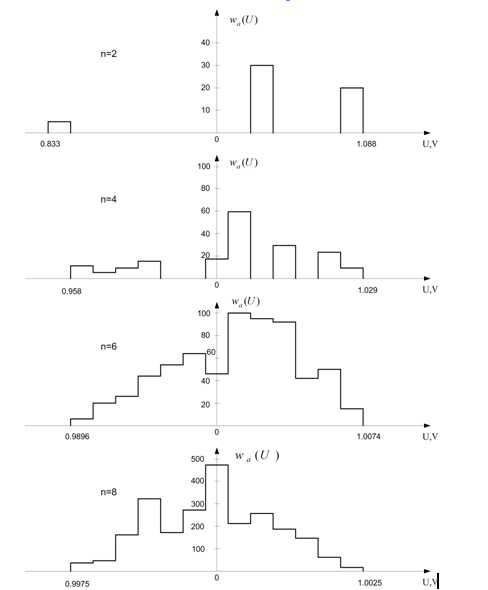
Fig. 6. Probability distribution laws
of the amplitude error for different word-length,
Conclusion
narrowband signal error
The results of theoretical analysis and computer simulation of the amplitude and phase errors of the narrowband signal, caused by quantizing of the signal's inphase and quadrature components show that the mean of the amplitude of the distorted signals remains equal to the input amplitude, but the output amplitude becomes fluctuated with the variance, determined by the variance of D/A converter error. The phase error has zero mean, maximum deviation 53° and a variance which is inversely proportional to the number of quantization levels. The results achieved may be used in digital filters' design.
references
Rabiner, L.R. Theory and Application of Digital Signal Processing / L.R. Rabiner, В. Gold // Englewood Cliffs, NJ. – Prentice-Hall, 2008.
Агеев, Р.В. Логарифмическая дискретизация сигналов с заданной абсолютной погрешностью / Р.В. Агеев, Ю.Н. Овчаров // Автометрия. – 2008. – № 6. – С. 23–27.
Лифшиц, Н.А.Численные характеристики ошибок квантования амплитуды / Н.А. Лифшиц, В.Е. Фарбер // Автоматика и телемеханика. – 2008. – т. 39, № 12. – с. 176–179.
Домрачеев, В.Г. Критерий оценки точности цифровых преобразователей угла / В.Г. Домрачеев, Б.С. Мейко // Измерительная техника. – 2008. – т. 18, № 11. – С. 22–25.
Koffler, H. Quantization and roundoff errors in a digital MTI filter, Siemens Forsch. and Entwicklungsber / H. Koffler. – Germany, 2010 – Vol. 2, № 2. – p. 73–78.
Snipad, A.B. A necessary and sufficient condition for quantization errors to be uniform and white / A.B. Snipad, D.L. Snyder // IEEE Trans, on Acoust. Speech and Sign. Proc.Vol. – ASSP-25. – 2007. – № 5 (Oct.) – p. 442–448.
O'Neal, Iz. Digital encoding of phase shift keying voiceband data signals / Iz. O 'Neal, R.R. Koneru, I.P. Agrawal // Conf. record of Int. Conf. on Acoustics Speech and Signal processing, ICASSP-80. Denver. Co. – 2010. – April 9–11. – P. 315–318.
Dvite, G.B. Tables of Integrals and Other Mathematical Data / G.B. Dvite // The Mac Millan Company. – N.Y., 2011. – 634 p.
Размещено на
15