Development of technology of crude smoked sausage
Smoked sausages become acute, pleasant taste and smell, dark red and glossy surface. As a result of penetration into the product of some factions of smoke, especially phenols and organic acids with high bactericidal and bacteriostatic action, suppresses the development of putrefactive microflora increases the shelf life of sausages.
Distinguish between cold and hot smoked sausages. Cold smoking is carried out at 18-220S for 2-3 days. It provides the greatest durability of products during storage. Subjected to cold-smoked summer sausage. Duration of smoking, depending on temperature and type of smoked sausage is from 1 to 48 h.
After precipitation smoked sausage in the cells with the smoke from the sawdust of solid hardwood (beech, oak, alder, etc.) within 2 ... 3 days at 20 ± 2 ˚ C, relative humidity of 77 ± 3% and its speed 0.2 ... 0.5 m / sec.
The process of smoking should continually monitor to avoid temper - compacted surface layer.
If smoking is undergoing considerable loss of moisture - in the summer sausages in cold-smoked for 4 days, they are 12-14%. There is evidence that prolonged storage of products smoke has a negative effect on fats. Heavily smoked sausage, depending on conditions become pungent taste of tar and phenol, which increased with further storage. Apparently, this causes a change in the substances contained in smoke. Found that when smoking smoked sausages reduced flexibility and ability moisture containing mince; significantly reduced stickiness meat, which indicates a change in denaturation of proteins in the process of smoking.
Drying.
This operation completes the technological cycle of dry sausage. As a
result, lowering the mass fraction of moisture and increasing the
mass fraction of salt and smoking materials increases the stability
of meat products to the action of putrefactive microorganisms. In
addition, the concentration of dry nutrients in the finished product,
improving the conditions for its storage and transportation.
Sausage, dried 5 ... 7 days a dryer at 13 ± 2 ˚ C,
relative humidity of 82 ± 3% and its velocity of 0.1 m / s.
dried on hatrack 25-30 days depending on the diameter of the shell.
Further drying pass for 20 ... 23 days at 11 ± 1 ˚ C,
relative humidity of 76 ± 2% and air velocity of 0.05 ... 0.1
m / sec. The total drying time of 25 ... 30sut depending on the
diameter of the shell; tourist sausages 5 ... 8 days.
When cooking sausages in synthetic protein coat drying time increases by 10 - 15 days compared with the sausage in natural casing. When drying is not permitted the strong air currents.
For uniformity of drying should be picked loaves of the same diameter. Air conditioners and other devices should provide in the drying chambers to the desired temperature and humidity.
Sausage is dried in drying chambers under certain temperature and humidity in which the capacity of each chamber must meet the daily performance of the shop, but their number - the number of days of drying. To maintain the regime of drying using air conditioners. Hang or frame on which hang sausages, place in several stages depending on the height of the room. Between long loafs leave gaps for air circulation.
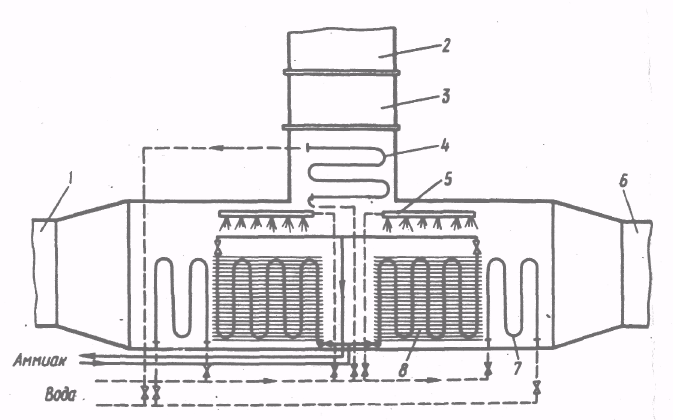
1 - the lower chamber for air, 2 - Top Breather, 3 - Fan, 4, 7 - additional heaters, 5 - a conduit for irrigation with warm water, 6 - chamber air supply, 8 – Evaporator
Fig. 2. Drying. Device for production of crude smoked sausage
Packaging, labeling, transportation and storage. Bulk transportation of meat products leads to a decrease in their quality, strain loaves, long loading of vehicles. For storage and transportation of meat products are packaged in clean, tight boxes or barrels of dry wood and kept in a dry and dark place or refrigerator. Be stored sausages, peppered with dry sawdust. Tara should have the cover be dry, clean and free of mold and unwanted odors.
The temperature of smoked sausages before placing in containers should be 0-120 0C. In each box or barrel packed sausages one name.
When marking packaging indicates the product, the manufacturer, date of manufacture, standard.
Transported sausages all modes of transport in accordance with the rules of cargo transportation.
Length of storage of raw sausages: at temperatures of 12-15 0C and a relative humidity of 75-78% - less than 4 months, at a temperature of -2 to -4 0C - no more than 4 months, at a temperature of -7 to -9 0C - no more than 9 months.
The second way
On the thread-mechanized lines recommended manufacturing grainy, Maikop, Moscow, Nevsky, sausage, Soviet, the capital of sausage and tourist sausages according to Fig. 1.
Preparation of raw materials. Trimmed beef, pork chunks and strips of bacon were frozen in aluminum basins or on trays layer thickness not exceeding 10cm in the freezer to a temperature in the thickness of a piece or block of -3 ± 2 ˚ C for 8 ... 12 hours or on the unit for light freezing meat and bacon followed by the alignment of the temperature in the chamber-drive around the block to the volume of 2 ± 1 ˚ C.
Frozen blocks trimmed beef and pork before processing is warmed to -3 ... -2 ˚ C. It is recommended to pre-crush on machines for grinding meat blocks into pieces of thickness 20 ... 50 mm.
Preparation of meat. Carried out on the cutter, designed for crushing frozen meat. After crushing large chunks of beef or lean pork in about 0.5 ... 1.0 min, table salt, spices and brandy or Madeira, 10g of sodium nitrite as a 5% solution, bold or fatty pork and continue to cutter 0.5 ... 1.0 min. Then add the lard or bacon and ground still 0.5 ... 1.5 min. The total duration of grinding 1.5 ... 3.5min.
End of cuttering determined by drawing mince; it is relatively uniform in size slices of bacon, bacon or pork fat should be evenly distributed. Temperature of meat after cuttering -2 ± 1 ˚ C. The load factor Cutter 0.4 ... 0.5.
Allowed for cooking meat use a mixture comprising not less than 50% of the frostbitten flesh and no more than 50% of salted meat. In this case, the cutter initially charged with first frostbitten shredded beef and pork, then seasoned in salting meat pieces.
The process is then performed as described above (Fig. 1).
Filling shells with minced meat. Ground cutter with handling the device or the cart is fed into a vacuum press. After the appropriate seals and vacuum is filled with minced meat sliding hollow cylinder capacity of 60 dm3. Cylinders with minced special mechanism established by a syringe device that produces a filling shells with minced meat. The process of dressing sticks similar to a method.
Heat treatment. Includes sediment, smoking and drying. These processes are similar to the first method.
Packaging, labeling and storage. Summer sausage packed in wood, plastics and aluminum multi-boxes, crates or containers made of other materials, as well as special container or packaging-equipment.
Containers for sausages must be clean, dry and free of mold and unwanted odors. Reusable packaging should have the cover.
Smoked sausage produced by weight or packaged in colorfully decorated cardboard box, net weight not exceeding 2 kg. Travel sausages produced weight or packed in cartons, net weight of 250 ... 500. Bags packed with smoked sausages the same name, grade and date of manufacture is placed in corrugated containers, multi-containers, specialized containers or packaging equipment. Net Weight of packaged meat products in the boxes should not exceed 20 kg.
Allowed the implementation of packaged smoked sausages in plastic multi-boxes with a gross mass not exceeding 30 kg, and in special containers and packaging - equipment, net weight not exceeding 250 kg.
Crude smoked sausage produced with temperatures in the interior of the stick 0 ... 12 ˚ C. Implementing weighted sausage at retail level should be carried out in the presence of information data on food and energy values. Sausage stored at 12 ... 15 ˚ C and relative humidity 75 ... 78% less than 4 months, with -2 ... -4 ˚ C for up to 6 months, with 7 ... -9 ˚ C ≤ 9 months.
3 The Production technology of the dry fermented sausage
The Dry fermented sausage is meat product, consisting from has overtaken meat with visible particles of fat which as a result combined a fermentation and drying gets such typical properties, as ability to threading on slices, color, taste and safety.
Process of acidification is essential to maintenance of firmness of a product in storage, for maintenance of color and flavor formation, but, besides, he is equally important for gelatinization salt soluble meat proteins. Acidification is caused by transformation of carbohydrates under the influence of the microbes naturally present at meat or entered into a compounding to dairy acid.
Manufacture of the dry fermented sausages is the ancient art which has arisen, basically, as a way of conservation. There is a set of regional distinctions both in used components, and in technology, the form and flavoring qualities of sausages. On this slide the assortment of this production is presented: salyami the big diameter, mini-sapami, the hunting sausage, sticks to beer, Milan sausage; Pepperoni; Spanish; Choriza; Salshishon, and also rural ring sausage.
Components: In manufacture of the dry fermented sausages following components are used: low-fat meat, fat or fat meat, sugar, salt, nitrate and nitrite, squirrels «Purin500Е», ascorbic acid, seasonings and ferments. It is possible to enter also the chemical compounds promoting process of a fermentation, for example, gluconodeltalicton.
A component used in manufacture of dry sausages, protein «Purin 500Е». Using correct technology it is possible to improve profitability of manufacture, raising exits at simultaneous decrease in expenses, and also to achieve favorable influence on a structure of a ready product, improving linkage between fat and meat particles at protein application «Purin500Е» [12]. Drying time Besides, decreases.
By tradition fermentation process in manufacture of dry sausages developed naturally under the influence of the bacteria which are present at used meat and fatty raw materials. However this process slow. He isn't free from certain degree of risk as he is difficult for supervising.
At introduction of the accelerated technologies began to use ferments. These bacterial ferments of industrial production are issued in the form of a broth, or contain sublimation bacterial cages which become again active after hydration by water and at the subsequent introduction in meat (Table 1).
Table 1
Influence components of meat on the quality of raw sausages.
|
Salts Dissolves salt-soluble meat proteins. Helps maintain quality. Promotes taste formation |
Nitrit-Nitrate nitrate should be reduced to a nitrite Nitrite is a source of NO. Nitrozomioglobin is stable color. |
|
Ascorbic acid Accelerator salting. Antioxidant. |
Seasonings Various possibilities Example: large grinding pepper Sweet paprika |
|
Sugar Impact on taste. Provide protection for fermenting bacteria. Glucose, lactose, oligosaccharides. |
Sourdough Broth Dehydrated |
In the fermentation process involved the following types of bacteria: lactobacilli, micrococcus, pediokokki.Прослушать
На латинице
3.1 Technological chart of dry fermented sausage
Every type of sausages is differs by speciphic operations of preparation raw materials. Manufacture of dry enzymatic sausages consists from follow stages:




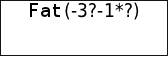
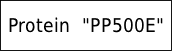



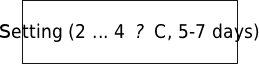

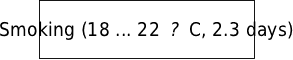




Fig. 3 Technological scheme of the enzymatic crude smoked sausage.
3.2 Technological line for dry enzymatic sausage production
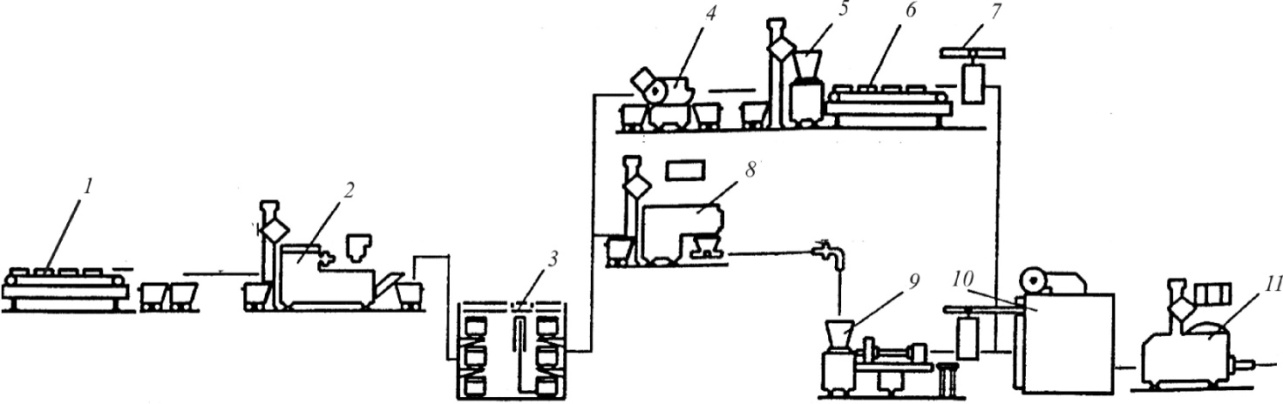
1,6- conveyor table; 2- brining unit; 3- cell maturation; 4- cup-shaped cutter; 5- syringe machine; 7- sausage frame; 8- sausages unit; 9- heat chamber; 10- smoking device.
Fig. 4 Technological line for dry enzymatic sausage production
After defrosting the meat is sent to the trimming section: where connective tissue, blood and lymph vessels, cartilage, small stones and dirt are removed. 1. Then meat is cut into the small pieces and frozen lightly.
Salting of chopping meat