Planning of mobile complete set for a rural wind generator
From the rated power of the generator which is 36W. If the rated voltage is assumed to be 12 V then the rated current of the generator can be calculated from equation 4.1 to be 1A.
Table 4.2 and 4.3 above gives the results of the simulated induced voltages and flux obtained from the generator with commercial and recycled magnets. Using the 1A above as the rated current, the output power of the generator using commercial magnets and recycled loudspeaker magnets is summarized in table 4.5 below. The output power in all the cases is calculated from equation 4.1.
|
Magnet |
Type |
Output Power |
|
Rare-Earth |
NdFeb32 |
28.3W |
|
Alnico |
Alnoco5 |
15.5W |
|
Ceramic |
Ceramic8 |
10.8W |
|
Ceramic |
Speaker magnet |
10.5W |
Table 4.5 The output power of the generator
Chapter 5. Analysis of the generator outputs
In this chapter the author first began by analysing the output power of the generator designed with commercial magnets and the one with recycled loudspeaker magnets. The author then explored the factors that may have affected the outputs from the recycled generator.
The terminal voltage induced from the recycled generator is also explored to view if it can be used in any applications in the rural village. This is done so that the voltage can be evaluated if it is useful or not
Lastly the loudspeaker magnets are investigated to view how they can be used in the recycled generator design; whether they should be smashed and aligned to be re-used in the generator design or if they should be used the way they are without being smashed.
5.1 The estimated output power of the generators
The output power of the generators is estimated from the output induced voltages of the generators. Consequently, this means that the higher the terminal voltage of the generator the larger the output power.
From the theory of magnets it is clear that the induced voltage is directly proportional to the remanent magnetic flux density Br of a magnet. In other words it is expected that rare-earth magnets which posses higher Br will always induce high voltage when used in generators. Therefore it can be said that the type of magnet used in a generator is very important as it determines the output power of the generator.
As can be seen from the results, the induced voltage of the generator with NdFeB magnets from the rare-earth magnet family is higher than that with the AlNiCo and ferrite magnets. This was expected because of the different B-H properties of these magnets.
The recycled generator in this thesis was designed using loudspeaker magnet that is from the ferrite family. These types of magnets are cheap and readily available, but their disadvantage is that they posses low surface flux density. The induced voltage was therefore expected to be much lower than the voltage induced in a generator with NdFeD magnets.
5.2 The rms output flux of the generator
The magnetic flux density in the gap of PM generators is limited by the remanent magnetic flux density of PMs and saturation magnetic flux density of ferromagnetic core. Hence, the simulated value of output flux is directly proportional to the remanent magnetic flux. In addition, permanent magnet machine cannot normally produce the high flux density of a wound pole rotor.
5.3 Factors that may have affected the recycled generator outputs
There are many factors that should be taken in consideration with regards to the induced voltage from the recycled generator. Some magnetic deterioration may have occurred after the magnets were thrown into the dump. But, due to the magnet’s magnetic permanent properties, these magnets are expected to still have some surface flux density when found in the dumpsites.
This is evidence that any permanent magnet that is found in the dumpsites can be reused in a generator design to induce some voltage, of course depending on their B-H properties.
The estimated properties of the speaker magnets that were used in this thesis were found from the loudspeaker manufacture, clearly these properties will not be the same as the properties of recycled magnets that were found in the rural area of Ga-Rampuru. These recycled magnets have been affected by different conditions such as temperatures, climates, etc.
The exact properties of the recycled magnets can only be found by testing these magnets in the laboratory. For this thesis the author was unable to take the loudspeaker magnets found in the rural area of Ga-Rampuru to the laboratory.
5.4 Applications of voltage from the wind turbine
The induced voltage of the generator will vary with the wind speeds experienced in this village. The generator can be connected to a battery to store the power which can be utilized when there is little or no wind.
If more power is required, the voltage can be boosted by using any economical booster that can convert the output of the recycled generator to at least a minimum of 12V. The voltage from the booster can then be put through a cheap electronic regulator that will only charge the battery if the boosted voltage from the wind generator is sufficient to produce at least 12V direct current.
To power the refrigerator in chapter 1, the store owner in the village will have to purchase an inverter that will convert the DC voltage to AC voltage. The inverter will convert the low-voltage from the battery (12V) into mains-type 230V alternating current.
5.5 Design using speaker magnets
Finally, the author investigated how speaker magnets can be used in the generator design, if they have to be smashed or used as they are.
As already investigated, loudspeaker magnets are commonly from the ferrite magnets family. Ferrite and rare-earth magnets are by nature very hard and brittle. Although they can be cut, drilled and machined this should only be done by individuals who are experienced with ceramics. If the magnets get over about 300 deg F, they will lose their magnetism permanently [17].
Therefore, it will be very difficult for rural artisans to cut these magnets and use them. Due to limited time the author could not investigate if these magnets can be used as they are in the machine.
In the next chapter the author attempts to assemble the wind generator in the laboratory.
Chapter 6. Practical comparison of the generators
6.1 Introduction
The following chapter outlines the steps that were taken in order to assemble the permanent magnet generator discussed in the previous chapters. This is done in order to compare the practical outputs of the generator with the simulated ones. The other reason is to investigate the performance of recyclable magnets with irregular shapes.
This investigation will only concentrate on assembling the generator part of the wind turbine system.
For the construction of the PM generator in this thesis two options were considered, the first was to collect readily available off-shelf materials to assemble a small generator. And the second was to convert an AC induction motor to a PM generator. Both options are discussed in this chapter.
6.2 Materials required to assemble a PM generator
The main idea is to build a portable generator that is easily assembled and constructed in the laboratory. The author first begins with highlighting all the materials that are needed in the construction of this generator. Figure 6.1 gives the schematic of how the generator will look like.
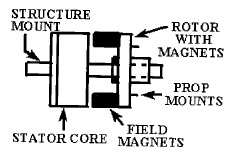
Figure 6.1 Basic wind generator design
From the generator illustrated above it is clear that the following materials will be required in the construction of the generator:
Magnets
Stator and rotor
Rotor mounted on a rotating structure
Structure mound
In the following sections the author will outline steps taken and the challenges faced in collecting these materials.
6.2.1 Magnets used in the generator
In the investigation of the performance of the generator, the author was to begin by designing the generator using standard commercial magnets, which were to be later substituted with recyclable magnets. The recyclable magnets are picked randomly in the dumpsites of Ga-Rampuru village.
Finding commercial magnets for this investigation was a major challenge since for this two-pole generator the author needed to purchase two NdFeb32 magnets, two Alnico5 magnets and two ceramic8 magnets.
6.2.2 Stator and rotor
The rotor rotates with the structure mount while the stator is fixed and mounted to a support structure. Since all these investigations were to be carried out under controlled laboratory conditions a drive and a frequency inverter which are readily available in the laboratory will be used to rotate the rotor at the desired speeds.
The drive will rotate the rotor and the induced voltage from the coils on the stator will be monitored by a voltmeter in the laboratory. Figure 6.2 illustrated this type of drive.
The size of the rotor in this thesis was constrained by the diameter of the recyclable speaker magnets. Therefore steel with this shape had to be found or cut to this shape. After finding the relevant steel, the cylindrical steel has to be drilled at the center.
6.3 Converting an induction motor into a PM generator
Due to the challenges faced in gathering the materials needed to assemble the generator the author then decided to find an alternative method to investigate the performance of the generator using recyclable magnets. A company called Magnetag that supplies motors and generators was approached and after some negotiations the company was willing to donate an AC induction motor to the author.
The idea was to convert this AC induction motor into a permanent magnet generator. This was going to be done by stripping the motor down and replacing the wound rotor with recyclable magnets. This looked like an attractive option since recyclable magnets with any shape can be used in the generator to explore its performance
The author was unable to complete investigating this option in detail. This is strongly recommended for further work most probably at MSc level.
6.4 Challenges faced during the construction of the PM generator
The main challenge in the construction of this wind generator was cost. For the laboratory investigation of the PM generator, a lot of materials, like the magnets and coils on the stator were found to be very expensive. This inadvertently gives more support for the use of recycled materials.
There was a lot of machining needed for this project, the rotor and the stator needed to be cut and shaped to the desired diameter and drilled in the centre to fit on the mount structure. Time was the major constrained since a lot of things were required to be done in the limited time given for this thesis.
However the framework of how to proceed in constructing and assembling the wind generator is already well laid out in this thesis.
Chapter 7. Conclusions
Based on the findings of the report, the following analyses and conclusions were drawn:
7.1 There is an urgent need of electricity
Due to the number of people living without electricity in rural South Africa it is clear that alternative means of supplying these areas is essential. According to ESKOM, all house holds will eventually be electrified, but the problem is, what is happening in the meantime? Where are children’s medicines being stored? Therefore this makes the electrification process extremely urgent.
7.2 Resource assessment
7.2.1Recyclable materials in the village
An extensive assessment on the rural village of Ga-Rampuru was conducted. There are plenty of recyclable materials including old milling machines that are not in use. These materials can be recycled to clean Ga-Rampuru village.
7.2.2 Rural artisans who can assemble the wind turbine
Since there are many local artisans who fix cars, electrical appliances and do some mechanical work in this village, manpower should not a problem. An engineer from the government or Non-governmental organization could educate these local artisans on assembling the wind generator. This will have a positive impact on Ga-Rampuru village as it will encourage people to work and be creative. There are many old wind mills used for pumping water in Ga-Rampuru village, most of these wind mills are working perfectly well supplying sufficient water. This is a clear indication that there is a reliable supply of wind in the village.
7.3 Simulation results
It has been shown that a reasonable amount of power can be realised from a generator using recycled magnets from the dumpsites
7.4 Cost involved in the design
The overall cost of assembling this wind generator system will be very cost effective since all the materials are recycled from the village, and the entire system will be assembled by local artisans.
7.5 Validity of this thesis
Small power that can turn on small lamps will really be appreciated in this village as children will be able to study after sunset. This will clearly have a wide range of positive developmental benefits on this community.
Chapter 8. Recommendations
Based on the above conclusions, the following recommendations were drawn:
For a more accurate recyclable wind turbine design, all its components such as the drum, the tower, rotor disk and cables must be explored in depth. The following must be considered:
Investigate how to extract maximum power from the wind using the drum, and how to prevent the drum from over spinning.
How to use other irregular recyclable magnets in the village in the generator design.
Investigate how a permanent magnet generator topology can be changed or re-designed to accommodate the design of a generator with the shape of the loudspeaker magnets.
Look in to how the magnets can
Если Вам нужна помощь с академической работой (курсовая, контрольная, диплом, реферат и т.д.), обратитесь к нашим специалистам. Более 90000 специалистов готовы Вам помочь.Бесплатные корректировки и доработки. Бесплатная оценка стоимости работы.Нужна помощь в написании работы?Мы - биржа профессиональных авторов (преподавателей и доцентов вузов). Пишем статьи РИНЦ, ВАК, Scopus. Помогаем в публикации. Правки вносим бесплатно.