Synchronization and sommerfeld effect as typical resonant patterns
 ,
 are the amplitude and phase of base oscillations, respectively,
 ,
 are the angular accelerations and
 ,
 are the angular velocities of the rotors. The standard form suitable
for further analysis is ready. Because of large records this standard
form is not given, but the interested reader can trace in detail the
stages of its derivation [12].
Solution of the system in a standard form is
solved as transform series in the small parameter
 :
 ;
 ;
(3)
 ;
 ;
 ;
 .
Here, the kernel expansion depends upon the slow
temporal scales
 ,
which characterize the evolution of resonant processes. The variables
with superscripts denote small rapidly oscillating correction to the
basic evolutionary solution.
Then it is necessary to identify the resonant
conditions in the standard form. The resonance in the system (2)
occurs within the first-order nonlinear approximation theory, when and when
 or if the both parameters are close to unity,
 .
All these cases require a separate study. Now we are interested in
the phenomenon of the phase synchronization in the system (2). This
case, in particular, is realized when
 ,
though the both partial angular velocities should be sufficiently far
and less than unity, in order to overcome the instability predicted
by the Sommefeld effect, since the first-order approximation
resonance is absent in the system (2) in this case. Such a kind of
resonance is manifested in the second approximation only.
In addition to the resonance associated with the
standard phase synchronization in the system (2) there is one more
resonance, when
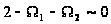 ,
which apparently has no practical significance, since its angular
velocities fall in the zone of instability.
Note that other resonances in the system (2) are absent within the second-order nonlinear approximation theory. The next section investigates these cases are in detail.
Synchronization
After the substitution the expressions (3) into
the standard form of equations and the separation between fast and
slow motions within the first order approximation theory in the small
parameter
one obtains the following information on the solution of the system.
In the first approximation theory, the slow steady-state motions
(when )
are the same as in the linearised set, i. e.
 ,
 ;
 ,
 ;
 ;
 .
This means that the slowly varying generalized coordinates
 ,
 ,
 and
 ,
 и
 do not depend within the first approximation analysis upon the
physical time
 nor the slow time
 .
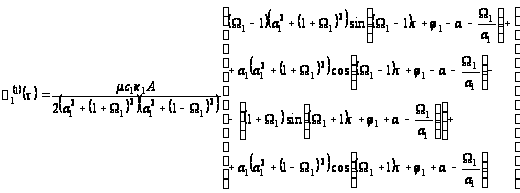
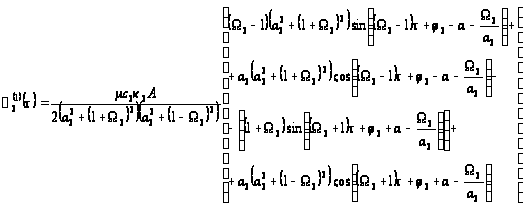
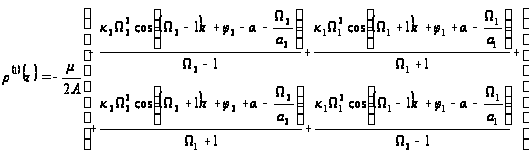
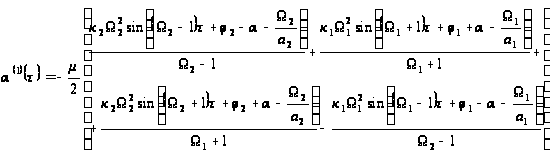
Solutions to the small non-resonant corrections appear as it follows:
 (4)

 .
This solution describes a slightly perturbed
motion of the base with the same frequencies as the angular
velocities of rotors, that is manifested in the appearance of
combination frequencies in the expression for the corrections to the
amplitude
 and the phase
 .
Amendments to the angular accelerations
 ,
 and the velocities
 ,
 also contain the similar small-amplitude combination harmonics at the
difference and sum.
Now the solution of the first-order approximation is ready. This one has not suitable for describing the synchronization effect and call to continue further manipulations with the equations along the small-parameter method. Using the solution (4), after the substitution into eqs. (3), one obtains the desired equation of the second-order nonlinear approximation, describing the synchronization phenomenon of a pair of drivers on the elastic foundation. So that, after the second substitution of the modified representation (3) in the standard form and the separation of motions into slow and fast ones, we obtain the following evolution equations.

(5)
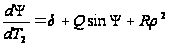 ,
where
 is the new slow variable (
 ),
 denotes the small detuning of the partial angular velocities,
 .
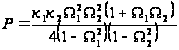
The coefficients of equations (5) are following:
 ;
 ;
 ;
 .
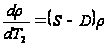
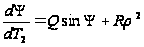
Let the detuning be zero, then these equations are highly simplified up to the full their separation:
(6)
 .
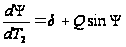
Equations (5) represent a generalization of the standard basic equations of the theory of phase synchronization [10], whose structure reads
 .(7)
Formally, this equation follows from the
generalized model (5) or (6), if we put
 .
The equation (7) has the general solution
 ,
where
 is an arbitrary constant of integration. This solution implies the
criterion of the stable phase synchronization:
(8)
 ,
which indicates that in the occurrence of the stable synchronization the phase detuning must be small enough, compared with the phase modulation parameter. If this condition is not satisfied, then the system can leave the zone of synchronization.
On the other hand the refined model (6) says that
for the stable synchronization the performance of the above
conditions (8) is not enough. It is also necessary condition that the
coefficient of the resonant excitation of vibrations in the base
 should not exceed the rate of energy dissipation
 ,
i. e.
 .
The last restriction significantly alters the stability zone of
synchronization in the space system parameters that is demonstrated
here on the specific computational examples.
Examples of stable and unstable regimes of synchronization
The table below shows the calculation of the
different theoretical implementations of stable and unstable regimes
of the phase synchronization. The example 1 (see the first line in
the table) demonstrates a robust synchronization with a small
mismatch between the angular velocities of drivers
 .
The example 2 (see, respectively, the second line in the table, etc.)
displays an unstable phase-synchronization regime at the same small
difference between the angular velocities, i. e.
.
One can reach a stable steady-state synchronization pattern in this
example by adding a damping element with the coefficient
 .
The example number 3. This is a robust synchronization for the small
differences in eccentrics (
 )
and equal angular velocities. The example number 4. This is an
unstable synchronization mode with the same small differences in
eccentrics ()
and small mismatch in angular velocities, i. e.
.
One can reach a stable regime in this example by adding a dissipative
element with the damping coefficient
 .
The example number 5. This is an unstable synchronization regime. One
cannot reach any stable synchronization regime in this example, it is
impossible, even when adding any damping element. The example number
6. This is an unstable regime of synchronization at different angular
speeds. It is also impossible to achieve any sustainable sync mode in
this case.
Table. Parameters of stable and unstable