Teddy Roosevelt
Report

Theodore Roosevelt
Icon
of the American Century
“The joy of living is his who has the heart to demand it.”
Theodore
Roosevelt
executed: Magomedova Z.A.
examined: Akhmedova Z.G.
Makhachkala 2001
Contents
Introduction page 3
Maverick in the Making , 1882 – 1901 page 3
Rough Rider in the White House , 1901 – 1909 page 7
The Restless Hunter , 1909 – 1919 page 10
Chronology of the Public Career of Theodore Roosevelt page 14
Source page 15
Introduction
The life of Theodore
Roosevelt (1858–1919) was one of constant activity, immense
energy, and enduring accomplishments. As the twenty-sixth President
of the United States, Roosevelt was the wielder of the Big Stick, the
builder of the Panama Canal, an avid conservationist,
 and
the nemesis of the corporate trusts that threatened to monopolize
American business at the start of the century. His exploits as a
Rough Rider in the Spanish-American War and as a cowboy in the Dakota
Territory were indicative of his spirit of adventure and love of the
outdoors. Reading and hunting were lifelong passions of his; writing
was a lifelong compulsion. Roosevelt wrote more than three dozen
books on topics as different as naval history and African big game.
Whatever his interest, he pursued it with extraordinary zeal. "I
always believe in going hard at everything," he preached time
and again. This was the basis for living what he called the
"strenuous life," and he exhorted it for both the
individual and the nation.
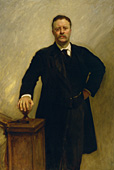
Roosevelt's engaging personality enhanced his popularity. Aided by scores of photographers, cartoonists, and portrait artists, his features became symbols of national recognition; mail addressed only with drawings of teeth and spectacles arrived at the White House without delay. TR continued to be newsworthy in retirement, especially during the historic Bull Moose campaign of 1912, while pursuing an elusive third presidential term. He remains relevant today. This exhibition is a retrospective look at the man and his portraiture, whose progressive ideas about social justice, representative democracy, and America's role as a world leader have significantly shaped our national character.
Maverick in the Making , 1882 - 1901
Theodore Roosevelt was born on October 27, 1858, in a brownstone house on Twentieth Street in New York City. A re-creation of the original dwelling, now operated by the National Park Service, replicates the tranquility of Roosevelt's earliest years. His father, Theodore Roosevelt Sr., was a prosperous glassware merchant, and was one of the wealthy old Knickerbocker class, whose Dutch ancestors had been living on Manhattan Island since the 1640s. His mother, Martha Bulloch, was reputedly one of the loveliest girls to have been born in antebellum Georgia. Together the parents instilled in their eldest son a strong sense of family loyalty and civic duty, values that Roosevelt would himself practice, and would preach from the bully pulpit all of his adult life.
Unfortunately the affluence to which the young Theodore grew accustomed could do little to improve the state of his fragile health. He was a sickly, underweight child, hindered by poor eyesight. Far worse, however, were the life threatening attacks of asthma he had to endure until early adulthood. To strengthen his constitution, he lifted dumbbells and exercised in a room of the house converted into a gymnasium. He took boxing lessons to defend himself and to test his competitive spirit. From an early age he never lacked energy or the will to improve himself physically and mentally. He was a voracious reader and writer; his childhood diaries reveal much about his interests and the quality of his expanding mind. Natural science, ornithology, and hunting were early hobbies of his, which became lifelong.
I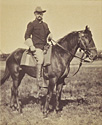 n
the fall of 1876, Roosevelt entered Harvard University. By the time
he graduated magna cum laude, he was engaged to be married to a
beautiful young lady named Alice Lee. The wedding took place on
Roosevelt's twenty-second birthday. Amid the intense happiness he
experienced during his first year of marriage, he laid the
foundations of his historic public career. "I rose like a
rocket," he said years later. Ironically, when he chartered his
own path for public office--the White House in 1912--he failed
bitterly. When others had selected him--as they did for the New York
Assembly in 1881, for the governorship in 1898, and for the vice
presidency in 1900--his election was almost a foregone conclusion.
Politics aside, Roosevelt shaped and molded his life as much as any
person could possibly do. He could not control fate, however. On
Valentine's Day, 1884, his mother died of typhoid fever and his wife
died of Bright's disease, two days after giving birth to a daughter,
Alice Lee. Amidst this personal trauma, Theodore Roosevelt was on the
verge of becoming a national presence.
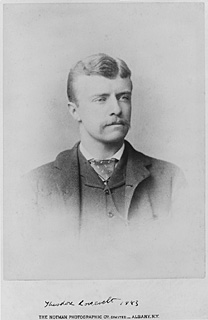
Between 1882 and 1884, Theodore Roosevelt represented the Twenty-first District of New York in the state legislative assembly in Albany. An 1881 campaign broadside noted that the young Republican candidate was "conspicuous for his honesty and integrity," qualities not taken for granted in a city run by self-serving machine politicians. This was the start of Roosevelt's long career as a political reformer.
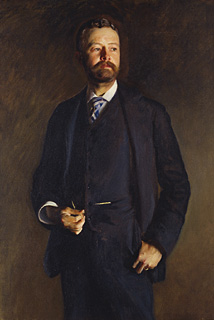
Roosevelt's political alliance with Henry Cabot Lodge of Massachusetts began in 1884, when the two were delegates to the Republican National Convention in Chicago. In time, both men would become leaders of the Republican Party. Their extensive mutual correspondence is an insightful record of shared interests and American idealism at the turn of the twentieth century. After serving in the United States House of Representatives for six years, Lodge became a senator in 1893 and retained his seat for the rest of his life. Like Roosevelt, Lodge was an advocate of civil service reform (he recommended Roosevelt to be a commissioner in 1889), a strong navy, the Panama Canal, and pure food and drug legislation. A specialist in foreign affairs, Lodge acted as one of Roosevelt's principal advisers during his presidency. Yet Lodge did not support many of Roosevelt's progressive reforms—women's suffrage, for instance—and he refused to endorse his friend in the Bull Moose campaign of 1912.
Love of adventure and the great outdoors, especially in the West, were the bonds that sealed the friendship between Theodore Roosevelt and Frederic Remington. "I wish I were with you out among the sage brush, the great brittle cottonwoods, and the sharply-channeled barren buttes," Roosevelt wrote to the western artist in 1897 from Washington. After the death of his wife Alice Lee in 1884, Roosevelt moved temporarily to the Bad Lands in the Dakota Territory, where he owned two cattle ranches. In 1888, Century Magazine published a series of articles about the West written by Roosevelt and illustrated by Remington. In a May article, Roosevelt told the story of his daring capture of three thieves who had stolen a boat from his Elkhorn Ranch. Remington depicted their capture in this painting.
Jacob Riis was a valuable friend and source of information for Roosevelt when he became a New York City police commissioner in the spring of 1895. As a police reporter for the New York Evening Sun, Riis understood the reforms needed within the police department, as well as the evils in the slums, which he frequented to gather stories. Riis was successful in awakening public awareness to the plight of New York's tenement population, especially the children, in several books, including his classic How the Other Half Lives. In 1904 Riis published a biography of his good friend, with whom he used to walk the streets of New York, titled Theodore Roosevelt: The Citizen.
I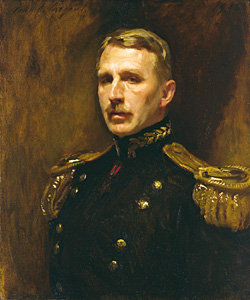 have "developed a playmate in the shape of Dr. Wood of the Army,
an Apache campaigner and graduate of Harvard, two years later than my
class," Roosevelt wrote from Washington in 1897. "Last
Sunday he fairly walked me down in the course of a scramble home from
Cabin John Bridge down the other side of the Potomac over the
cliffs." Theodore Roosevelt and Leonard
Wood liked each
other from their first meeting that spring. Both were robust and
athletic, and both, from the vantage points of their respective
jobs—Roosevelt as assistant secretary of the navy, and Wood as
an army officer (and the physician of President and Mrs. William
McKinley)—took a belligerent attitude toward Spain with respect
to Cuba. When Roosevelt was offered the chance to raise a regiment of
volunteer cavalry, he in turn recruited the more experienced Wood to
be the regiment's colonel and commander. After the war in Cuba, Wood
remained as military governor of Santiago, and shortly thereafter was
appointed to administer to the affairs of the entire island.
John Singer Sargent painted this portrait of Wood in 1903, when he went to Washington to do the official portrait of President Roosevelt. Sargent recalled then that the two veteran Rough Riders enjoyed competing against each other with fencing foils.
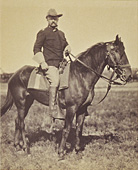
A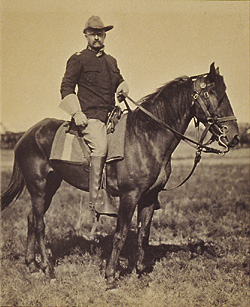 fter
his return from the war in Cuba, Colonel Roosevelt posed for this
photograph at Montauk, Long Island, shortly before his First
Volunteer Cavalry Regiment was mustered out of service in September
1898. Later, in a letter to sculptor James E. Kelly—who like
Frederick MacMonnies sculpted a statuette of the Rough Rider upon a
horse—Roosevelt described in detail how he looked and dressed
in the war. Unlike his image here, he said, "In Cuba I did not
have the side of my hat turned up."
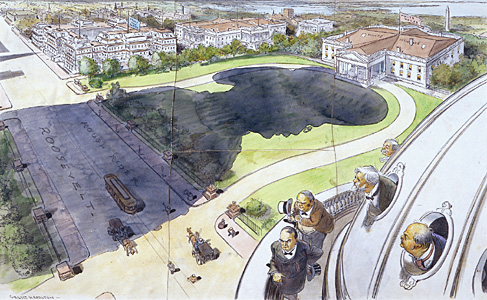
Theodore Roosevelt emerged from the Spanish-American War a national hero. His military fame now enhanced his reputation as a reform politician in his home state of New York, where he was nominated to run for the governorship that fall of 1898.
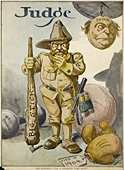
This cartoon appeared in Judge, October 29, 1898, just prior to Roosevelt's successful election, and predicted his ultimate political destiny, the White House.
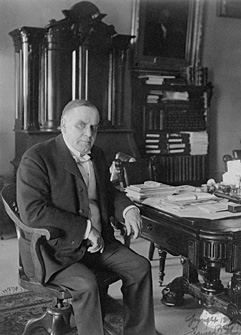 President
William McKinley
represented the status quo for most Americans at the turn of the
century. By and large, they were comfortable with him in the White
House. As the standard bearer of the Republican Party,