Teddy Roosevelt
Rough Rider in the White House , 1901 - 1909
No event had a more
profound effect on Theodore Roosevelt's political career than t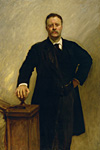 he
assassination of President William McKinley in September 1901. At the
age of forty-two, Vice President Theodore Roosevelt took the oath of
office, becoming the youngest President of the United States before
or since. From the start, Roosevelt was committed to making the
government work for the people, and in many respects, the people
never needed government more. The post-Civil War industrial
revolution had generated enormous wealth and power for the men who
controlled the levers of business and capital. Regulating the great
business trusts to foster fair competition without socializing the
free enterprise system would be one of Roosevelt's primary concerns.
The railroads, labor, and the processed food industry all came under
his scrutiny. Although the regulations he implemented were modest by
today's standards, collectively they were a significant first step in
an age before warning labels and consumer lawsuits.
Internationally, America was on the threshold of world leadership. Acquisition of the Philippines and Guam after the recent war with Spain expanded the nation's territorial borders almost to Asia. The Panama Canal would only increase American trade and defense interests in the Far East, as well as in Central and South America. In an age that saw the rise of oceanic steamship travel, the country's sense of isolation was on the verge of suddenly becoming as antiquated as yardarms and sails.
A conservative by nature, Roosevelt was progressive in the way he addressed the nation's problems and modern in his view of the presidency. If the people were to be served, according to him, then it was incumbent upon the President to orchestrate the initiatives that would be to their benefit and the nation's welfare. Not since Abraham Lincoln, and Andrew Jackson before him, had a President exercised his executive powers as an equal branch of government. If the Constitution did not specifically deny the President the exercise of power, Roosevelt felt at liberty to do so. "Is there any law that will prevent me from declaring Pelican Island a Federal Bird Reservation? . . .Very well, then I so declare it!" By executive order in March 1903, he established the first of fifty-one national bird sanctuaries. These and the national parks and monuments he created are a part of his great legacy.
Theodore Roosevelt's dynamic view of the presidency infused vigor into a branch of government that traditionally had been ceremonial and sedate. His famous "Tennis Cabinet" was indicative of how he liked to work. Riding and hiking were daily pastimes; one senator jested that anyone wishing to have influence with the President would have to buy a horse. When the press could keep pace with him, it reveled in his activities, making him the first celebrity of the twentieth century. His spectacled image adorned countless magazine covers before beauty, sex, and scandal became chic. This image of Roosevelt by Peter Juley appeared on the cover of Harper's Weekly, July 2, 1904.
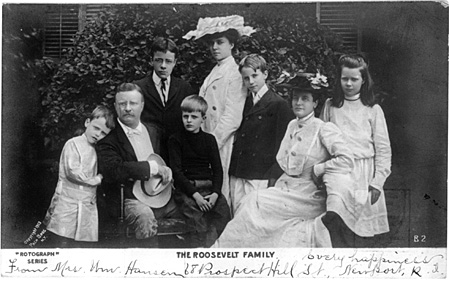
(Left to
right):
Quentin
(1897-1918), Theodore (1858-1919), Theodore Jr. (1887-1944),
Archibald (1894-1979),Alice Lee (1884-1980), Kermit (1889-1943),
Edith Kermit (1861-1948),
and Ethel Carow (1891-1977)
Like Roosevelt himself, the first family was young, energetic, and a novelty in the White House. Public interest in them was spontaneous, as pictures of Theodore, Edith, and their six children began appearing in newspapers and magazines. For once in history, the executive mansion acquired aspects of a normal American home, complete, with roller skates, bicycles, and tennis racquets.
T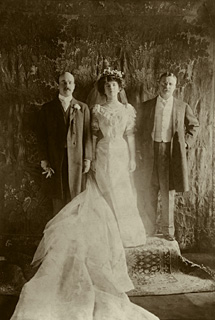 heodore
Roosevelt's eldest child, Alice
Lee, was an
impressionable teenager when the family moved into the White House in
1901. High-spirited and defiant by nature, she enjoyed pushing the
limits of decorum, while competing for her father's attention.
Naturally she was a favorite of the press, which called her Princess
Alice. Stories about her antics, her favorite color, a blue-gray
dubbed "Alice blue," and her cast of acquaintances filled
the newspapers. She smoked in public, bet at the racetrack, and was
caught speeding in her red runabout by the Washington police.
Photographs of her connote the classic Gibson Girl and suggest an air
of youthful haughtiness. In 1906, she married Nicholas
Longworth, a
Republican congressman from Ohio. He was fifteen years her senior,
short and bald, and something of a bon vivant. Their White House
wedding was the most talked-about social event of the Roosevelt
years.
A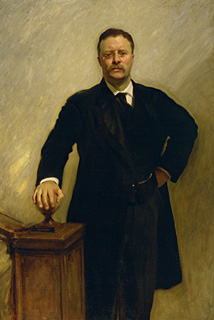 t
the invitation of the first family, John Singer Sargent was a White
House guest for a week in the middle of February 1903, while he
painted a portrait of the President. For Sargent, the foremost
Anglo-American portraitist of his era, the experience was vexing in
many respects. Particularly, Sargent found the President's strong
will daunting from the start. The choice of a suitable place to
paint, where the lighting was good, tried Roosevelt's patience. No
room on the first floor agreed with the artist. When they began
climbing the staircase, Roosevelt told Sargent he did not think the
artist knew what he wanted. Sargent replied that he did not think
Roosevelt knew what was involved in posing for a portrait. Roosevelt,
who had just reached the landing, swung around, placing his hand on
the newel and said, "Don't I!" Sargent saw his opportunity
and told the President not to move; this would be the pose and the
location for the sittings. Still, over the next few days Sargent was
frustrated by the President's busy schedule, which limited their
sessions to a half-hour after lunch. Sargent would have liked to have
had more time. Nevertheless, Roosevelt considered the portrait a
complete success. He liked it immensely, and continued to favor it
for the rest of his life. Commissioned by the federal government,
Sargent's Roosevelt
is the official White House portrait of the twenty-sixth President.
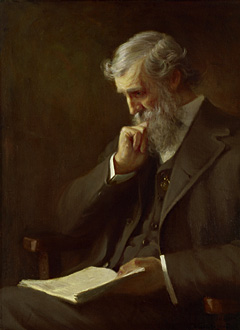
On an extended visit to the West in the spring of 1903, President Roosevelt sought the company of naturalists John Burroughs and John Muir. With Burroughs, Roosevelt camped in Yellowstone Park for two weeks, and with Muir he explored the wonders of the Yosemite Valley and had his picture taken in front of a giant sequoia tree in the Mariposa Grove. Roosevelt's visit was an opportunity for Muir to be able to impress upon the President the need for immediate preservation measures, especially for the giant forests. In 1908, Roosevelt paid tribute to Muir by designating Muir Woods, a redwood forest north of San Francisco, a national monument.
A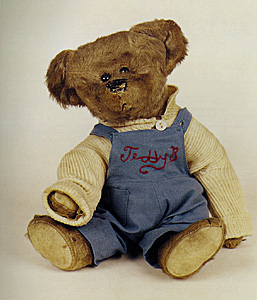 hunting trip President Roosevelt made into the swamps of Mississippi
in 1902 became legendary when he refused to shoot an exhausted black
bear, which had been run down by a pack of hounds and roped to a
tree. Although the incident was reported in the local press, Clifford
K. Berryman, a staff artist for the Washington
Post, made it
memorable on November 16 with a small front-page cartoon titled
"Drawing the Line in Mississippi." Roosevelt is shown
holding a rifle, but refusing to shoot the bedraggled bear. The bear,
however, received no executive clemency; Roosevelt ordered someone
else to put the creature out of its misery. Clifford Berryman elected
to keep the bear alive in his cartoons, and it evolved, ever more
cuddly, as a companion to Roosevelt, ultimately spawning the Teddy
Bear craze.
The Restless Hunter , 1909 - 1919
Only once in American history had a President vacated the White House and then returned to it again as President. This had been Grover Cleveland's unique destiny in 1893. That this had occurred within recent memory, and to a politician in whose footsteps Roosevelt had followed as governor of New York and finally as President, must have given Roosevelt reason to pause as he himself became a private citizen again in March 1909. He was only fifty years old, the youngest man to leave the executive office. Cleveland had been just eighteen months older when he temporarily yielded power to Benjamin Harrison in 1889. For the record, Roosevelt claimed that he was through with politics. This was the only thing he could have said as William Howard Taft, his successor, waited in the wings. Theodore Roosevelt had enjoyed being President as much as any person possibly could. Filling the post-White House vacuum would require something big and grand, and with that in mind, Roosevelt planned his immediate future. The prospect of a yearlong safari in Africa brightened for him what otherwise would have been the dreary prospect of retirement. It "will let me down to private life without that dull thud of which we hear so much," he wrote.
Aided by several British experts, Roosevelt oversaw every preparation: itinerary, gear and clothing, food and provisions, weapons, personnel, and expenses. He had been an avid naturalist and hunter since the days of his youth. Because he was genuinely interested in the African fauna, he arranged for his safari to be as scientific as possible, and enticed the Smithsonian Institution to join the expedition by offering to contribute extensively to its fledgling collection of wildlife specimens. Roosevelt invited his son, Kermit, along for companionship, if the lad would be willing to interrupt his first year of studies at Harvard. Kermit needed no persuading.
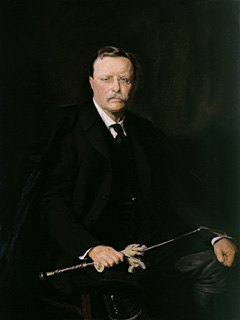
By President Roosevelt's last year in the White House, he had long grown tired of requests to sit to photographers and portrait painters. Only as a favor to an old friend from England, Arthur Lee, did he agree to sit for a portrait by the accomplished Hungarian born artist, Philip A. de Laszlo. The sittings took place in the spring of 1908, about which Roosevelt reported enthusiastically to Lee. "I took a great fancy to Laszlo himself," he wrote, "and it is the only picture which I really enjoyed having painted." Laszlo encouraged the President to invite guests to the sittings to keep Roosevelt entertained. "And if there weren't any visitors," said Roosevelt, "I would get Mrs. Laszlo, who is a trump, to play the violin on the other side of the screen." When the painting was finished, Roosevelt said that he liked it "better than any other."
Ten years later, however, Roosevelt expressed a preference for Sargent's portrait, done in 1903, which he thought had "a singular quality, a blend of both the spiritual and the heroic." Still he thought that Mrs. Roosevelt favored Laszlo's more relaxed image, a trademark of the artist's ingratiating style.
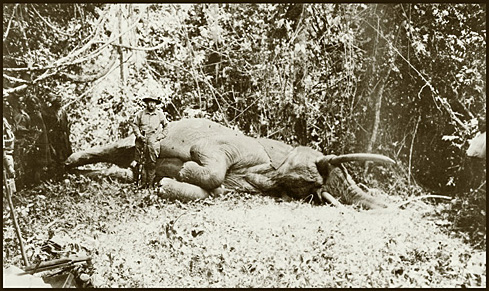
Three weeks after Theodore Roosevelt left the White House in March 1909, he embarked with his son, Kermit, upon an African safari, lasting nearly a year. He had always wanted to hunt the big game of Africa, but he also wanted his expedition to be as scientific as possible. With this in mind, he invited the Smithsonian Institution to take part, and promised to give the Institution significant animal trophies, representing dozens of new species for its collections. Roosevelt himself made extensive scientific notes about his African expedition. For instance, he was keenly interested in the flora of Africa, and recorded the dietary habits of the animals he killed after examining the contents of their stomachs.
While on safari, Roosevelt wrote extensively about his African adventure. Scribner's magazine was paying him $50,000 for a series of articles, that appeared in 1910 as a book, African Game Trails. This photograph of Roosevelt with a bull elephant was used as an illustration.
In March 1910, Roosevelt ended his eleven month African safari and, reunited with his wife, embarked on an extended tour of Europe. He accepted many invitations from national sovereigns and gave much anticipated lectures at the Sorbonne in Paris and at Oxford University in England. In Norway, he delivered finally his formal acceptance speech for having won the Nobel Peace Prize four years earlier. "I am received everywhere," he wrote, "with as much wild enthusiasm as if I were on a Presidential tour at home."
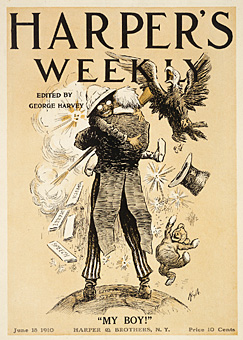
This cover of Harper's Weekly, June 18, 1910, was one of numerous graphic commentaries celebrating Roosevelt's return to the United States.
S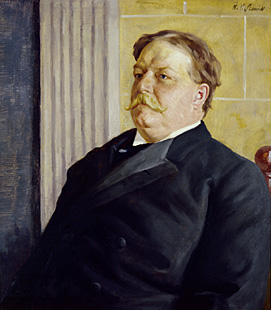 upreme
Court Justice David J. Brewer used to jest that
William Howard Taft
was the politest