Колледжи и университеты США
A short time after the first colonists came to the territory, which we now call Massachusetts, the General Court of Massachusetts made the first contribution for Harvard College. It was in 1636. This school later became the famous Harvard University. It is the oldest university in the United States. It was named in honor of John Harvard, who died in 1638. This man left his library and half of his property to the university. People knew that the future of the new country depended on education. And after the establishment of Harvard they began to establish other schools. In 1776 the Americans declared their independence. By this time nine other institutions were opened. Their present names and the dates of their opening are:
College of Willian and Mary (1693).
Yale University (1701).
Princeton University (1746).
Washington and Lee University (1749).
Columbia University (1754).
University of Pensilvania (1755).
Brown University (1764).
Rutgers College (1766).
Dartmouth College (1770).
Some of the money for the educational institutions came from the government, but most of it came from people who felt that by giving their money they were investing in the new country. People believed that the new country needed colleges. They voted for their state governments to organize colleges, which would be supported by taxes. These are called state universities and they arc playing leading roles in the world of education in America. By 1894 all states had such universities. The University of Michigan, which first opened as a school in Detroit in 1817, became a state university in 1837 when Michigan became a state.
In the early 1800s most people thought that only men should affend college. But other people fell certain that women too must be educated. Some of them thought that the best would be to have co-educated colleges. Others thought that there must be separate colleges for men and women; Oberlin College, which was founded it 1833 was the first co-educational school. Mount Holyoke was founded in 1837. It was the first school for women. Other schools for women are: Vassar (1821), Wells (1868), Wellesley (1871). In 1870 Michigan, Illinois, Missouri, California began to admit women to state universities. Now all public universities admit women. Even many private men's colleges are beginning to admit women. So the ideas about American education are changing.
Princeton University
P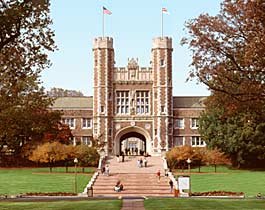
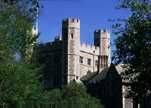 rinceton
University
is
a vibrant community of scholarship and learning that stands in the
nation's service and in the service of all nations. Chartered in
1746, and known as the College of New Jersey until 1896, it was
British North America's fourth college. Fully coeducational since
1969, Princeton in the 2002-2003 academic year enrolled 6,632
students -- 4,635 undergraduates and 1,997 graduate students -- with
a ratio of full-time students to faculty members of 5.6 to 1. The
University, with more than 12,000 employees, is Mercer County's
largest private employer and plays a major role in the educational,
cultural and economic life of the region.
T he
College of William and Mary.
The College of William and Mary, one of the nation's premier
state-assisted liberal arts universities, believes that excellence in
teaching is the key to unlocking intellectual and personal
possibilities for students. Dedicated to this philosophy and
committed to limited enrollment, the College provides high-quality
undergraduate, graduate and professional education that prepares
students to make significant contributions to the Commonwealth of
Virginia and the nation. In recognition, the media have included
William and Mary among the nation's prestigious "Public Ivys,"
and ranked it first among state institutions in terms of commitment
to teaching.
History
Chartered
on February 8, 1693, by King William III and Queen Mary II as the
second college in the American colonies. Severed formal ties with
Britain in 1776. Became state-supported in 1906 and coeducational in
1918. Achieved modern university status in 1967. Phi Beta Kappa, the
nation's premier academic honor society, and the honor code system of
conduct were founded at William and Mary.
Location
Located
in historic Williamsburg, Va., approximately 150 miles south of
Washington, D.C., midway between Richmond and Norfolk, Va.
Campus
Approximately
1,200 acres including picturesque Lake Matoaka and the College Woods.
Adjacent to Colonial Williamsburg, the Ancient Campus section is
restored to 18th-century appearance.
Instructional
Faculty
569
in arts and sciences, marine science, education, business
administration and law; 93 percent of the faculty teaching
undergraduate courses have attained terminal degrees.
Enrollment
7,500
of whom approximately 5,500 are undergraduates.
Student-Faculty
Ratio
Approximately
12 to 1.
Student
Statistics
Students
from 50 states and 75 foreign countries; 79 percent of current
freshmen graduated in top tenth of their class with the middle 50
percent having total SAT scores ranging from 1240-1400; 28 percent of
all students received need-based financial aid totaling $14 million
in 2000-2001.
Tuition
and Fees For the 2002-2003 session, total annual cost of tuition,
fees, room and board for in-state undergraduate s tudents
is$10,626; for out-of-state undergraduate students, $24,826. In-state
students in the School of Law pay $11,100 and out-of-state students
pay $21,290. In-state students in the Master's of Business
Administration program pay $9,978 and out-of-state students pay
$21,258. In-state graduate students in the Schools of Marine Science,
Education, and Arts and Sciences pay $6,138 and out-of-state students
pay $17,972.
Student
Activities Over 250 student-interest groups plus 16 national social
fraternities and 12 sororities; William and Mary Theatre, Concert and
Sunday Series; Choir; Band; Speakers Forum; live entertainment in
10,000-seat W&M Hall. There are a total of 23 men's and women's
intercollegiate athletic teams.
Degrees A.B., B.S., B.B.A., M.A., M.S., M.B.A., M.A.C., M.Ed.,
M.A.Ed., Ph.D., J.D., Ed.D., Psy.D., LL.M., M.P.P.
Programs
of Study American Studies+#, Anthropology+#, Applied Science+#,
Art/Art History, Biochemistry (minor only), Biological Psychology*,
Biology+, Black Studies*, Business Administration+^, Chemistry+,
Classical Studies (Latin, Greek, Hebrew), Computer Science+#, Dance
(minor only),Economics, Education (certification)+#, English,
Environmental Science/Studies*, Film Studies (minor only), Geology,
Government, History+#, International Studies (International Relations
and separate concentrations in African, East Asian, European, Latin
American, Middle Eastern and Russian Studies), Kinesiology, Law^,
Linguistics*, Literary and Cultural Studies*, Marine Science+#,
Mathematics+, Medieval and Renaissance Studies*, Military Science,
Modern Languages (Arabic, Chinese, French, German, Italian, Japanese,
Portuguese, Russian and Spanish), Music, Philosophy, Physics+#,
Psychology+#, Public Policy+, Religion, Sociology, Theatre and
Speech, Women's Studies*
* Interdisciplinary
Studies Degree
+Master's
Degree Program
#Doctoral
Degree Program
^Professional
Degree Program
Schools Arts and Sciences, Business Administration, Education, Law,
Marine Science
Special Opportunities Freshman seminars focusing on specialized
topics with a limited class-size of 17 students. Undergraduate
research opportunities. Community service projects and organizations.
Psy.D. degree in Clinical Psychology in conjuction with Eastern
Virginia Medical Authority. Center for International Studies with
Study Abroad programs in Australia, Canada, China, Denmark, Egypt,
England, France, Germany, Italy, Japan and Scotland. Summer session
with graduate offerings on campus. Special institutes and seminars.
Departmental Honors programs. 17 computer labs outfitted with the
latest Pentium PCs. A high-speed fiber-optic network connects all
campus buildings, including residence hall rooms. Foreign language
houses. Military Science Program. Advisory programs in
pre-engineering, pre-law and pre-medicine.
Library The Earl Gregg Swem Library contains more than one million
volumes and computer access to many standard computerized data bases.
Special Collections include documents from many historical figures,
including the lifetime papers of U.S. Chief Justice Warren Burger.
Computers
Seventeen computer labs around campus outfitted with the latest
Pentium PC computers. Campus buildings--including all residence hall
rooms - are tied to a high-speed fiber-optic network, featuring the
World Wide Web and cable television.
Major Buildings Sir Christopher Wren Building (1695), oldest academic
building in the U.S.; President's House (1732); the Brafferton
(1723); Phi Beta Kappa Memorial Hall; William and Mary Hall seating
up to 10,000 for convocations, sports events, cultural programs.
Among the College's newest buildings are the University Center,
McGlothlin-Street Hall, the Reves Center, Plumeri Park and the
McCormack-Nagelsen Tennis Center. Residential halls and houses for
4,450 students.
Endowment
$366
million
Annual
Budget
Total--$172
million for 2002-2003
Alumni
70,000
Governance
A
17-member Board of Visitors appointed by the Governor of Virginia.
Administration
Chancellor: Dr.
Henry A. Kissinger
(The
former Secretary of State and recipient of the Nobel Peace Prize in
1973 is 22nd Chancellor of the College)
President: Timothy
J. Sullivan '66 (25th President of the College)
Provost: Gillian
T. Cell
Vice
President for University Development:
Dennis Cross
Vice
President for Student Affairs:
W. Samuel Sadler '64
Vice
President for Public Affairs:
Stewart H. Gamage '72
Vice
President of Finance:
Samuel E. Jones '75
Vice
President for Administration:
Anna Martin
Director
of Athletics:
Edward C. Driscoll, Jr.
Yale University.
Y ale
University was founded in 1701 as the Collegiate School in the home
of Abraham Pierson, its first rector, in Killingworth, Connecticut.
In 1716 the school moved to New Haven and, with generous gift by
Elihu Yale of nine bales of goods, 417 books, and a portrait of King
George the first, renamed Yale College in 1718.
Yale embarked on a steady expansion, establishing the Medical Institution (1810), Divinity School (1822), Law School (1843), Graduate School of Arts and Sciences (1847), the School of Fine Arts (1869) and School of Music (1894). In 1887 Yale College became Yale University. It continued to add to its academic offerings with the School of Forestry & Environmental Studies (1900), School of Nursing (1923), School of Drama (1955), School of Architecture (1972), and School of Management (1974).
R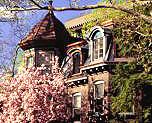 utgers
College.
Rutgers, the State University of New Jersey, with over 60,000 students on campuses in Camden, Newark, and New Brunswick, is one of the major state university systems in the nation. The university is made up of twenty-six degree-granting divisions; twelve undergraduate colleges, eleven graduate schools, and three schools offering both undergraduate and graduate degrees. Five are located in Camden, seven in Newark, and fourteen in New Brunswick.
Rutgers has a unique history as a colonial college, a land-grant institution, and a state university. Chartered in 1766 as Queen's College, the eighth institution of higher learning to be founded in the colonies before the revolution, the school opened its doors in New Brunswick in 1771 with one instructor, one sophomore, and a handful of freshmen. During this early period the college developed as a classical liberal arts institution. In 1825, the name of the college was changed to Rutgers to honor a former trustee and revolutionary war veteran, Colonel Henry Rutgers.
Rutgers
College became the land-grant college of New Jersey in 1864,
resulting in the establishment of the Rutgers Scientific S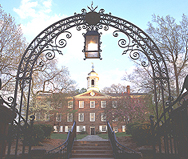 chool
with departments of agriculture, engineering, and chemistry. Further
expansion in the sciences came with the founding of the New Jersey
Agricultural Experiment Station in 1880, the College of Engineering
in 1914, and the College of Agriculture (now Cook College) in 1921.
The precursors to several other Rutgers divisions were also founded
during this period: the College of Pharmacy in 1892, the New Jersey
College for Women (now Douglass College) in 1918, and the School of
Education (now a graduate school) in 1924.
Brown University
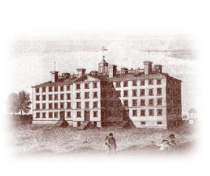 Founded
in 1764, Brown University was the third college in New England and
the seventh in America - and the only one that welcomed students of
all religious persuasions. A commitment to diversity and intellectual
freedom remains a hallmark of the University
today.
Established
as Rhode Island College in the town of Warren, Rhode Island, the
University moved to its present location on Providence's College Hill
in 1770. In 1804, the University was renamed to honor a $5,000
donation from Providence merchant Nicholas Brown.
Over
the years the University grew steadily, adding graduate courses in
the 1880s, a women's college in 1889 (renamed Pembroke College in
1928), a graduate school in 1 927,
and a medical education program in 1973 (now the Brown Medical
School). The men's and women's undergraduate colleges merged in
1971.
While
facilities and programs expanded, Brown chose to keep its enrollment
relatively small, with an undergraduate student-faculty ratio of
about 9 to 1. The main campus covers nearly 140 acres, all of it
within a 10-minute walk of its hub, the College Green. The University
is situated on a historic residential hill overlooking downtown
Providence, a city of some 170,000 people.
The
University library system contains more than 5 million items,
including bound volumes, periodicals, maps, sheet music, and
manuscripts. The number of items grows by more than 100,000 each
year.
The John D.
Rockefeller Jr. Library, known as "the Rock," is Brown's
primary humanities and social-sciences resource center.
The
Sciences Library houses the University's collection of science and
medical books and periodicals. Located on the 14th floor is the
University's media services operation.
The
John Hay Library houses special collections, including most of the
University's rare books, manuscripts, and archives.
The
John Carter Brown Library is an independently administered and funded
center for advanced research in history and the humanities. It houses
an internationally renowned collection of primary sources pertaining
to the Americas before 1825.
Other
specialty libraries include the Orwig Music Library (the general
music collection), the Art Slide Library (slides of art and
art-related subjects, including architecture and archaeology), and
the Demography Library (a major resource for population
research).
Teaching,
research and public service are conducted through a number of centers
and institutes affiliated with the University. They include the
Annenberg Institute for School Reform, the Center for Alcohol and
Addiction Studies, the Center for Gerontology and Health Care
Research, the Population Studies and Training Center, and