Колледжи и университеты США
 Carrying on an intercollegiate athletic tradition more than 100
years old, the Brown Bears compete against the seven other Ivy League
schools and against other colleges and universities at the NCAA
Division I level. Brown has one of the nation's broadest arrays of
varsity teams -- 37 in all; 20 for women and 17 for
men.
Brown has its
share of historic firsts, including the nation's first
intercollegiate men's ice hockey game (defeating Harvard 6-0 on
January 19, 1898) and the nation's first women's varsity ice hockey
team (organized in 1964).
As
a member of the Ivy League, Brown awards financial aid on the basis
of need; it does not grant athletic scholarships.
University of Pensilvania.
Students:
Full-time:
18,050
Part-time: 4,276
Total: 22,326
Full-time
Undergraduate: 9,863
Full-time Graduate/professional: 8,187
(Fall
2001; most current figures)
Undergraduate Admissions:
Penn received record-high 19,153 applications for admission to the Class of 2005. Of those applicants, 4,132, or 21.6 percent, were offered admission, making the class of 2005 the most selective in Penn's history and the institution among the most selective universities in America. Ninety-two percent of the students admitted for Fall 2001 came from the top 10 percent of their high school graduating class and scored a combined 1,412 on the SAT. 2,391 students matriculated into this year's freshman class.
Internationalism:
R ecord-high
2,588 international students applied for admission to Penn's
undergraduate schools for Fall 2001, and 401 (15.5%) received
admissions offers. Ten percent of the first Ten percent of the first
year classes are international students. Of the international
students accepted to the Class of 2005, 11.1% were from Africa and
the Middle East, 44.6% from Asia, 1% from Australia and the Pacific,
14.3% from Canada and Mexico, 10.6% from Central/South America and
the Caribbean, and 18.6% from Europe. Penn had 3,485 international
students enrolled in Fall 2001.
Study Abroad:
Penn offers 65 study-abroad programs in 36 countries. Penn ranks first among the Ivy League schools in the number of students studying abroad, according to the most recent data (Institute for International Education, 1999-2000). In 1999-2000, 1,196 Penn undergraduate students participated in study- abroad programs.
Diversity:
About 42 percent of those accepted for admission to the Class of 2005 are Black, Hispanic, Asian, or Native American. Women comprise 50 percent of all students currently enrolled.
Undergraduate Schools:
Penn's four undergraduate schools, with their Fall 2001 student populations, are:
The
College at Penn (School of Arts and Sciences), 6,464
School of
Engineering and Applied Science, 1,612
School of Nursing, 363
The
Wharton School, 1,729
Graduate and Professional Schools:
Penn's 12 graduate and professional schools, with their Fall 2001 student populations, are:
Annenberg
School for Communication, 78
School of Arts and Sciences,
2,302
School of Dental Medicine, 530
Graduate School of
Education, 1,059
School of Engineering and Applied Science,
884
Graduate School of Fine Arts, 562
Law School, 856
School
of Medicine, 1,091
School of Nursing, 351
School of Social
Work, 326
School of Veterinary Medicine, 451
The Wharton
School, 2,055
Faculty:
Standing:
2,257
Associated: 2,062
Total: 4,319
The
student-faculty ratio is 6.4:1 (Fall 2001).
Measures
of distinction of the faculty include:
61
members of the Academy of Arts and Sciences;
44 members of the
Institute of Medicine;
39 members of the National Academy of
Sciences;
91 Guggenheim Fellowships (1980-2001);
11 members of
the National Academy of Engineering;
Seven MacArthur Award
recipients;
Six National Medal of Science recipients;
Four
Nobel Prize recipients; and
Two Pulitzer Prize winners
Staff:
Penn is the largest private employer in the city of Philadelphia and the fourth-largest in the Commonwealth of Pennsylvania. As of Fall 2001, Penn has a total regular work force of 12,290. The University of Pennsylvania Health System, which includes the Hospital of the University of Pennsylvania, employs an additional 12,673 people.
Academics:
Total undergraduate majors currently being pursued: 94 (Academic Year 2002).
Libraries:
5.0
million books
3.6 million items on microfilm
39,439 periodical
subscriptions
1,952 CD-ROM databases
4,734 e-journals
Athletics and Recreation:
A charter member of the Ivy League, Penn offers intercollegiate competition for men in 20 sports, including basketball, baseball, heavyweight crew, lightweight crew, cross country, fencing, football, golf, lacrosse, soccer, sprint football, squash, swimming, tennis, indoor track, outdoor track and wrestling. It offers intercollegiate competition for women in 14 sports, including basketball, crew, cross country, field hockey, fencing, golf, gymnastics, lacrosse, soccer, softball, squash, swimming, tennis, indoor track, outdoor track and volleyball. During the 2001-2002 academic year, there were 14,678 team members participating in 20 intramural teams; 927 additional students were members of 30 club sports.
Campus Size:
West Philadelphia campus: 269 acres, 151 buildings (excluding hospital)
New Bolton Center: 600 acres, 77 buildings
Morris Arboretum: 92 acres, 30 buildings
Living Alumni of Record:
T otal:
233,303 (Fiscal Year 2001)
Undergraduate Admission and Fees:
$27,988 (Academic Year 2003)
Room and Board Fees:
$8,224 (Academic Year 2003)
Community Service:
Approximately 5,000 University students, faculty and staff participate in more than 300 Penn volunteer and community service programs. The Middle States Association of Colleges and Schools recognized the University's West Philadelphia Improvement Corps (WEPIC), in Penn's Center for Community Partnerships, for exemplary school-college partnerships in Pennsylvania.
Fundraising (Fiscal Year 2001):
Endowment
$3.382 billion (as of June 30, 2001)
Voluntary support: $285
million
107,941 donors gave $138 million in contributions
$92
million in gifts from foundations and associations
$37 million in
gifts from corporations
S ponsored
Projects (Fiscal
Year 2001):
$550
million in awards
4,169 awards
2,655 projects
1,219
principal investigators
Budget:
$3.21 billion (Fiscal Year 2002)
Payroll (including benefits):
$1.324 billion (Fiscal Year 2002)
Washington and Lee University.
Washington and Lee is a small, private, liberal arts university nestled between the Blue Ridge and Allegheny Mountains in Lexington, VA. It is the ninth oldest institution of higher learning in the nation.
In 1749, Scotch-Irish pioneers who had migrated deep into the Valley of Virginia founded a small classical school called Augusta Academy, some 20 miles north of what is now Lexington. In 1776, the trustees, fired by patriotism, changed the name of the school to Liberty Hall. Four years later the school was moved to the vicinity of Lexington, where in 1782 it was chartered as Liberty Hall Academy by the Virginia legislature and empowered to grant degrees. A limestone building, erected in 1793 on the crest of a ridge overlooking Lexington, burned in 1803, though its ruins are preserved today as a symbol of the institution's honored past.
In 1796, George Washington saved the struggling Liberty Hall Academy when he gave the school its first major endowment--$20,000 worth of James River Canal stock. The trustees promptly changed the name of the school to Washington Academy as an expression of their gratitude. In a letter to the trustees, Washington responded, "To promote the Literature in this rising Empire, and to encourage the Arts, have ever been amongst the warmest wishes of my heart." The donations - one of the largest to any educational institution at that time –continue to contribute to the University's operating budget today.
G eneral
Robert E. Lee reluctantly accepted the position of president of the
College in 1865. Because of his leadership of the Confederate army,
Lee worried he "might draw upon the College a feeling of
hostility," but also added that "I think it the duty of
every citizen in the present condition of the Country, to do all in
his power to aid in the restoration of peace and harmony."
During his brief presidency, Lee established the School of Law,
encouraged development of the sciences, and instituted programs in
business instruction that led to the founding of the School of
Commerce in 1906. He also inaugurated courses in journalism, which
developed by 1925 into The School of Journalism--now the Department
of Journalism and Mass Communications. These courses in business and
journalism were the first offered in colleges in the United States.
After Lee's death in 1870, the trustees voted to change the name from
Washington College to Washington and Lee University.
Once an all-male institution, Washington and Lee first admitted women to its law school in 1972. The first undergraduate women matriculated in 1985. Since then, Washington and Lee has flourished. The University now boasts a new science building, a performing arts center and an indoor tennis facility, and it continues to climb the ranking charts of U.S. News and World Report and other rating agencies. Washington and Lee is ranked 15th among the top national liberal arts colleges by U.S. News.
Washington and Lee University observed its 250th Anniversary with a year-long, national celebration during the 1998-99 academic year.
Columbia University.
Columbia
University was founded in 1754 as King’s College by royal
charter of King George II of England. It is the oldest institution of
higher learning in the state of New York and the f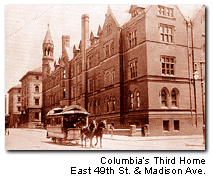 ifth
oldest in the United States.
Controversy preceded the founding of the College, with various groups competing to determine its location and religious affiliation. Advocates of New York City met with success on the first point, while the Anglicans prevailed on the latter. However, all constituencies agreed to commit themselves to principles of religious liberty in establishing the policies of the College.
In
July 1754, Samuel Johnson held the first classes in a new schoolhouse
adjoining Trinity Church, located on what is now lower Broadway in
Manhattan. There were eight students in the class. At King’s
College, the future leaders of colonial society could receive an
education designed to “enlarge the Mind, improve the
Understanding, polish the whole Man, and qualify them to support the
brightest Characters in all the elevated stations in life.” One
early manifestation of the institution’s lofty g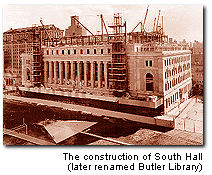 oals
was the establishment in 1767 of the first American medical school to
grant the MD degree.
The American Revolution brought the growth of the College to a halt, forcing a suspension of instruction in 1776 that lasted for eight years. However, the institution continued to exert a significant influence on American life through the people associated with it. Among the earliest students and Trustees of King’s College were John Jay, the first Chief Justice of the United States; Alexander Hamilton, the first Secretary of the Treasury; Gouverneur Morris, the author of the final draft of the U.S. Constitution; and Robert R. Livingston, a member of the five-man committee that drafted the Declaration of Independence.
The College reopened in 1784 with a new name—Columbia—that embodied the patriotic fervor, which had inspired the nation’s quest for independence. The revitalized institution was recognizable as the descendant of its colonial ancestor, thanks to its inclination toward Anglicanism and the needs of an urban population, but there were important differences: Columbia College reflected the legacy of the Revolution in the greater economic, denominational, and geographic diversity of its new students and leaders. Cloistered campus life gave way to the more common phenomenon of day students, who lived at home or lodged in the city.
In
1849, the College moved from Park Place, near the present site of
City Hall, to 49th Street and Madison Avenue, where it r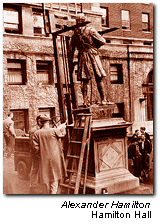 emained
for the next fifty years. During the last half of the nineteenth
century, Columbia rapidly assumed the shape of a modern university.
The Law School was founded in 1858, and the country’s first
mining school, a precursor of today’s School of Engineering and
Applied Science, was established in 1864.
When Seth Low became Columbia’s president in 1890, he vigorously promoted the university ideal for the College, placing the fragmented federation of autonomous and competing schools under a central administration that stressed cooperation and shared resources. Barnard College for women had become affiliated with Columbia in 1889; the medical school came under the aegis of the University in 1891, followed by Teachers of graduate faculties in political science, philosophy, and pure science established Columbia as one of the nation’s earliest centers for graduate education. In 1896, the Trustees officially authorized the use of yet another new name, Columbia University, and today the institution is officially known as Columbia University in the City of New York.
Low’s greatest accomplishment, however, was moving the University from 49th Street to Morningside Heights and a more spacious campus designed as an urban academic village by McKim, Mead & White, the renowned turn-of-the-century architectural firm. Architect Charles Follen McKim provided Columbia with stately buildings patterned after those of the Italian Renaissance. The University continued to prosper after its move uptown.
During
the presidency of Nicholas Murray Butler (1902–1945), Columbia
emerged as a preeminent national center for educational innovation
and scholarly achievement. John Erskine taught the first Great Books
Honors Seminar at Columbia College in 1919, making the study of
original masterworks the foundation of undergraduate education.
Columbia became, in the words of College alumnus Herman Wouk, a place
of “doubled magic,” where “the best things of the
moment were outside the rectangle of Columbia; the best things o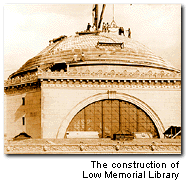 f
all human history and thought were inside the rectangle.” The
study of the sciences flourished along with the liberal arts, and in
1928, Columbia–Presbyterian Medical Center, the first such
center to combine teaching, research, and patient care, was
officially opened as a joint project between the medical school and
The Presbyterian Hospital.
By the late 1930s, a Columbia student could study with the likes of Jacques Barzun, Paul Lazarsfeld, Mark Van Doren, Lionel Trilling, and I.I. Rabi, to name just a few of the great minds of the Morningside campus. The University’s graduates during this time were equally accomplished—for example, two alumni of Columbia’s Law School, Charles Evans Hughes and Harlan Fiske Stone (who also held the position of Law School dean), served successively as Chief Justice of the United States Supreme Court.
Research
into the atom by faculty