Колледжи и университеты США
Columbia celebrated its Bicentennial in 1954 during a period of steady expansion. This growth mandated a major campus-building program in the 1960s, and, by the end of the decade, five of the University’s schools were housed in new buildings.
T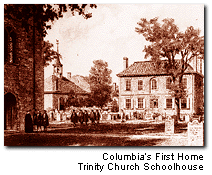 he
revival of spirit and energy on Columbia’s campus in recent
years has been even more sweeping. The 1980s saw the completion of
over $145 million worth of new construction, including two residence
halls, a computer science center, the Rare Book and Manuscript
Library, a chemistry building, the Miriam and Ira D. Wallach Art
Gallery, Lawrence A. Wien Stadium, and much more. The quality of
student life on campus has been a primary concern, and the opening of
Morris A. Schapiro Hall in 1988 enabled Columbia College to achieve
its long-held goal of offering four years of housing to all
undergraduate students. A second gift from this farsighted benefactor
led to the opening in 1992 of the Morris A. Schapiro Center for
Engineering and Physical Science Research, which is helping to secure
Columbia’s leadership in telecommunications and high-tech
research.
On
the Health Sciences campus, a generous commitment from t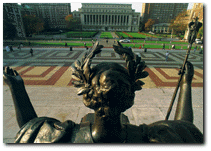 he
Sherman Fairchild Foundation has lent impetus to the development of
the Audubon Biomedical Science and Technology Park by providing funds
for construction of the Center for Disease Prevention. In addition to
securing Columbia’s place at the forefront of medical research,
this project will help spur the growth of the biotechnology industry
in New York City, forge vital new links between Columbia and the
local community, and help to revitalize the area around the medical
center.
Thanks
to concerted efforts to place the University on the strongest
possible foundations, Columbia is approaching the twenty-first
century with a firm sense of the importance of w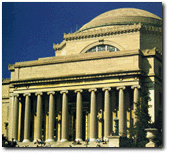 hat
has been accomplished in the past and confidence in what it can
achieve in the years to come.
In 1897, the University moved from 49th Street and Madison Avenue, where it had stood for fifty years, to its present location on Morningside Heights at 116th Street and Broadway. Seth Low, the President of the University at the time of the move, sought to create an academic village in a more spacious setting. Charles Follen McKim of the architectural firm of McKim, Mead & White modeled the new campus after the Athenian agora. The Columbia campus comprises the largest single collection of McKim, Mead & White buildings in existence.
The
architectural centerpiece of the campus is Low Memorial Library,
named in honor of Seth Low’s father. Built in the Roman
classical style, it appears in the New York City Register of Historic
Places. The building today houses the University’s c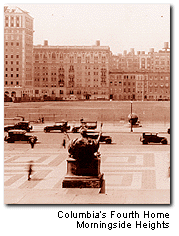 entral
administration offices and the Visitors Center.
A broad flight of steps descends from Low Library to an expansive plaza, a popular place for students to gather, and from there to College Walk, a promenade that bisects the central campus. Beyond College Walk is the South Campus, where Butler Library, the University’s main library, stands. South Campus is also the site of many of Columbia College’s facilities, including student residences, the Ferris Booth Hall activities center, and the College’s administrative offices and classroom buildings, along with the building housing the Journalism School.
To the north of Low Library stands Pupin Hall, which in 1966 was designated a national historic landmark in recognition of the atomic research undertaken there by Columbia’s scientists beginning in 1925. To the east is St. Paul’s Chapel, which is listed with the New York City Register of Historic Places.
Many newer buildings surround the original campus. Among the most impressive are the Sherman Fairchild Center for the Life Sciences, the Computer Science building, Morris A. Schapiro Hall, and the Morris A. Schapiro Center for Engineering and Physical Science Research.
Two
miles to the north of Morningside Heights is the twenty-acre campus
of the Columbia-Presbyterian Medical Center, overlooking the Hudson
River in Manhattan’s Washington Heights. Among the most
prominent buildings on the site are the twenty-story Julius and
Armand Hammer Health Sciences Center, the William Black Medical
Research building, and the seventeen-story tower of the College of
Physicians and Surgeons. In 1989, The Presbyterian Hospital opened
the Milstein Hospital Building, a 745-bed facility that incorporates
t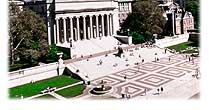 he
very latest advances in medical technology and patient care. To the
west is the New York State Psychiatric Institute; east of Broadway
will be the Audubon Biomedical Science and Technology Park, which
will include the new Center for Disease Prevention. The Park is being
developed as a major urban research complex to house activities on
the cutting edge of scientific and medical research.
Other interesting information.
It is also very interesting, that in the USA many universities are connected with each other. They belong to different unions. For example, Dartmouth College, Brown University, Columbia University, Princeton University and Yale University are the parts of «Ivy League». It is a union of the most respectable and famous universities in the United States of America.
« Ivy
League» consists of eight colleges and universities. All of
them are rather old and popular. But they are not cheap, because
students must pay much money for their education.
The most expensive University is Dartmouth. The cheapest one is Yale.
All the universities have their own emblems, which are always different and have definite meanings.


The Report.
Klimenko Ekaterina.
9 form «V».

Education
and Culture
In the United States, education, cultural activities, and the communications media exert a tremendous influence on the lives of individuals. Through these means, knowledge and cultural values are generated, transmitted, and preserved from one generation to the next.
I n
most of the United States, illiteracy has been virtually eliminated.
However, census estimates suggest that 2.4 percent of the population
over age 25 is functionally illiterate, that is, they are unable to
read and write well enough to meet the demands of everyday life. More
of the population has received more education than ever before. Among
Americans aged 25 and older in 1993, about four-fifths had completed
high school, as compared with only about one-fourth as recently as
1940. In 1993 nearly 22 percent of the population had com
pleted
four or more years of college. This same trend toward increased
accessibility and usage applies to America's cultural institutions,
which have continued to thrive despite a troubled economy.
Education
In the United States, education is offered at all levels from prekindergarten to graduate school by both public and private institutions. Elementary and secondary education involves 12 years of schooling, the successful completion of which leads to a high school diploma. Although public education can be defined in various ways, one key concept is the accountability of school officials to the voters. In theory, responsibility for operating the public education system in the United States is local. In fact, much of the local control has been superseded, and state legislation controls financing methods, academic standards, and policy and curriculum guidelines. Because public education is separately developed within each state, variations exist from one state to another. Parallel paths among states have developed, however, in part because public education is also a matter of national interest.
Public elementary and secondary education is supported financially by three levels of government—local, state, and federal. Local school districts often levy property taxes, which are the major source of financing for the public school systems. One of the problems that arises because of the heavy reliance on local property tax is a disparity in the quality of education received by students. Rich communities can afford to pay more per student than poorer communities; consequently, the disparity in wealth affects the quality of education received. Some states have taken measures to level this imbalance by distributing property tax collections to school districts based on the number of students enrolled.
When public education was established in the American colonies in the mid-17th century, it was viewed by many as an instrument that would break down the barriers of social class and prejudice. Public schools were intended for all creeds, classes, and religions. In addition to the development of individuals, public schools were to promote social harmony by equalizing the conditions of the population.
M ost
students attended private schools, however, until well into the 19th
century. Then, in the decades before the American
Civil War
(1861-1865), a transition took place from private to public school
education. This transition was to provide children of all classes
with a free education. The idea of free public education did,
however, encounter opposition. The nonw
hite
population, which consisted primarily of blacks, was either totally
denied an education or allowed to attend only racially segregated
schools.
School Segregation
Before the Civil War, public school segregation was common both in the South and in the North. In every southern state except Kentucky and Maryland, laws existed that forbade the teaching of reading and writing to slaves.
In 1867, after the end of the Civil War, schools for blacks began to be established in various parts of the South. For nearly a century, until 1954, most education facilities in the southern states remained racially segregated by state laws. Not only were schools segregated, but, in schools for blacks, the physical conditions and facilities were poor, transportation to such schools was meager or nonexistent, and expenditures per black pupil fell below those per white pupil.
I n
the northern states during this same period, most black chi
ldren
also attended separate schools. Sometimes this was the result of
state laws; more often it was the result of policy decisions, either
officially acknowledged or clandestine. Examples of the latter are
gerrymandered school districts and pupil transfer systems. The
result, in the South and the North, was a dual system of education
for blacks and whites.
I n
1954 the Supreme Court of the United States declared racial
segregation in schools illegal, in its landmark Brown v. Board of
Education of Topeka decision. Since then progress has been made
toward desegregation; however, widespread de facto segregation still
exists today in both suburban and urban areas. In the late 1980s more
than 60 percent of black and Hispanic American students attended
schools where minority group enrollment constituted over 50 percent
of the total. In some large cities, either because of residential
patterns or because of an intent to segregate schools, entire school
districts are still segregated. Some districts have attempted the
busing of pupils to help achieve integration, but this has proved
generally unpopular and unworkable. Thus, the right to a desegregated
education remains more theoretical than real for many children.
E lementary
and Secondary Enrollments
In
1993 some 59,680 public elementary and 19,995 public secondary
schools were in operation in the United States, in addition to 4826
special-purpose or combined schools. Enrollment in public schools in
1993 totaled about 31 million elementary pupils and about 11.7
million secondary students. In addition, private elementary and
secondary schools together enrolled about 4.9 million students in
1991. The largest system of private education in the United States is
that of the Roman Catholic church, with some 2.6 million students