Triple-wave ensembles in a thin cylindrical shell
Kovriguine DA, Potapov AI
Introduction
Primitive nonlinear quasi-harmonic triple-wave patterns in a thin-walled cylindrical shell are investigated. This task is focused on the resonant properties of the system. The main idea is to trace the propagation of a quasi-harmonic signal — is the wave stable or not? The stability prediction is based on the iterative mathematical procedures. First, the lowest-order nonlinear approximation model is derived and tested. If the wave is unstable against small perturbations within this approximation, then the corresponding instability mechanism is fixed and classified. Otherwise, the higher-order iterations are continued up to obtaining some definite result.
The theory of thin-walled shells based on the Kirhhoff-Love hypotheses is used to obtain equations governing nonlinear oscillations in a shell. Then these equations are reduced to simplified mathematical models in the form of modulation equations describing nonlinear coupling between quasi-harmonic modes. Physically, the propagation velocity of any mechanical signal should not exceed the characteristic wave velocity inherent in the material of the plate. This restriction allows one to define three main types of elemental resonant ensembles — the triads of quasi-harmonic modes of the following kinds:
high-frequency longitudinal and two low-frequency bending waves (-type triads);
high-frequency shear and two low-frequency bending waves ();
high-frequency bending, low-frequency bending and shear waves ();
high-frequency bending and two low-frequency bending waves ().
Here subscripts identify the type of modes, namely () — longitudinal, () — bending, and () — shear mode. The first one stands for the primary unstable high-frequency mode, the other two subscripts denote secondary low-frequency modes.
Triads of the first three kinds (i — iii) can be observed in a flat plate (as the curvature of the shell goes to zero), while the -type triads are inherent in cylindrical shells only.
Notice that the known Karman-type dynamical governing equations can describe the -type triple-wave coupling only. The other triple-wave resonant ensembles, , and , which refer to the nonlinear coupling between high-frequency shear (longitudinal) mode and low-frequency bending modes, cannot be described by this model.
Quasi-harmonic bending waves, whose group velocities do not exceed the typical propagation velocity of shear waves, are stable against small perturbations within the lowest-order nonlinear approximation analysis. However amplitude envelopes of these waves can be unstable with respect to small long-wave perturbations in the next approximation. Generally, such instability is associated with the degenerated four-wave resonant interactions. In the present paper the second-order approximation effects is reduced to consideration of the self-action phenomenon only. The corresponding mathematical model in the form of Zakharov-type equations is proposed to describe such high-order nonlinear wave patterns.
Governing equations
We consider a deformed state of a thin-walled cylindrical shell of the length , thickness , radius , in the frame of references . The -coordinate belongs to a line beginning at the center of curvature, and passing perpendicularly to the median surface of the shell, while and are in-plane coordinates on this surface (). Since the cylindrical shell is an axisymmetric elastic structure, it is convenient to pass from the actual frame of references to the cylindrical coordinates, i.e. , where and . Let the vector of displacements of a material point lying on the median surface be . Here , and stand for the longitudinal, circumferential and transversal components of displacements along the coordinates and , respectively, at the time . Then the spatial distribution of displacements reads
accordingly to the geometrical paradigm of the Kirhhoff-Love hypotheses. From the viewpoint of further mathematical rearrangements it is convenient to pass from the physical sought variables to the corresponding dimensionless displacements . Let the radius and the length of the shell be comparable values, i.e. , while the displacements be small enough, i.e. . Then the components of the deformation tensor can be written in the form
where is the small parameter; ; and . The expression for the spatial density of the potential energy of the shell can be obtained using standard stress-straight relationships accordingly to the dynamical part of the Kirhhoff-Love hypotheses:
where is the Young modulus; denotes the Poisson ratio; (the primes indicating the dimensionless variables have been omitted). Neglecting the cross-section inertia of the shell, the density of kinetic energy reads
where is the dimensionless time; is typical propagation velocity.
Let the Lagrangian of the system be .
By using the variational procedures of mechanics, one can obtain the following equations governing the nonlinear vibrations of the cylindrical shell (the Donnell model):
(1)
(2)
Equations (1) and (2) are supplemented by the periodicity conditions
Dispersion of linear waves
At the linear subset of eqs.(1)-(2) describes a superposition of harmonic waves
(3)
Here
 is the vector of complex-valued wave amplitudes of the longitudinal,
circumferential and bending component, respectively;
 is the phase, where
 are the natural frequencies depending upon two integer numbers,
namely
 (number of half-waves in the longitudinal direction) and
 (number of waves in the circumferential direction). The dispersion
relation defining this dependence
has the form
(4)
where
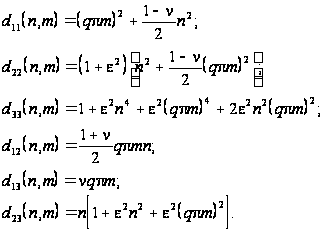
In the general case
this equation possesses three different roots ( )
at fixed values of
 and
 .
Graphically, these solutions are represented by a set of points
occupied the three surfaces
 .
Their intersections with a plane passing the axis of frequencies are
given by fig.(1). Any natural frequency
 corresponds to the three-dimensional vector of amplitudes
 .
The components of this vector should be proportional values, e.g.
 ,
where the ratios
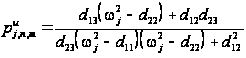
and
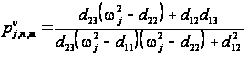
are obeyed to the orthogonality conditions

as

 .
Assume that
 ,
then the linearized subset of eqs.(1)-(2) describes planar
oscillations in a thin ring. The low-frequency branch corresponding
generally to bending waves is approximated by
 and
 ,
while the high-frequency azimuthal branch —
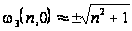 and
 .
The bending and azimuthal modes are uncoupled with the shear modes.
The shear modes are polarized in the longitudinal direction and
characterized by the exact dispersion relation
 .
Consider now
axisymmetric waves (as
 ).
The axisymmetric shear waves are polarized by azimuth:
 ,
while the other two modes are uncoupled with the shear mode. These
high- and low-frequency branches are defined by the following
biquadratic equation
 .
At the vicinity of
 the high-frequency branch is approximated by
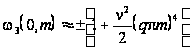 ,
while the low-frequency branch is given by
 .
Let
 ,
then the high-frequency asymptotic be
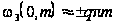 ,
while the low-frequency asymptotic:
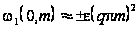 .
When neglecting the in-plane inertia of elastic waves, the governing equations (1)-(2) can be reduced to the following set (the Karman model):
(5)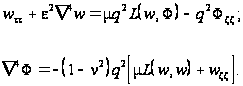
Here
 and
 are the differential operators;
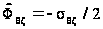
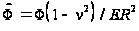
 denotes the Airy stress function defined by the relations
 ,
 and
 ,
where
 ,
while
 ,
 and
 stand for the components of the stress tensor. The linearized subset
of eqs.(5), at
 ,
is represented by a single equation

defining a single
variable
 ,
whose solutions satisfy the following dispersion relation
(6)
Notice that the expression (6) is a good approximation of the low-frequency branch defined by (4).
Evolution equations
If
 ,
then the ansatz (3) to the eqs.(1)-(2) can lead at large times and
spatial distances,
 ,
to a lack of the same order that the linearized solutions are
themselves. To compensate this defect, let us suppose that the
amplitudes
 be now the slowly varying functions of independent coordinates
 ,
 and
 ,
although the ansatz to the nonlinear governing equations conserves
formally the same form (3):

Obviously, both the
slow
 and the fast
 spatio-temporal scales appear in the problem. The structure of the
fast scales is fixed by the fast rotating phases (
 ),
while the dependence of amplitudes
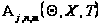 upon the slow variables is unknown.
This dependence is defined by the evolution equations describing the slow spatio-temporal modulation of complex amplitudes.
There are many routs
to obtain the evolution equations. Let us consider a technique based
on the Lagrangian variational procedure. We pass from the density of
Lagrangian function
 to its average value
(7)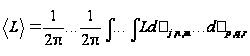 ,
An advantage of the
transform (7) is that the average Lagrangian depends only upon the
slowly varying complex amplitudes and their derivatives on the slow
spatio-temporal scales
 ,
 and
 .
In turn, the average Lagrangian does not depend upon the fast
variables.
The average
Lagrangian
 can be formally represented as power series in
 :
(8)
At
the average Lagrangian (8) reads
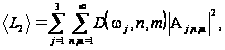
where the
coefficient
 coincides exactly with the dispersion relation (3). This means that
 .
The first-order
approximation average Lagrangian
 depends upon the slowly varying complex amplitudes and their first
derivatives on the slow spatio-temporal scales
,
and
.
The corresponding evolution equations have the following form
(9)
Notice that the
second-order approximation evolution equations cannot be directly
obtained using the formal expansion of the average Lagrangian
 ,
since some corrections of the term
 are necessary. These corrections are resulted from unknown additional
terms
 of order
,
which should generalize the ansatz (3):

provided that the second-order approximation nonlinear effects are of interest.
Triple-wave resonant ensembles
The lowest-order nonlinear analysis predicts that eqs.(9) should describe the evolution of resonant triads in the cylindrical shell, provided the following phase matching conditions
(10) ,
hold true, plus the
nonlinearity in eqs.(1)-(2) possesses some appropriate structure.
Here
 is a small phase detuning of order
,
i.e.
 .
The phase matching conditions (10) can be rewritten in the
alternative form
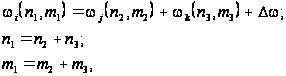
where
 is a small frequency detuning;
 and
