Triple-wave ensembles in a thin cylindrical shell
(15)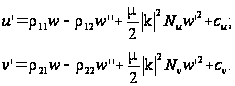
Here
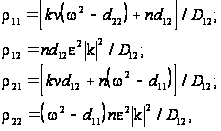
while
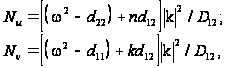
where and
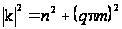 .
Using (15) one can get the following nonlinear ordinary differential equation of the fourth order:
(16) ,
which describes simple stationary waves in the cylindrical shell (primes denote differentiation). Here
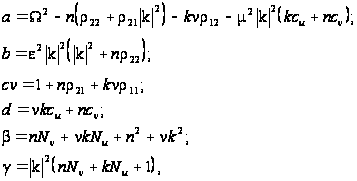
where and
 are the integration constants.
If the small
parameter
 ,
and
 ,
 ,
 satisfies the dispersion relation (4), then a periodic solution to
the linearized equation (16) reads

where
 are arbitrary constants, since
 .
Let the parameter
 be small enough, then a solution to eq.(16) can be represented in the
following form
(17)
where the amplitude
 depends upon the slow variables
 ,
while
 are small nonresonant corrections. After the substitution (17) into
eq.( 16) one obtains the expression of the first-order nonresonant
correction

and the following modulation equation
(18)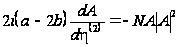 ,
where the nonlinearity coefficient is given by
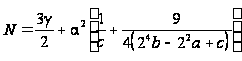 .
Suppose that the
wave vector
 is conserved in the nonlinear solution. Taking into account that the
following relation

holds true for the stationary waves, one gets the following modulation equation instead of eq.(18):
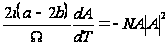
or
 ,
where the point
denotes differentiation on the slow temporal scale
 .
This equation has a simple solution for spatially uniform and
time-periodic waves of constant amplitude
 :
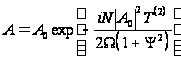 ,
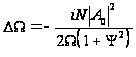
which characterizes the amplitude-frequency response curve of the shell or the Stocks addition to the natural frequency of linear oscillations:
(19) .
Spatio-temporal modulation of waves
Relation (19) cannot provide information related to the modulation instability of quasi-harmonic waves. To obtain this, one should slightly modify the ansatz (17):
(20)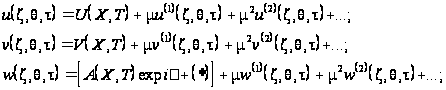
where
 and
 denote the long-wave slowly varying fields being the functions of
arguments
 and
 (these turn in constants in the linear theory);
 is the amplitude of the bending wave;
 ,
 and
are small nonresonant corrections. By substituting the expression
(20) into the governing equations (1)-(2), one obtains, after some
rearranging, the following modulation equations
(21)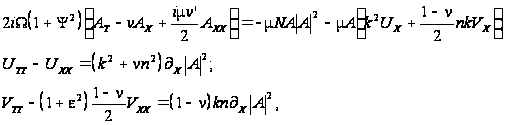
where
 is the group velocity, and
 .
Notice that eqs.(21) have a form of Zakharov-type equations.
Consider the stationary quasi-harmonic bending wave packets. Let the propagation velocity be , then eqs.(21) can be reduced to the nonlinear Schrцdinger equation
(22) ,
where the nonlinearity coefficient is equal to
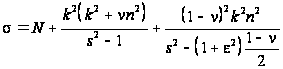 ,
while the non-oscillatory in-plane wave fields are defined by the following relations
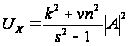
and
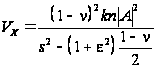 .
The theory of modulated waves predicts that the amplitude envelope of a wavetrain governed by eq.(22) will be unstable one provided the following Lighthill criterion
(23)
is satisfied.
Envelope solitons
The experiments
described in the paper [7] arise from an effort to uncover wave
systems in solids which exhibit soliton behavior. The thin open-ended
nickel cylindrical shell, having the dimensions
 cm,
 cm and
 cm, was made by an electroplating process. An acoustic beam generated
by a horn driver was aimed at the shell. The elastic waves generated
were flexural waves which propagated in the axial,
,
and circumferential,
,
direction. Let
 and
 ,
respectively, be the eigen numbers of the mode. The modes in which
is always one and
ranges from 6 to 32 were investigated. The only modes which we failed
to excite (for unknown reasons) were
=
9,10,19. A flexural wave pulse was generated by blasting the shell
with an acoustic wave train typically 15 waves long. At any given
frequency the displacement would be given by a standing wave
component and a traveling wave component. If the pickup transducer is
placed at a node in the standing wave its response will be limited to
the traveling wave whose amplitude is constant as it propagates.
The wave pulse at frequency of 1120 Hz was generated. The measured speed of the clockwise pulse was 23 m/s and that of the counter-clockwise pulse was 26 m/s, which are consistent with the value calculated from the dispersion curve (6) within ten percents. The experimentally observed bending wavetrains were best fitting plots of the theoretical hyperbolic functions, which characterizes the envelope solitons. The drop in amplitude, in 105/69 times, was believed due to attenuation of the wave. The shape was independent of the initial shape of the input pulse envelope.
The agreement
between the experimental data and the theoretical curve is excellent.
Figure 7 displays the dependence of the nonlinearity coefficient
 and eigen frequencies
 versus the wave number
of the cylindrical shell with the same geometrical dimensions as in
the work [7]. Evidently, the envelope solitons in the shell should
arise accordingly to the Lighthill criterion (23) in the range of
wave numbers
=6,7,..,32,
as
 .
REFERENCES
Bretherton FP (1964), Resonant interactions between waves, J. Fluid Mech., 20, 457-472.
Bloembergen K. (1965), Nonlinear optics, New York-Amsterdam.
Ablowitz MJ, H Segur (1981), Solitons and the Inverse Scattering Transform, SIAM, Philadelphia.
Kubenko VD, Kovalchuk PS, Krasnopolskaya TS (1984), Nonlinear interaction of flexible modes of oscillation in cylindrical shells, Kiev: Naukova dumka publisher (in Russian).
Ginsberg JM (1974), Dynamic stability of transverse waves in circular cylindrical shell, Trans. ASME J. Appl. Mech., 41(1), 77-82.
Bagdoev AG, Movsisyan LA (1980), Equations of modulation in nonlinear dispersive media and their application to waves in thin bodies, .Izv. AN Arm.SSR, 3, 29-40 (in Russian).
Kovriguine DA, Potapov AI (1998), Nonlinear oscillations in a thin ring - I(II), Acta Mechanica, 126, 189-212.