Triple-wave ensembles in a thin cylindrical shell
(11)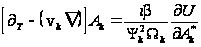 .
Here
 is the potential of the triple-wave coupling;
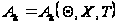 are the slowly varying amplitudes of three waves at the frequencies
 and the wave numbers
 and
 ;
 are
the group velocities;
 is the differential operator;
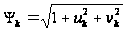 stand for the lengths of the polarization vectors (
 and
 );
 is the nonlinearity coefficient:
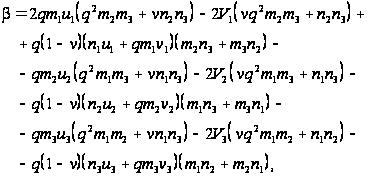
where
 .
Solutions to
eqs.(11) describe four main types of resonant triads in the
cylindrical shell, namely
 -,
 -,
 -
and
 -type
triads. Here subscripts identify the type of modes, namely ()
— longitudinal, ()
— bending, and ()
— shear mode. The first subscript stands for the primary
unstable high-frequency mode, the other two subscripts denote the
secondary low-frequency modes.
A new type of the
nonlinear resonant wave coupling appears in the cylindrical shell,
namely
-type
triads, unlike similar processes in bars, rings and plates. From the
viewpoint of mathematical modeling, it is obvious that the
Karman-type equations cannot describe the triple-wave coupling of
-,
-
and
-types,
but the
-type
triple-wave coupling only. Since
-type
triads are inherent in both the Karman and Donnell models, these are
of interest in the present study.
-triads
High-frequency
azimuthal waves in the shell can be unstable with respect to small
perturbations of low-frequency bending waves. Figure (2) depicts a
projection of the corresponding resonant manifold of the shell
possessing the spatial dimensions:
 and
 .
The primary high-frequency azimuthal mode is characterized by the
spectral parameters
 and
 (the numerical values of
and
are given in the captions to the figures). In the example presented
the phase detuning
 does
not exceed one percent. Notice that the phase detuning almost always
approaches zero at some specially chosen ratios between
 and
 ,
i.e. at some special values of the parameter
 .
Almost all the exceptions correspond, as a rule, to the long-wave
processes, since in such cases the parameter
cannot be small, e.g.
 .
NB Notice that
-type
triads can be observed in a thin rectilinear bar, circular ring and
in a flat plate.
NBThe wave modes
entering
-type
triads can propagate in the same spatial direction.
 -triads
Analogously,
high-frequency shear waves in the shell can be unstable with respect
to small perturbations of low-frequency bending waves. Figure (3)
displays the projection of the
-type
resonant manifold of the shell with the same spatial sizes as in the
previous subsection. The wave parameters of primary high-frequency
shear mode are
and
.
The phase detuning does not exceed one percent. The triple-wave
resonant coupling cannot be observed in the case of long-wave
processes only, since in such cases the parameter
cannot be small.
NBThe wave modes
entering
-type
triads cannot propagate in the same spatial direction. Otherwise, the
nonlinearity parameter
in eqs.(11) goes to zero, as all the waves propagate in the same
direction. This means that such triads are essentially
two-dimensional dynamical objects.
-triads
High-frequency
bending waves in the shell can be unstable with respect to small
perturbations of low-frequency bending and shear waves. Figure (4)
displays an example of projection of the
-type
resonant manifold of the shell with the same sizes as in the previous
sections. The spectral parameters of the primary high-frequency
bending mode are
and
.
The phase detuning also does not exceed one percent. The triple-wave
resonant coupling can be observed only in the case when the group
velocity of the primary high-frequency bending mode exceeds the
typical velocity of shear waves.
NBEssentially, the
spectral parameters of
-type
triads fall near the boundary of the validity domain predicted by the
Kirhhoff-Love theory. This means that the real physical properties of
-type
triads can be different than theoretical ones.
NB-type
triads are essentially two-dimensional dynamical objects, since the
nonlinearity parameter goes to zero, as all the waves propagate in
the same direction.
-triads
High-frequency
bending waves in the shell can be unstable with respect to small
perturbations of low-frequency bending waves. Figure (5) displays an
example of the projection of the
-type
resonant manifold of the shell with the same sizes as in the previous
sections. The wave parameters of the primary high-frequency bending
mode are
and
.
The phase detuning does not exceed one percent. The triple-wave
resonant coupling cannot also be observed only in the case of
long-wave processes, since in such cases the parameter
cannot be small.
NBThe resonant
interactions of
-type
are inherent in cylindrical shells only.
Manly-Rawe relations
By multiplying each equation of the set (11) with the corresponding complex conjugate amplitude and then summing the result, one can reduce eqs.(11) to the following divergent laws
(12)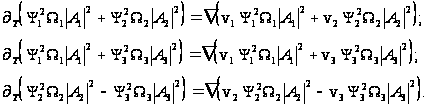
Notice that the
equations of the set (12) are always linearly dependent. Moreover,
these do not depend upon the nonlinearity potential
 .
In the case of spatially uniform wave processes (
 )
eqs.(12) are reduced to the well-known Manly-Rawe algebraic relations
(13)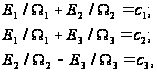
where
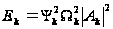 are the portion of energy stored by the quasi-harmonic mode number
 ;
 are the integration constants dependent only upon the initial
conditions. The Manly-Rawe relations (13) describe the laws of energy
partition between the modes of the triad. Equations (13), being
linearly dependent, can be always reduced to the law of energy
conservation
(14) .
Equation (14)
predicts that the total energy of the resonant triad is always a
constant value
 ,
while the triad components can exchange by the portions of energy
 ,
accordingly to the laws (13). In turn, eqs.(13)-(14) represent the
two independent first integrals to the evolution equations (11) with
spatially uniform initial conditions. These first integrals describe
an unstable hyperbolic orbit behavior of triads near the stationary
point
 ,
or a stable motion near the two stationary elliptic points
 ,
and
 .
In the case of
spatially uniform dynamical processes eqs.(11), with the help of the
first integrals, are integrated in terms of Jacobian elliptic
functions [1,2]. In the particular case, as
 or
 ,
the general analytic solutions to eqs.(11), within an appropriate
Cauchy problem, can be obtained using a technique of the inverse
scattering transform [3]. In the general case eqs.(11) cannot be
integrated analytically.
Break-up instability of axisymmetric waves
Stability prediction of axisymmetric waves in cylindrical shells subject to small perturbations is of primary interest, since such waves are inherent in axisymmetric elastic structures. In the linear approximation the axisymmetric waves are of three types, namely bending, shear and longitudinal ones. These are the axisymmetric shear waves propagating without dispersion along the symmetry axis of the shell, i.e. modes polarized in the circumferential direction, and linearly coupled longitudinal and bending waves.
It was established experimentally and theoretically that axisymmetric waves lose the symmetry when propagating along the axis of the shell. From the theoretical viewpoint this phenomenon can be treated within several independent scenarios.
The simplest
scenario of the dynamical instability is associated with the
triple-wave resonant coupling, when the high-frequency mode breaks up
into some pairs of secondary waves. For instance, let us suppose that
an axisymmetric quasi-harmonic longitudinal wave ( and
 )
travels along the shell. Figure (6) represents a projection of the
triple-wave resonant manifold of the shell, with the geometrical
sizes
 m;
 m;
 m, on the plane of wave numbers. One can see the appearance of six
secondary wave pairs nonlinearly coupled with the primary wave.
Moreover, in the particular case the triple-wave phase matching is
reduced to the so-called resonance 2:1. This one can be proposed as
the main instability mechanism explaining some experimentally
observed patterns in shells subject to periodic cinematic excitations
[4].
It was pointed out
in the paper [5] that the resonance 2:1 is a rarely observed in
shells. The so-called resonance 1:1 was proposed instead as the
instability mechanism. This means that the primary axisymmetric mode
(with
)
can be unstable one with respect to small perturbations of the
asymmetric mode (with
 )
possessing a natural frequency closed to that of the primary one.
From the viewpoint of theory of waves this situation is treated as
the degenerated four-wave resonant interaction.
In turn, one more mechanism explaining the loss of stability of axisymmetric waves in shells based on a paradigm of the so-called nonresonant interactions can be proposed [6,7,8]. By the way, it was underlined in the paper [6] that theoretical prognoses relevant to the modulation instability are extremely sensible upon the model explored. This means that the Karman-type equations and Donnell-type equations lead to different predictions related the stability properties of axisymmetric waves.
Self-action
The propagation of any intense bending waves in a long cylindrical shell is accompanied by the excitation of long-wave displacements related to the in-plane tensions and rotations. In turn, these long-wave fields can influence on the theoretically predicted dependence between the amplitude and frequency of the intense bending wave.
Moreover, quasi-harmonic bending waves, whose group velocities do not exceed the typical propagation velocity of shear waves, are stable against small perturbations within the lowest-order nonlinear approximation analysis. However amplitude envelopes of these waves can be unstable with respect to small long-wave perturbations in the next approximation.
Amplitude-frequency curve
Let us consider a stationary wave

traveling along the
single direction characterized by the ''companion'' coordinate
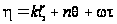 .
By substituting this expression into the first and second equations
of the set (1)-(2), one obtains the