Private sector and human-resource development in Georgia
Activities related to precious metals, precious stones and their products – Testing Supervisory Inspection of Ministry of Finance of Georgia;
Aero photographing of the country's territory, creating state geodesic network, works related to the publication of maps and plans – State Department of Geodesy and Cartography;
Activities related to job finding services (including abroad) - Ministry of Labor, Health and Social Protection;
Geologic activities - State Department of Geology;
Transportation of passengers by a minicab – Relevant Department of local government (self-government) authorities;
Activities of public dining halls, which can simultaneously accommodate 25 persons or more - Relevant Department of local government (self-government) authorities.
The notification is made as a statement, which includes:
For an individual – data about the identification card of a citizen of Georgia, registration into enterprise register, occupation, home address);
For a legal entity - the company's name, legal status, location (legal address), name of authorized representative;
Indication about the type of activity and the place, where the person carries out this activity.
Within 15 days from starting the activity, a person is required to notify about starting this activity the relevant agency, which is obliged to issue a document certifying the receipt of such notification within 3 days after receiving the notification.
The Documentation that has to be Submitted for Obtaining a License. A license seeker submits a written application about obtaining the license to a licensing agency. The application about obtaining the license should include:
For an individual:
First name, last name, date and place of birth
Registration data from the registry
Registration number
Occupation
Work and home addresses
Type of license requested
Document proving the payment of license fee
For a legal entity:
Company name
Organizational-legal status
Legal address
First and last names of company representative
Type of license requested
Proof of payment for license fee
Licensing Fee. A license seeker pays a licensing fee for issuing a license certificate. The amount of a licensing fee, the procedure of its payment into the budget and claiming back is defined in "Law of Georgia on Licensing Fees". For issuing a copy of a license, the license holder covers the cost of making a copy of the license.
Duration of a License. A license is issued for an indefinite period of time. A license holder carries out the activity defined by the license since the date of making decision by the licensing agency about issuing the license. The transfer of a license to another person is prohibited.
License Register and its Maintenance. There are two types of license register: a) Departmental license register; and b) The state license register. A licensing agency enters the data related to a license into a departmental license register within 3 days after making the decision about issuing a license. The following data is recorded into a departmental license register:
For an individual:
Data about the holder of a license (first name, last name)
Home address
The type (types) of licensed activities
The number of a license and the date of issue
Data about suspending, resuming, revoking a license or issuing a copy of the license
For a legal entity:
Data about the holder of a license (the company's name)
The company's legal status
The data of the state registration
Location (legal address)
The data about making amendments into the company's name, legal status and location (legal address), as well as about the reorganization of the company
The type (types) of licensed activities
The number of a license and the date of issue
Data about suspending, resuming, revoking a license or issuing a copy of the license
Local Enterprises
Joint Stock Companies traded at Georgian Stock Exchange
First, we will analyse the aggregate figures concerning all Joint Stock Companies (JSC) traded at Georgian Stock Exchange (GSE) and then will present the data on individual enterprises.
Market Capitalization. The figures describing the market capitalization of all Joint Stock Companies traded at GSE are presented in Table 4.1.1.1:
Table 4.1.1.1Market Capitalization of all JSCs
|
Year |
2000 |
2001 |
2002 |
|
Market Capitalization (GEL) |
66,799,785 |
184,017,886 |
218,402,008 |
|
Source: GSE |
|||
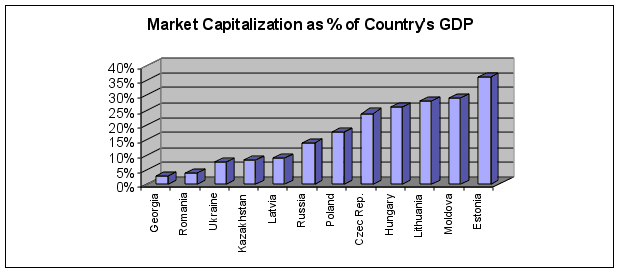

Fig. 4.1.1.1. Market Capitalization as % of GDP for Eastern European Countries, including Georgia
It is interesting to note that about 82.8% of the total market capitalization is formed by only 10 companies. The remaining 278 companies that are admitted for trading at the GSE constitute to only about 17.2% of the total market capitalization. This is shown in Fig. 4.1.1.2:
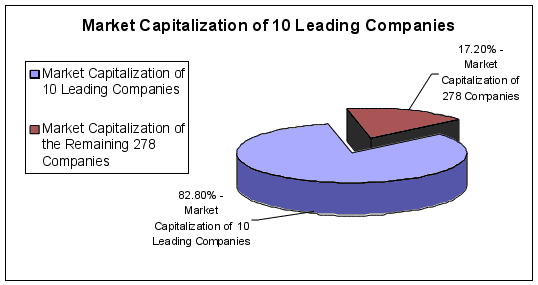
Fig. 4.1.1.2 Market Capitalization of 10 Leading Georgian Joint Stock Companies
Volume and Value of Trades. The figures given in Table 4.1.1.2 reflect the combined volume and value of trades of all Joint Stock Companies conducted at GSE since its inception to date.
Table 4.1.1.2 Volume & Value of Trades at GSE
|
Year |
2000* |
2001 |
2002 |
2003** |
|
Volume of Trades (Shares) |
4,354,640 |
10,862,784 |
11,418,196 |
5,103,555 |
|
Value of Trades (GEL) |
5,892,326 |
13,077,244 |
8,401,206 |
1,398,781 |
|
* Apr. – Dec. 2000; ** Jan. – Oct. 2003. Source: GSE |
||||
Value Turnover. The value turnover is calculated by dividing the annual value of trades over the total market capitalization in that year. This is shown in Table 4.1.1.3 for years 2001 and 2002:
|
Year |
2001 |
2002 |
|
Value of Trades (GEL) |
13,077,244 |
8,401,206 |
|
Market Capitalization (GEL) |
184,017,886 |
218,402,008 |
|
Value Turnover |
7.11% |
3.85% |
|
Source: GSE |
||
The large part of the total value of trades comes on the trading of the securities of 10 leading companies mentioned in the above. This is shown in Fig. 4.1.1.3:
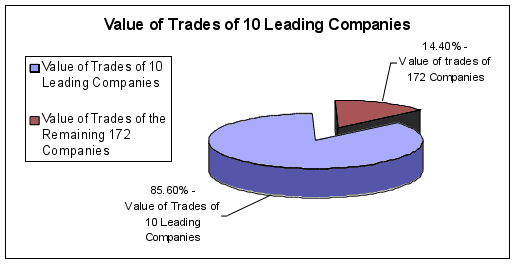
Fig. 4.1.1.3 Value of Trades of 10 Leading Georgian Companies
Liquidity. All the factors considered in the previous paragraphs, i.e. Low Market Capitalization, low Volume and Value of Trades, and low Value Turnover, all indicate that there is little (or even no) liquidity at the GSE. Indeed, out of 282 companies, whose shares are currently admitted for trading at the GSE, the shares of only 93 companies (i.e. 33%) were traded in 2002. The shares of the remaining companies were not traded during the year at all. This is shown in Figure 4.1.1.4:
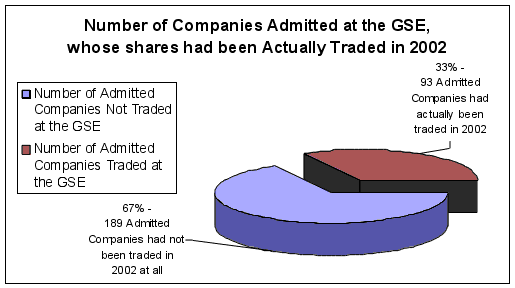
Fig. 4.1.1.4 Number of Admitted Companies Actually Traded in 2002
Even those companies, whose shares have been traded in the past, do not satisfy the requirements for getting listed at the GSE. The main listing criteria are: a) Company should be functioning for more than 3 years; b) Equity Capital of a company should be greater than 100,000 USD; and c) Company should be profitable for 2 years during the last 3-year period (GSE, 2003). Out of 282 companies, only 2 companies were listed at the GSE in 2001, while only 1 company has been left listed in 2002, after the GSE removed 1 company from the list. Furthermore, the total number of trades and therefore an average number of trades per trading session are also extremely low, as shown in Tab. 4.1.1.4:
Table 4.1.1.4 Average Number of Trades per Trading Session
|
Year |
2000 |
2001 |
2002 |
|
Total Number of Trades |
601 |
1,591 |
1,343 |
|
Number of Trading Sessions |
80 |
102 |
102 |
|
Average Number of Trades per Session* |
8 |
16 |
13 |
|
* Figures are Rounded to the Nearest Integer Source: GSE |
|||
In total, 309 trading sessions have been held during 2000 – 2003 and 3780 trades have been executed during this period. It then follows, that average number of trades per trading session (i.e. per day) is equal to 12. This figure gives some idea about the number of buyers and sellers participating in trades each day. Also note that the total number of the securities admitted for trading at the GSE is equal to 282. All these means that there are virtually no liquid shares at the GSE.
Composite Index. The poor performance of the GSE in terms of all the above-mentioned market indicators indicate that the nature of the composite index would be rather unreliable and would not reflect the true picture of market performance. One solution to the problem is to select only the leading companies (blue-chip companies) and construct the index for these companies. Indeed, such approach is employed by Georgian Investment Bank Galt & Taggart (G&T) Securities LLC, which publishes so-called G&T Blue-Chip Index. This is shown in Fig. 4.1.1.5:
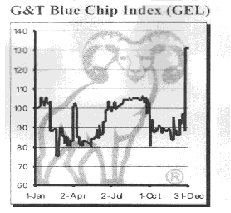
Fig. 4.1.1.5 G&T Blue-Chip Index (GEL), 2002
 The
problems facing GSE. Below is the problem tree
describing the set of problems currently facing GSE:
General recommendations for improving the performance of GSE. The fact that at present there is no sound and liquid capital market in Georgia can be attributed to two fundamental problems: (I) A low potential of the capital market in Georgia; and (II) A high unrealized potential of Georgian capital market. The government of Georgia (GoG) should undertake both, long-term and short-to-medium term measures in order to improve the performance of Georgian Stock Exchange (GSE).
(I) It is suggested that the potential of the capital market in Georgia could be increased by means of:
Long-term goals:
Increasing the rate of country's economic growth;
Reducing the size of the shadow economy;
Attracting higher Foreign Direct Investments (FDI).
short-to-medium term goals:
Conducting the 2nd round of the privatization through GSE by involving investment funds into the privatization process;
Including the majority of leading Georgian companies into the listing of the securities traded at GSE.
(II) A high unrealized potential of Georgian capital market can be explained by low confidence (trust) amongst the investors towards the stock market, which in turn is the result of the problems existing in terms of protecting the shareholders' rights. In order to solve the latter problem, there is a need: (i) to improve the corporate governance practice, and (ii) to ensure the fairness of the market. These mainly are the goals that can be achieved in short-to-medium term.
The measures needed to improve the corporate governance practice in Georgia include:
To simplify the tax system;
To adopt the International Standards on Auditing (ISA) into law;
To enforce the International Accounting Standards (IAS).
These measures are designed to remove the incentives to pay bribes for the purposes of hiding profits and avoiding paying taxes, which would result in lower levels of corruption in tax administrations and increased transparency of corporate disclosure.
Another measure to improve the corporate governance practice in Georgia is:
To conduct an educational campaign amongst shareholders, company directors and the members of supervisory boards.
The objective of the educational campaign is to lessen the entrenched culture of abusive self-dealing and to give to shareholders sufficient knowledge about their rights. The entrenched culture of abusive self-dealing can also be alleviated by means of putting in place effective regulations and institutions for controlling the self-dealing. All these should lead to regular shareholder meetings and increase the role of the supervisory boards in giving the strategic direction to companies.
Another important factor for improving the corporate governance practice in Georgia is to have an active market for corporate control. Namely, there is a need:
To put in place an adequate legislation for investor protection. More specifically, to introduce the investment compensation schemes, strengthen the bankruptcy system and adopt the rules for takeovers;
To adopt the legislation regulating the financial intermediaries (such as private pension funds and mutual funds), which at present are absent in Georgia.
Properly functioning financial intermediaries would act as large domestic institutional investors and ensure that large volumes of capital resources are directed to the market. This, in turn, would facilitate the competition in the financial market and lead to an active market for corporate control.
The measures needed to ensure the fairness of the market include:
To Enforce a trading transparency;
To deter an unfair trading.
The last two objectives can be reached by means of ensuring an effective functioning of the National Securities Commission of Georgia (NSCG), which should be capable of ensuring an effective enforcement of the securities regulations. More specifically:
The NSCG should have an adequate Inspection, Investigation and Enforcement power, including the criminal prosecution authority;
The Government of Georgia (GoG) should increase the budgetary support of the NSCG to ensure a proper functioning of the agency;
The NSCG should be more accountable to GoG for its activities regarding the regulation of Georgian capital market;
The NSCG should develop a program to supervise the activities of Self Regulatory Organizations (SROs); and
The NSCG has to develop a code of ethics for its staff.
Another measure needed to ensure the fairness of the market is:
To enforce adequately the rights of the shareholders, which should be done through the improved court system.
In order to improve Georgian court system, it is important to conduct training of judges in the topics concerning the corporate law and operation of the securities market
All the above-described measures are designed to achieve in future a sound and liquid capital market in Georgia.
Specific recommendations for improving the performance of GSE. More specific recommendations, together with the objectives to be achieved, performance indicators, responsible agencies, duration, etc., are presented in the next page. Objectives given in parenthesis correspond to the Problem Tree given in the above:
|
Recommendations |
Objectives to be Achieved |
Performance Indicators |
Responsible Agencies |
Duration |
Comment |
|
|
|