Private sector and human-resource development in Georgia
The World Bank has taken the lead in the policy dialogue on structural issues, focusing on: (i) strengthening public expenditure management; (ii) deepening and diversifying sources of growth, (iii) protecting the environment; and (iv) reducing poverty. The table on page 53 summarizes the division of responsibility between the two institutions. In a number of areas – for example the social sectors, rural development, environment, and infrastructure – the Bank takes the lead in the dialogue and there is no cross conditionality with the IMF-supported program. The Bank is also leading the dialogue on private sector reform, and Bank analysis serves as inputs into the Fund program. In other areas – energy, the financial sector, public expenditure management, and revenue and customs – both institutions work together. Finally, in areas like monetary policy the IMF takes the lead with little Bank involvement.
Areas in which the World Bank leads and there is no direct IMF involvement
Areas in which the Bank leads and there is no direct IMF involvement include the social sectors, infrastructure and environment.
In the social sectors the Bank conducts annual updates of Georgia’s Poverty Assessment based on household data collected on a quarterly basis. The Bank’s focus has been to improve the budget execution of expenditures for health, education and poverty benefits and to raise the efficiency in the use of scarce public resources. Through the Social Investment Fund Credits IDA is focusing in particular on areas with high poverty levels to provide basic infrastructure to the poorest communities. A recently approved Self-reliance Fund Grant will help authorities address the complex issues related to internally displaced people. IDA is also supporting a dialogue with the Government on social protection reform that may lead to an IDA-supported project.
In education the Education Adaptable Program Credit aims at improving the learning outcomes of primary and secondary students, through curriculum reform, development of an examination system, training of teachers, provision of learning materials, and development of capacity to make better use of Georgia’s physical, financial and human resources. While the investment needs of school buildings are substantially higher than is currently affordable for Georgia, the Social Investment Fund projects continue to assist in financing urgent repairs to school facilities in many communities.
In health IDA Credits to support the Government in improving the health care financing system, exploring risk-pooling options, introducing a new system of primary health care and improving the focus of services funded through public funds on the poor and on priority public health interventions. In addition hospital restructuring has been supported by SAC 3 and the Structural Reform Support Credit.
In infrastructure support is being provided through the Municipal Development and Decentralization Credit and the Social Investment Fund Credit. These projects are providing financing at the community level for critical infrastructure needs, primarily for school and health facilities heating and repair, small hydropower schemes to provide electricity, drinking water and sanitation rehabilitation, as well as transportation infrastructure rehabilitation.
In rural development IDA credits have supported the development of private sector farming and agro-processing improvements, agricultural credit, irrigation and drainage, and agriculture research and extension. IDA has also been supporting the creation of local institutions such as rural credit unions and water users associations through its Credits.
Areas in which the World Bank leads and its analysis serves as input into the IMF program
The Bank has been leading the dialogue on structural reforms through SAC 3, approved by the Bank’s Board of Executive Directors in June, 1999, and closed in October, 2002. Despite considerable delays, the core conditions of SAC 3 were met, but their impact was reduced by poor governance. Institution building and technical assistance has been supported through the Structural Reform Support Credit, also approved by the Bank’s Board of Executive Directors on June 29, 1999. The Bank also leads in the areas of:
Private sector development. SAC 3 supported improvements in the environment for private sector development, focusing on: (i) simpler licensing regulations; (ii) more transparent government procurement; (iii) reduced cost of entry for businesses; and (iv) privatization of state-owned commercial assets. IDA has also been supporting private sector participation in other areas such as energy, telecommunications, urban services and agriculture. The IMF has worked with the authorities to initiate audits of the 2002 accounts of three major state owned enterprises.
Energy. The energy system is in poor condition, with unreliable supply, massive non-payment and mounting debts. IDA has been working with other donors, including the IMF, to encourage more private management and ownership, and to implement a series of short-term action plans to improve the overall functioning of the sector. The IMF has also been focusing on improved payments for electricity.
Public Sector Management. The Bank is supporting the development of a civil service reform program, while the Fund is providing technical assistance in support of tax and customs administration reform.
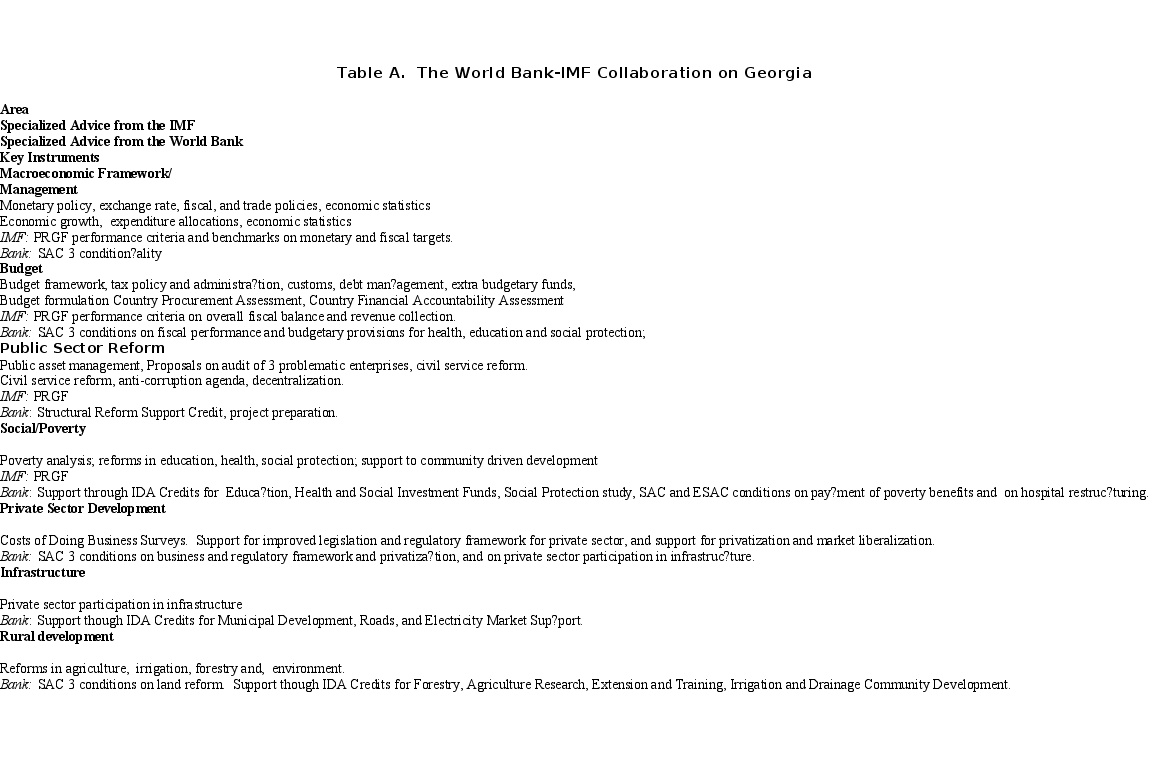
Areas of shared responsibility of the World Bank and IMF
The Bank and the Fund have been working jointly in the following main areas (supported by the Bank’s SAC 3 and Structural Reform Support Credit, several investment operations and the Fund’s PRGF):
Poverty Reduction Strategy. Both institutions have been working closely with the Government to provide support to the development of the PRSP, through seminars and workshops, direct staff input, and a multi-donor Trust Fund to support the work of the PRSP secretariat..
Budget Planning and Execution. The annual process-based Public Expenditure Reviews will provide the underpinnings for systemic changes in expenditure management, with the immediate aim being improved budget formulation in 2004. The IMF is focusing on Treasury reform within the Ministry of Finance.
Financial Sector Reforms. The joint Financial Sector Assessment Program has supported: (i) strengthened banking and non-banking supervision; (ii) introduction of international accounting standards; (iii) and consolidation of banks through higher capital requirement ratios; and (iv) anti money-laundering legislation. The IMF has focused in particular on banking supervision.
Debt Sustainability Analysis (DSA). Given Georgia’s heavy external debt burden, the Bank and the Fund conduct joint Debt Sustainability Analysis on a regular basis.
Areas in which the IMF leads and its analysis serves as input into the World Bank program
Fiscal Framework. The IMF’s focus on prudent fiscal policy has served as an important framework for IDA’s work on public expenditure management.
Areas in which the IMF leads and there is no direct World Bank involvement
Monetary Framework. The IMF closely collaborates with the NBG in the design and implementation of a monetary program that aims at remonetization of the economy, while keeping inflation low and the exchange rate of the Lari stable
Economic Statistics. IMF technical assistance has been conducive to improvements in national accounts, price, monetary and government financial statistics.
The World Bank Country Assistance Strategy for Georgia
|
Activities (as identified in the EDPRP) |
Responsible Agencies |
Focus of Bank Actions |
Expected Results FY04-06 |
Bank Group Program |
Part-ners |
WB Performance Indicators for End FY06 |
|
Improvement of Governance |
||||||
|
State Chancellery, Ministry of Justice, Ministry of Finance relevant executive government bodies |
Assistance to the State Chancellery in carrying out a functional analysis of the central government agencies and assessment of budgetary employment, remuneration, and training policy; on the basis of the above studies, develop recommendations |
Widely owned program to improve functioning of government administration and agencies; remuneration and retrenchment policy for core civil service introduced, and plans for civil service training developed |
Public Sector Management Project |
DFID, USAID, UNDP |
Initiation of reform and restructuring of civil service |
|
State Chancellery of Georgia, Ministry of Justice |
Review of the existing legal framework |
Initiation of legislative change and amendments |
Public Sector Management Project; Public Expenditure Reviews |
DFID EU USAID UNDP |
Duplications and overlap among the central state agencies reduced, mandates more clearly defined |
|
State Chancellery, Ministry of Economy, Industry and Trade, Agency of State Property Management, Ministry of Justice, Ministry of Finance |
Advice on financing mechanism for transfer of road and transport properties and legal mechanisms for owning and managing very low volume farm access roads |
Revised functional/administration classification of roads; sound allocation formula for dividing Road Fund revenues between road owners |
Secondary Roads Project; Trade and Transport Facilitation Project; Rural Infrastructure Study |
Kuwait Fund for Economic Development |
New road classification; new procedures for managing the road fund, including allocation of funds between road owners |
|
Macroeconomic Stability |
||||||
|
Ministry of Economy, Industry and Trade |
Improvement of linkage between policy, resource constraints and budgets |
Develop a more realistic medium-term budget framework |
Public Expenditure Reviews, PRSC in High Case |
IMF DFID |
Budget execution closer to planned |
|
National Bank |
Assistance to the MoF develop long-term debt instruments, e.g. government bond market |
MoF starts to use medium to long-term government bonds to replace the rolling of short-term debt instruments |
Financial Sector Advisory Program |
IMF |
1-10 year government bond market in place |
|
National Bank |
Advise to National Bank on management of reserves |
Increased import coverage |
Financial Sector Advisory Program |
IMF |
Gross foreign reserves to reach over 2 months of imports |
|
Ministry of Finance, State Tax and Customs Departments |
Development of a business-friendly tax environment |
Increased collection of excise taxes and improved VAT administration |
Public Expenditure Reviews, Business Environment Study, PRSC in High Case |
IMF USAID EU |
Collection of excise taxes to reach over 2 percent of GDP |
|
Ministry of Finance |
Assistance to the MOF to improve its cash and debt management capacity and skills |
Consolidation of effective control system, and adoption of a single treasury account |
CPAR Updates, Public Expenditure Reviews, PRSC in High Case |
IMF |
Improved cash management and debt management capacity |
|
State Procurement Department, Ministry of Economy, Industry and Trade |
Establishment of a transparent state procurement system; decentralization of State procurement functions to line agencies |
Greater efficiency and competition within the system; reduced delays and corruption in procurement process |
CPAR, Public Expenditure Reviews, PRSC, project lending (e.g. Secondary Roads and Trade and Transport Facilitation) |
Recommendations of Country Portfolio Assessment Report implemented |
|
|
Ministry of Finance, Ministry of Economy, Industry and Trade |
Develop program-based budgeting |
Improve consistency between medium-term indicative plan and the budget |
Public Expenditure Reviews, Public Sector Management Credit, PRSC in High Case |
DFID |
Public Expenditure Reviews assessment of better targeting of programs in the budget |
|
Ministry of Finance |
Establish accurate estimates of past government liabilities |
Better information on, and reduction in, arrears |
CFAA Updates, Public Expenditure Reviews |
IMF |
Reduced arrears |
|
Ministry of Finance, National Bank, National Commission of Securities |
More competitive and efficient T-bill market |
Short term: more participants for competitive bidding, and for non-competitive quota; medium term: cash management, coordination between MOF & NBG on T-bills/open market operations; long term: independent debt management office |
Financial Sector Advisory Program, PRSC in High Case |
USAID FIRST |
Lower T-bill yield |
|
Ministry of Finance, National Commission of Securities |
Help build legal environment for investment funds; provide information/advice |
Establishment of legal environment for investment funds |
Financial Sector Advisory Program |
Regulation of investment funds in place; NCS has capacity to supervise those funds |
|
|
Ministry of Labor, Health and Social Protection |
Support to Ministry of Labor, Health and Social Protection on legal reforms and their implementation |
Law adopted successfully |
Social Protection Reform Project |
Regularization of 1st pillar of pension system; better links between pensions and contributions |
|
|
National Securities Commission, Ministry of Labor, Health and Social Protection |
Support to National Securities Commission and Ministry of Labor, Health and Social Protection on legal reforms and their implementation |
Normative acts developed and adopted |
Social Protection Reform Project |
Improved regulatory environment in the area of private pensions |
|
|
Ministry of Finance, State Service of Insurance Supervision, National Commission of Securities |
Support to relevant agencies on amendments to tax code and investment rules |
Improved functioning of Если Вам нужна помощь с академической работой (курсовая, контрольная, диплом, реферат и т.д.),
обратитесь к нашим специалистам. Более 90000 специалистов готовы Вам помочь.
Бесплатные корректировки и доработки. Бесплатная оценка стоимости работы.
Нужна помощь в написании работы?
Мы - биржа профессиональных авторов (преподавателей и доцентов вузов). Пишем статьи РИНЦ, ВАК, Scopus.
Помогаем в публикации. Правки вносим бесплатно.
Похожие рефераты: |