BRITISH MONARCHY AND ITS INFLUENCE UPON GOVERNMENTAL INSTITUTIONS
1470–1471)
Richard, Duke = Cecily Elizabeth of York, = HENRY VII
 of
York Neville
dau. of EDWARD
IV
(1485–1509)


EDWARD IV = Elizabeth, dau. RICHARD III
(1461–1470,
of Sir Richard
(1483–1485)
1471–1483) Woodville
EDWARD V Elizabeth = HENRY VII
(1483) (1485–1509)
HENRY III (1216-1272)
H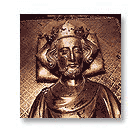 enry
III, King John's son, was only nine when he became King. By 1227,
when he assumed power from his regent, order had been restored, based
on his acceptance of Magna Carta. However, the King's failed
campaigns in France (1230 and 1242), his choice of friends and
advisers, together with the cost of his scheme to make one of his
younger sons King of Sicily and help the Pope against the Holy Roman
Emperor, led to further disputes with the barons and united
opposition in Church and State. Although Henry was extravagant and
his tax demands were resented, the King's accounts show a list of
many charitable donations and payments for building works (including
the rebuilding of Westminster Abbey which began in 1245). The
Provisions of Oxford (1258) and the Provisions of Westminster (1259)
were attempts by the nobles to define common law in the spirit of
Magna Carta, control appointments and set up an aristocratic council.
Henry tried to defeat them by obtaining papal absolution from his
oaths, and enlisting King Louis XI's help. Henry renounced the
Provisions in 1262 and war broke out. The barons, under their leader,
Simon de Montfort, were initially successful and even captured Henry.
However, Henry escaped, joined forces with the lords of the Marches
(on the Welsh border), and Henry finally defeated and killed de
Montfort at the Battle of Evesham in 1265. Royal authority was
restored by the Statute of Marlborough (1267), in which the King also
promised to uphold Magna Carta and some of the Provisions of
Westminster.
E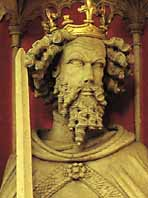 DWARD
I (1272-1307)
Born in June 1239 at Westminster, Edward was named by his father Henry III after the last Anglo Saxon king (and his father's favourite saint), Edward the Confessor. Edward's parents were renowned for their patronage of the arts (his mother, Eleanor of Provence, encouraged Henry III to spend money on the arts, which included the rebuilding of Westminster Abbey and a still-extant magnificent shrine to house the body of Edward the Confessor), and Edward received a disciplined education - reading and writing in Latin and French, with training in the arts, sciences and music. In 1254, Edward travelled to Spain for an arranged marriage at the age of 15 to 9-year-old Eleanor of Castile. Just before Edward's marriage, Henry III gave him the duchy of Gascony, one of the few remnants of the once vast French possessions of the English Angevin kings. Gascony was part of a package which included parts of Ireland, the Channel Islands and the King's lands in Wales to provide an income for Edward. Edward then spent a year in Gascony, studying its administration. Edward spent his young adulthood learning harsh lessons from Henry III's failures as a king, culminating in a civil war in which he fought to defend his father. Henry's ill-judged and expensive intervention in Sicilian affairs (lured by the Pope's offer of the Sicilian crown to Henry's younger son) failed, and aroused the anger of powerful barons including Henry's brother-in-law Simon de Montfort. Bankrupt and threatened with excommunication, Henry was forced to agree to the Provisions of Oxford in 1258, under which his debts were paid in exchange for substantial reforms; a Great Council of 24, partly nominated by the barons, assumed the functions of the King's Council. Henry repudiated the Provisions in 1261 and sought the help of the French king Louis IX (later known as St Louis for his piety and other qualities). This was the only time Edward was tempted to side with his charismatic and politically ruthless godfather Simon de Montfort - he supported holding a Parliament in his father's absence. However, by the time Louis IX decided to side with Henry in the dispute and civil war broke out in England in 1263, Edward had returned to his father's side and became de Montfort's greatest enemy. After winning the battle of Lewes in 1264 (after which Edward became a hostage to ensure his father abided by the terms of the peace), de Montfort summoned the Great Parliament in 1265 - this was the first time cities and burghs sent representatives to the parliament. (Historians differ as to whether de Montfort was an enlightened liberal reformer or an unscrupulous opportunist using any means to advance himself.) In May 1265, Edward escaped from tight supervision whilst hunting. On 4 August, Edward and his allies outmanoeuvred de Montfort in a savage battle at Evesham; de Montfort predicted his own defeat and death 'let us commend our souls to God, because our bodies are theirs ... they are approaching wisely, they learned this from me.' With the ending of the civil war, Edward worked hard at social and political reconciliation between his father and the rebels, and by 1267 the realm had been pacified. In April 1270 Parliament agreed an unprecedented levy of one-twentieth of every citizen's goods and possessions to finance Edward's Crusade to the Holy Lands. Edward left England in August 1270 to join the highly respected French king Louis IX on Crusade. At a time when popes were using the crusading ideal to further their own political ends in Italy and elsewhere, Edward and King Louis were the last crusaders in the medieval tradition of aiming to recover the Holy Lands. Louis died of the plague in Tunis before Edward's arrival, and the French forces were bought off from pursuing their campaign. Edward decided to continue regardless: 'by the blood of God, though all my fellow soldiers and countrymen desert me, I will enter Acre ... and I will keep my word and my oath to the death'. Edward arrived in Acre in May 1271 with 1,000 knights; his crusade was to prove an anticlimax. Edward's small force limited him to the relief of Acre and a handful of raids, and divisions amongst the international force of Christian Crusaders led to Edward's compromise truce with the Baibars. In June 1272, Edward survived a murder attempt by an Assassin (an order of Shi'ite Muslims) and left for Sicily later in the year. He was never to return on crusade. Meanwhile, Henry III died on 16 November 1272. Edward succeeded to the throne without opposition - given his track record in military ability and his proven determination to give peace to the country, enhanced by his magnified exploits on crusade. In Edward's absence, a proclamation in his name delcared that he had succeeded by hereditary right and the barons swore allegeiance to him. Edward finally arrived in London in August 1274 and was crowned at Westminster Abbey. Aged 35, he was a veteran warrior ('the best lance in all the world', according to contemporaries), a leader with energy and vision, and with a formidable temper. Edward was determined to enforce English kings' claims to primacy in the British Isles. The first part of his reign was dominated by Wales. At that time, Wales consisted of a number of disunited small Welsh princedoms; the South Welsh princes were in uneasy alliance with the Marcher lords (feudal earldoms and baronies set up by the Norman kings to protect the English border against Welsh raids) against the Northern Welsh based in the rocky wilds of Gwynedd, under the strong leadership of Llywelyn ap Gruffyd, Prince of Gwynedd. In 1247, under the Treaty of Woodstock, Llywelyn had agreed that he held North Wales in fee to the English king. By 1272, Llywelyn had taken advantage of the English civil wars to consolidate his position, and the Peace of Montgomery (1267) had confirmed his title as Prince of Wales and recognised his conquests. However, Llywelyn maintained that the rights of his principality were 'entirely separate from the rights' of England; he did not attend Edward's coronation and refused to do homage. Finally, in 1277 Edward decided to fight Llywelyn 'as a rebel and