BRITISH MONARCHY AND ITS INFLUENCE UPON GOVERNMENTAL INSTITUTIONS
He was proclaimed Lord Protector immediately after his father's death, on 3rd September 1658. Unfortunately, the Commonwealth had been held together by his father and Richard was no Oliver. It was an unstable mixture of zealous reform and a yearning for stability, Parliamentary authority and military power.
Richard soon faced serious problems. The army were disillusioned with a government that had grown increasingly ceremonious. They grew more restless when Richard appointed himself commander in chief. A new Parliament was elected in 1659 but a vacuum of power prompted the army council to seize power. In April 1659 it forced Richard to dissolve Parliament.
The officers now recalled the Rump Parliament, dissolved by Oliver Cromwell in 1653. It dismissed Richard as Lord Protector; he officially abdicated in May. Yet the Rump was incapable of governing without financial and military support and the army itself remained bitterly divided. George Monck, one of the army's most capable officers, marched south from Scotland to protect Parliament but, on arriving in London, realised that only the restoration of Charles II could put an end to the political chaos that now gripped the state.
Richard, having amassed large debts during his time in office, left for Paris in 1660 to escape his creditors, living under the name of John Clarke. After living in Geneva, he returned to England in around 1680, where he lived quietly until his death.
C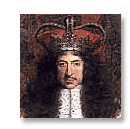 HARLES
II (1660-85)
Although those who had signed Charles I's death warrant were punished (nine regicides were put to death, and Cromwell's body was exhumed from Westminster Abbey and buried in a common pit), Charles pursued a policy of political tolerance and power-sharing. In April 1660, fresh elections had been held and a Convention met with the House of Lords. Parliament invited Charles to return, and he arrived at Dover on 25 May.
Despite the bitterness left from the Civil Wars and Charles I's execution, there were few detailed negotiations over the conditions of Charles II's restoration to the throne. Under the Declaration of Breda of May 1660, Charles had promised pardons, arrears of Army pay, confirmation of land purchases during the Interregnum and 'liberty of tender consciences' in religious matters, but several issues remained unresolved. However, the Militia Act of 1661 vested control of the armed forces in the Crown, and Parliament agreed to an annual revenue of Ј1,200,000 (a persistent deficit of Ј400,000-500,000 remained, leading to difficulties for Charles in his foreign policy). The bishops were restored to their seats in the House of Lords, and the Triennial Act of 1641 was repealed - there was no mechanism for enforcing the King's obligation to call Parliament at least once every three years. Under the 1660 Act of Indemnity and Oblivion, only the lands of the Crown and the Church were automatically resumed; the lands of Royalists and other dissenters which had been confiscated and/or sold on were left for private negotiation or litigation.
The early years of Charles's reign saw an appalling plague which hit the country in 1665 with 70,000 dying in London alone, and the Great Fire of London in 1666 which destroyed St Paul's amongst other buildings. Another misfortune included the second Dutch war of 1665 (born of English and Dutch commercial and colonial rivalry). Although the Dutch settlement of New Amsterdam was overrun and renamed New York before the war started, by 1666 France and Denmark had allied with the Dutch. The war was dogged by poor administration culminating in a Dutch attack on the Thames in 1667; a peace was negotiated later in the year.
In 1667, Charles dismissed his Lord Chancellor, Clarendon - an adviser from Charles's days of exile (Clarendon's daughter Anne was the first wife of Charles's brother James and was mother of Queens Mary and Anne). As a scapegoat for the difficult religious settlement and the Dutch war, Clarendon had failed to build a 'Court interest' in the Commons. He was succeeded by a series of ministerial combinations, the first of which was that of Clifford, Ashley, Buckingham, Arlington and Lauderdale (whose initials formed the nickname Cabal). Such combinations (except for Danby's dominance of Parliament from 1673 to 1679) were largely kept in balance by Charles for the rest of his reign.
Charles's foreign policy was a wavering balance of alliances with France and the Dutch in turn. In 1670, Charles signed the secret treaty of Dover under which Charles would declare himself a Catholic and England would side with France against the Dutch - in return Charles would receive subsidies from the King of France (thus enabling Charles some limited room for manoeuvre with Parliament, but leaving the possibility of public disclosure of the treaty by Louis). Practical considerations prevented such a public conversion, but Charles issued a Declaration of Indulgence, using his prerogative powers to suspend the penal laws against Catholics and Nonconformists. In the face of an Anglican Parliament's opposition, Charles was eventually forced to withdraw the Declaration in 1673.
In 1677 Charles married his niece Mary to William of Orange partly to restore the balance after his brother's second marriage to the Catholic Mary of Modena and to re-establish his own Protestant credentials. This assumed a greater importance as it became clear that Charles's marriage to Catherine of Braganza would produce no legitimate heirs (although Charles had a number of mistresses and illegitimate children), and his Roman Catholic brother James's position as heir apparent raised the prospect of a Catholic king.
Throughout Charles's reign, religious toleration dominated the political scene. The 1662 Act of Uniformity had imposed the use of the Book of Common Prayer, and insisted that clergy subscribe to Anglican doctrine (some 1,000 clergy lost their livings). Anti-Catholicism was widespread; the Test Act of 1673 excluded Roman Catholics from both Houses of Parliament. Parliament's reaction to the Popish Plot of 1678 (an allegation by Titus Oates that Jesuit priests were conspiring to murder the King, and involving the Queen and the Lord Treasurer, Danby) was to impeach Danby and present a Bill to exclude James (Charles's younger brother and a Roman Catholic convert) from the succession. In 1680/81 Charles dissolved three Parliaments which had all tried to introduce Exclusion Bills on the basis that 'we are not like to have a good end'.
Charles sponsored the founding of the Royal Society in 1660 (still in existence today) to promote scientific research. Charles also encouraged a rebuilding programme, particularly in the last years of his reign, which included extensive rebuilding at Windsor Castle, a huge but uncompleted new palace at Winchester and the Greenwich Observatory. Charles was a patron of Christopher Wren in the design and rebuilding of St Paul's Cathedral, Chelsea Hospital (a refuge for old war veterans) and other London buildings.
Charles died in 1685, becoming a Roman Catholic on his deathbed.
JAMES II (1685-88)
B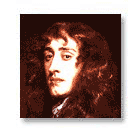 orn
in 1633 and named after his grandfather James I, James II grew up in
exile after the Civil War (he served in the armies of Louis XIV) and,
after his brother's restoration, commanded the Royal Navy from 1660
to 1673. James converted to Catholicism in 1669. Despite his
conversion, James II succeeded to the throne peacefully at the age of
51. His position was a strong one - there were standing armies of
nearly 20,000 men in his kingdoms and he had a revenue of around Ј2
million. Within days of his succession, James announced the summoning
of Parliament in May but he sounded a warning note: 'the best way to
engage me to meet you often is always to use me well'. A rebellion
led by Charles's illegitimate son, the Duke of Monmouth, was easily
crushed after the battle of Sedgemoor in 1685, and savage punishments
were imposed by the infamous Lord Chief Justice, Judge Jeffreys, at
the 'Bloody Assizes'.
James's reaction to the Monmouth rebellion was to plan the increase of the standing army and the appointment of loyal and experienced Roman Catholic officers. This, together with James's attempts to give civic equality to Roman Catholic and Protestant dissenters, led to conflict with Parliament, as it was seen as James showing favouritism towards Roman Catholics. Fear of Catholicism was widespread (in 1685, Louis XIV revoked the Edict of Nantes which gave protection to French Protestants), and the possibility of a standing army led by Roman Catholic officers produced protest in Parliament. As a result, James prorogued Parliament in 1685 and ruled without it.
James attempted to promote the Roman Catholic cause by dismissing judges and Lord Lieutenants who refused to support the withdrawal of laws penalising religious dissidents, appointing Catholics to important academic posts, and to senior military and political positions. Within three years, the majority of James's subjects had been alienated.
In 1687 James issued the Declaration of Indulgence aiming at religious toleration; seven bishops who asked James to reconsider were charged with seditious libel, but later acquitted to popular Anglican acclaim. When his second (Roman Catholic) wife, Mary of Modena, gave birth on 10 June 1688 to a son (James Stuart, later known as the 'Old Pretender' and father of Charles Edward Stuart, 'Bonnie Prince Charlie'), it seemed that a Roman Catholic dynasty would be established. William of Orange, Protestant husband of James's elder daughter, Mary (by James's first and Protestant wife, Anne Hyde), was therefore welcomed when he invaded on 5 November 1688. The Army and the Navy (disaffected despite James's investment in them) deserted to William, and James fled to France.
James's attempt to regain the throne by taking a French army to Ireland failed - he was defeated at the Battle of the Boyne in 1690. James spent the rest of his life in exile in France, dying there in 1701.
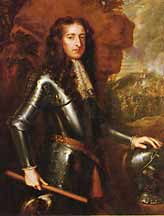
WILLIAM III (1689-1702) AND MARY II (1689-94)
In 1689 Parliament declared that
James had abdicated by deserting his kingdom. William (reigned
1689-1702) and Mary (reigned 1689-94) were offered t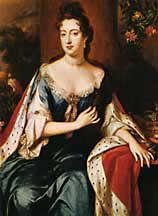 he
throne as joint monarchs. They accepted a Declaration of Rights
(later a Bill), drawn up by a Convention of Parliament, which limited
the Sovereign's power, reaffirmed Parliament's claim to control
taxation and legislation, and provided guarantees against the abuses
of power which James II and the other Stuart Kings had committed. The
exclusion of James II and his heirs was extended to exclude all
Catholics from the throne, since 'it hath been found by experience
that it is inconsistent with the safety and welfare o
 f
this protestant kingdom to be governed by a papist prince'. The
Sovereign was required in his coronation oath to swear to maintain
the Protestant religion.
The Bill was designed to ensure Parliament could function free from royal interference. The Sovereign was forbidden from suspending or dispensing with laws passed by Parliament, or imposing taxes without Parliamentary consent. The Sovereign was not allowed to interfere with elections or freedom of speech, and proceedings in Parliament were not to be questioned in the courts or in any body outside Parliament itself. (This was the basis of modern parliamentary privilege.) The Sovereign was required to summon Parliament frequently (the Triennial Act of 1694 reinforced this by requiring the regular summoning of Parliaments). Parliament tightened control over the King's expenditure; the financial settlement reached with William and Mary deliberately made them dependent upon Parliament, as one Member of Parliament said, 'when princes have not needed money they have not needed us'. Finally the King was forbidden to maintain a standing army in time of peace without Parliament's consent.
The Bill of Rights added further defences of individual rights. The King was forbidden to establish his own courts or to act as a judge himself, and the courts were forbidden to impose excessive bail or fines, or cruel and unusual punishments. However, the Sovereign could still summon and dissolve Parliament, appoint and dismiss Ministers, veto legislation and declare war.
The so-called 'Glorious Revolution' has been much debated over the degree to which it was conservative or radical in character. The result was a permanent shift in power; although the monarchy remained of central importance, Parliament had become a permanent feature of political life.
The Toleration Act of 1689 gave all non-conformists except Roman Catholics freedom of worship, thus rewarding Protestant dissenters for their refusal to side with James II.
After 1688 there was a rapid development of party, as parliamentary sessions lengthened and the Triennial Act ensured frequent general elections. Although the Tories had fully supported the Revolution, it was the Whigs (traditional critics of the monarchy) who supported William and consolidated their position. Recognising the advisability of selecting a Ministry from the political party with the majority in the House of Commons, William appointed a Ministry in 1696 which was drawn from the Whigs; known as the Junto, it was regarded with suspicion by Members of Parliament as it met separately, but it may be regarded as the forerunner of the modern Cabinet of Ministers.
In 1697, Parliament decided to give an annual grant of Ј700,000 to the King for life, as a