BRITISH MONARCHY AND ITS INFLUENCE UPON GOVERNMENTAL INSTITUTIONS
E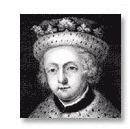 DWARD
V (April-June 1483)
Edward V was a minor, and his uncle Richard, Duke of Gloucester, was made Protector. Richard had been loyal throughout to his brother Edward IV including the events of 1470-71, Edward's exile and their brother's rebellion (the Duke of Clarence, who was executed in 1478 by drowning, reputedly in a barrel of Malmsey wine). However, he was suspicious of the Woodville faction, possibly believing they were the cause of Clarence's death. In response to an attempt by Elizabeth Woodville to take power, Richard and Edward V entered London in May, with Edward's coronation fixed for 22 June. However, in mid-June Richard assumed the throne as Richard III (reigned 1483-85). Edward V and his younger brother Richard were declared illegitimate, taken to the Royal apartments at the Tower of London (then a Royal residence) and never seen again. (Skeletons, allegedly theirs, found there in 1674 were later buried in Westminster Abbey.)
RICHARD III (1483-1485)
R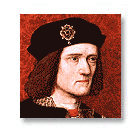 ichard
III usurped the throne from the young Edward V, who disappeared with
his younger brother while under their ambitious uncle's supposed
protection. On becoming king, Richard attempted genuine
reconciliation with the Yorkists by showing consideration to
Lancastrians purged from office by Edward IV, and moved Henry VI's
body to St George's Chapel at Windsor. The first laws written
entirely in English were passed during his reign. In 1484, Richard's
only legitimate son Edward predeceased him. Before becoming king,
Richard had had a strong power base in the north, and his reliance on
northerners during his reign was to increase resentment in the south.
Richard concluded a truce with Scotland to reduce his commitments in
the north. Nevertheless, resentment against Richard grew. On 7 August
1485, Henry Tudor (a direct descendant through his mother Margaret
Beaufort, of John of Gaunt, one of Edward III's younger sons) landed
at Milford Haven in Wales to claim the throne. On 22 August, in a
two-hour battle at Bosworth, Henry's forces (assisted by Lord
Stanley's private army of around 7,000 which was deliberately posted
so that he could join the winning side) defeated Richard's larger
army and Richard was killed. Buried without a monument in Leicester,
Richard's bones were scattered during the English Reformation.
THE TUDORS
The five sovereigns of the Tudor dynasty are among the most well-known figures in Royal history. Of Welsh origin, Henry VII succeeded in ending the Wars of the Roses between the houses of Lancaster and York to found the highly successful Tudor house. Henry VII, his son Henry VIII and his three children Edward VI, Mary I and Elizabeth I ruled for 118 eventful years.
During this period, England developed into one of the leading European colonial powers, with men such as Sir Walter Raleigh taking part in the conquest of the New World. Nearer to home, campaigns in Ireland brought the country under strict English control.
Culturally and socially, the Tudor period saw many changes. The Tudor court played a prominent part in the cultural Renaissance taking place in Europe, nurturing all-round individuals such as William Shakespeare, Edmund Spenser and Cardinal Wolsey. The Tudor period also saw the turbulence of two changes of official religion, resulting in the martyrdom of many innocent believers of both Protestantism and Roman Catholicism. The fear of Roman Catholicism induced by the Reformation was to last for several centuries and to play an influential role in the history of the Succession.
THE TUDORS
1485 - 1603
 HENRY
VII =
Elizabeth of York,
(1485–1509) dau. of EDWARD IV


Catherine of (1) = HENRY VIII = (2) Anne Boleyn, = (3) Jane, dau. Margaret (1) = JAMES IV,
A ragon,
dau. (1509–1547) dau. of Earl
of Sir John
King of Scotland
o
 f
FERDINAND V, of Wiltshire
Seymour
(1488–1513)
first King of Spain
ELIZABETH
I EDWARD VI JAMES
V, = Mary of
MARY I (1547–1553) (1558–1603) King of Scotland Lorraine,
(1553–1558) (1513–1542) dau. of Duke
of Guise
MARY, = Henry, Lord
 Queen
Darnley
of Scots
(1542–1567,
ex.1587)
THE STUARTS 1603 – 1714 Anne, dau. of = JAMES VI OF SCOTLAND