BRITISH MONARCHY AND ITS INFLUENCE UPON GOVERNMENTAL INSTITUTIONS
The Bill of Rights had established the succession with the heirs of Mary II, Anne and William III in that order, but by 1700 Mary had died childless, Anne's only surviving child (out of 17 children), the Duke of Gloucester, had died at the age of 11 and William was dying. The succession had to be decided.
The Act of Settlement of 1701 was designed to secure the Protestant succession to the throne, and to strengthen the guarantees for ensuring parliamentary system of government. According to the Act, succession to the throne went to Princess Sophia, Electress of Hanover and James I's granddaughter, and her Protestant heirs.
The Act also laid down the conditions under which alone the Crown could be held. No Roman Catholic, nor anyone married to a Roman Catholic, could hold the English Crown. The Sovereign now had to swear to maintain the Church of England (and after 1707, the Church of Scotland). The Act of Settlement not only addressed the dynastic and religious aspects of succession, it also further restricted the powers and prerogatives of the Crown.
Under the Act, parliamentary consent had to be given for the Sovereign to engage in war or leave the country, and judges were to hold office on good conduct and not at royal pleasure - thus establishing judicial independence. The Act of Settlement reinforced the Bill of Rights, in that it strengthened the principle that government was undertaken by the Sovereign and his or her constitutional advisers (i.e. his or her Ministers), not by the Sovereign and any personal advisers whom he or she happened to choose.
One of William's main reasons for accepting the throne was to reinforce the struggle against Louis XIV. William's foreign policy was dominated by the priority to contain French expansionism. England and the Dutch joined the coalition against France during the Nine Years War. Although Louis was forced to recognise William as King under the Treaty of Ryswick (1697), William's policy of intervention in Europe was costly in terms of finance and his popularity. The Bank of England, established in 1694 to raise money for the war by borrowing, did not loosen the King's financial reliance on Parliament as the national debt depended on parliamentary guarantees. William's Dutch advisers were resented, and in 1699 his Dutch Blue Guards were forced to leave the country.
Never of robust health, William died as a result of complications from a fall whilst riding at Hampton Court in 1702.
ANNE (1702-14)
A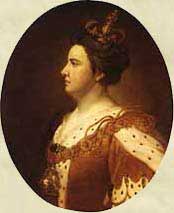 nne,
born in 1665, was the second daughter of James II and Anne Hyde. She
played no part in her father's reign, but sided with her sister and
brother-in-law (Mary II and William III) during the Glorious
Revolution. She married George, Prince of Denmark, but the pair
failed to produce a surviving heir. She died at 49 years of age,
after a lifelong battle with the blood disease porphyria.
The untimely death of William III nullified, in effect, the Settlement Act of 1701: Anne was James' daughter through his Protestant marriage, and therefore, presented no conflict with the act. Anne refrained from politically antagonizing Parliament, but was compelled to attend most Cabinet meetings to keep her half-brother, James the Old Pretender, under heel. Anne was the last sovereign to veto an act of Parliament, as well as the final Stuart monarch. The most significant constitutional act in her reign was the Act of Union in 1707, which created Great Britain by finally fully uniting England and Scotland (Ireland joined the Union in 1801).
The Stuart trait of relying on favorites was as pronounced in Anne's reign as it had been in James I's reign. Anne's closest confidant was Sarah Churchill, who exerted great influence over the king. Sarah's husband was the Duke of Marlborough, who masterly led the English to several victories in the War of Spanish Succession. Anne and Sarah were virtually inseparable: no king's mistress had ever wielded the power granted to the duchess, but Sarah became too confident in her position. She developed an overbearing demeanor towards Anne, and berated the Queen in public. In the meantime, Tory leaders had planted one Abigail Hill in the royal household to capture Anne's need for sympathy and affection. As Anne increasingly turned to Abigail, the question of succession rose again, pitting the Queen and the Marlborough against each other in a heated debate. The relationship of Anne and the Churchill's fell asunder. Marlborough, despite his war record, was dismissed from public service and Sarah was shunned in favor of Abigail.
Many of the internal conflicts in English society were simply the birth pains of the two-party system of government. The Whig and Tory Parties, fully enfranchised by the last years of Anne's reign, fought for control of Parliament and influence over the Queen. Anne was torn personally as well as politically by the succession question: her Stuart upbringing compelled her to choose as heir her half-brother, the Old Pretender and favorite of the Tories, but she had already elected to side with Whigs when supporting Mary and William over James II. In the end, Anne abided by the Act of Settlement, and the Whigs paved the way for the succession of their candidate, George of Hanover.
Anne's reign may be considered successful, but somewhat lackluster in comparison to the rest of the Stuart line. 1066 and All That, describes her with its usual tongue-in-cheek manner: "Finally the Orange... was succeeded by the memorable dead queen, Anne. Queen Anne was considered rather a remarkable woman and hence was usually referred to as Great Anna, or Annus Mirabilis. The Queen had many favourites (all women), the most memorable of whom were Sarah Jenkins and Mrs Smashems, who were the first wig and the first Tory... the Whigs being the first to realize that the Queen had been dead all the time chose George I as King."
THE HANOVERIANS
The Hanoverians came to power in difficult circumstances that looked set to undermine the stability of British society. The first of their Kings, George I, was only 52nd in line to the throne, but the nearest Protestant according the Act of Settlement. Two descendants of James II, the deposed Stuart King, threatened to take the throne and were supported by a number of 'Jacobites' throughout the realm.
The Hanoverian period for all that, was remarkably stable, not least because of the longevity of its Kings. From 1714 through to 1837, there were only five, one of whom, George III, remains the longest reigning King in British History. The period was also one of political stability, and the development of constitutional monarchy. For vast tracts of the eighteenth century politics were dominated by the great Whig families, while the early nineteenth century saw Tory domination. Britain's first 'Prime' Minister, Robert Walpole, dates from this period, while income tax was introduced. Towards the end of the reign, the Great Reform Act was passed, which amongst other things widened the electorate.
It was in this period that Britain came to acquire much of her overseas Empire, despite the loss of the American colonies, largely through foreign conquest in the various wars of the century. At the end of the Hanoverian period the British empire covered a third of the globe while the theme of longevity was set to continue, as the longest reigning monarch in British history, Queen Victoria, prepared to take the throne.
THE HANOVERIANS
1714 - 1837
GEORGE I = Sophia Dorothea, dau. of Duke of Brunswick and Celle
 (1714–1727)
GEORGE II = Caroline, dau. of Margrave of
(1727–1760)
Brandenburg-Anspach
Augusta of = Frederick Lewis,
Saxe-Gotha-Altenberg
Prince of Wales
GEORGE III = Sophia Charlotte of
(1760–1820)
Mecklenburg-Strelitz

GEORGE IV WILLIAM IV Edward, = Victoria
(1820–1830)
(1830–1837)
Duke of Kent of
Saxe-Coburg
VICTORIA
(1837–1901)
G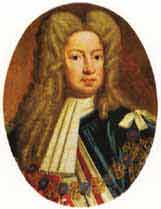 EORGE
I (1714-27)
George I was born March 28, 1660, son of Ernest, Elector of Hanover and Sophia, granddaughter of James I. He was raised in the royal court of Hanover, a German province, and married Sophia, Princess of Zelle, in 1682. The marriage produced one son (the future George II) and one daughter (Sophia Dorothea, who married her cousin, Frederick William I, King of Prussia). After ruling England for thirteen years, George I died of a stroke on a journey to