BRITISH MONARCHY AND ITS INFLUENCE UPON GOVERNMENTAL INSTITUTIONS
RICHARD II (1377-99)
E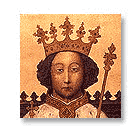 dward
III's son, the Black Prince, died in 1376. The King's grandson,
Richard II, succeeded to the throne aged 10, on Edward's death. In
1381 the Peasants' Revolt broke out and Richard, aged 14, bravely
rode out to meet the rebels at Smithfield, London. Wat Tyler, the
principal leader of the peasants, was killed and the uprisings in the
rest of the country were crushed over the next few weeks (Richard was
later forced by his Council's advice to rescind the pardons he had
given). Highly cultured, Richard was one of the greatest royal
patrons of the arts; patron of Chaucer, it was Richard who ordered
the technically innovative transformation of the Norman Westminster
Hall to what it is today. (Built between 1097 and 1099 by William II,
the Hall was the ceremonial and administrative centre of the kingdom;
it also housed the Courts of Justice until 1882.) Richard's
authoritarian approach upset vested interests, and his increasing
dependence on favourites provoked resentment. In 1388 the 'Merciless
Parliament' led by a group of lords hostile to Richard (headed by the
King's uncle, Gloucester) sentenced many of the King's favourites to
death and forced Richard to renew his coronation oath. The death of
his first queen, Anne of Bohemia, in 1394 further isolated Richard,
and his subsequent arbitrary behaviour alienated people further.
Richard took his revenge in 1397, arresting or banishing many of his
opponents; his cousin, Henry of Bolingbroke, was also subsequently
banished. On the death of Henry's father, John of Gaunt (a younger
son of Edward III), Richard confiscated the vast properties of his
Duchy of Lancaster (which amounted to a state within a state) and
divided them among his supporters. Richard pursued policies of peace
with France (his second wife was Isabella of Valois); Richard still
called himself king of France and refused to give up Calais, but his
reign was concurrent with a 28 year truce in the Hundred Years War.
His expeditions to Ireland failed to reconcile the Anglo-Irish lords
with the Gaels. In 1399, whilst Richard was in Ireland, Henry of
Bolingbroke returned to claim his father's inheritance. Supported by
some of the leading baronial families (including Richard's former
Archbishop of Canterbury), Henry captured and deposed Richard.
Bolingbroke was crowned King as Henry IV. Risings in support of
Richard led to his murder in Pontefract Castle; Henry V subsequently
had his body buried in Westminster Abbey.
THE LANCASTRIANS
The accession of Henry IV sowed the seeds for a period of unrest which ultimately broke out in civil war. Fraught by rebellion and instability after his usurpation of Richard II, Henry IV found it difficult to enforce his rule. His son, Henry V, fared better, defeating France in the famous Battle of Agincourt (1415) and staking a powerful claim to the French throne. Success was short-lived with his early death.
By the reign of the relatively weak Henry VI, civil war broke out between rival claimants to the throne, dating back to the sons of Edward III. The Lancastrian dynasty descended from John of Gaunt, third son of Edward III, whose son Henry deposed the unpopular Richard II. Yorkist claimants such as the Duke of York asserted their legitimate claim to the throne through Edward III's second surviving son, but through a female line. The Wars of the Roses therefore tested whether the succession should keep to the male line or could pass through females.
Captured and briefly restored, Henry VI was captured and put to death, and the Yorkist faction led by Edward IV gained the throne.
HENRY IV (1399-1413)
H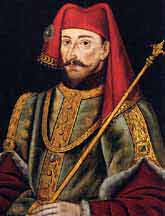 enry
IV was born at Bolingbroke in 1367 to John of Gaunt and Blanche of
Lancaster. He married Mary Bohun in 1380, who bore him seven children
before her death in 1394. In 1402, Henry remarried, taking as his
bride Joan of Navarre. Henry
had an on-again, off-again relationship with his cousin, Richard II.
He was one of the Lords Appellant, who, in 1388, persecuted many of
Richard's advisor-favorites, but his excellence as a soldier gained
the king's favor - Henry was created Duke of Hereford in 1397. In
1398, however, the increasingly suspicious Richard banished him for
ten years. John of Gaunt's death in 1399 prompted Richard to
confiscate the vast Lancastrian estates; Henry invaded England while
Richard was on campaign in Ireland, usurping the throne from the
king. The very nature of Henry's usurpation dictated the
circumstances of his reign - incessant rebellion became the order of
the day. Richard's supporters immediately revolted upon his
deposition in 1400. In Wales, Owen Glendower led a national uprising
that lasted until 1408; the Scots waged continual warfare throughout
the reign; the powerful families of Percy and Mortimer (the latter
possessing a stronger claim to the throne than Henry) revolted from
1403 to 1408; and Richard Scrope, Archbishop of York, proclaimed his
opposition to the Lancastrian claim in 1405. Two political blunders
in the latter years of his reign diminished Henry's support. His
marriage to Joan of Navarre (of whom it was rumored practiced
necromancy) was highly unpopular - she was, in fact, convicted of
witchcraft in 1419. Scrope and Thomas Mawbray were executed in 1405
after conspiring against Henry; the Archbishop's execution alarmed
the English people, adding to his unpopularity. He developed a nasty
skin disorder and epilepsy, persuading many that God was punishing
the king for executing an archbishop. Crushing the myriad of
rebellions was costly, which involved calling Parliament to fund such
activities. The House of Commons used the opportunity to expand its
powers in 1401, securing recognition of freedom of debate and freedom
from arrest for dissenting opinions. Lollardy, the Protestant
movement founded by John Wycliffe during the reign of Edward III,
gained momentum and frightened both secular and clerical landowners,
inspiring the first anti-heresy statute, De
Heritico Comburendo,
to become law in 1401. Henry, ailing from leprosy and epilepsy,
watched as Prince Henry controlled the government for the last two
years of his reign. In 1413, Henry died in the Jerusalem Chamber of
Westminster Abbey. Rafael Holinshed explained his unpopularity in
Chronicles of England: "... by punishing such as moved with
disdain to see him usurp the crown, did at sundry times rebel against
him, he won(himself more hatred, than in all his life time ... had
been possible for him to have weeded out and removed." Unlikely
as it may seem (due to the amount of rebellion in his reign); Henry
left his eldest son an undisputed succession.
HENRY V (1413-1422)
H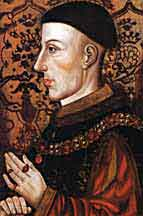 enry
V, the eldest son of Henry IV and Mary Bohun, was born in 1387. As
per arrangement by the Treaty of Troyes, he married Catherine,
daughter of the French King Charles VI, in June 1420. His only child,
the future Henry VI, was born in 1421.
Henry was an accomplished soldier: at age fourteen he fought the Welsh forces of Owen ap Glendower; at age sixteen he commanded his father's forces at the battle of Shrewsbury; and shortly after his accession he put down a major Lollard uprising and an assassination plot by nobles still loyal to Richard II . He proposed to marry Catherine in 1415, demanding the old Plantagenet lands of Normandy and Anjou as his dowry. Charles VI refused and Henry declared war, opening yet another chapter in the Hundred Years' War. The French war served two purposes - to gain lands lost in previous battles and to focus attention away from any of his cousins' royal ambitions. Henry, possessed a masterful military mind and defeated the French at the Battle of Agincourt in October 1415, and by 1419 had captured Normandy, Picardy and much of the Capetian stronghold of the Ile-de-France.
By the Treaty of Troyes in 1420, Charles VI not only accepted Henry as his son-in-law, but passed over his own son to name Henry as heir to the French crown. Had Henry lived a mere two months longer, he would have been king of both England and France.
Henry had prematurely aged due to living the hard life of a soldier. He became seriously ill and died after returning from yet another French campaign; Catherine had bore his only son while he was away and Henry died having never seen the child. The historian Rafael Holinshed, in Chronicles of England , summed up Henry's reign as such: "This Henry was a king, of life without spot, a prince whom all men loved, and of none disdained, e captain against whom fortune never frowned, nor mischance once spurned, whose people him so severe a justicer both loved and obeyed (and so humane withal) that he left no offence unpunished, nor friendship unrewarded; a terror to rebels, and suppressor of sedition, his virtues notable, his qualities most praiseworthy."
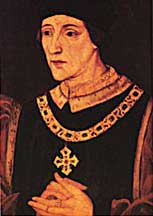
HENRY VI (1422-61, 1470-71 AD)
Henry VI was the only child of Henry V and Catherine of Valois, born on December 6, 1421. He married Margaret of Anjou in 1445; the union produced one son, Edward, who was killed in battle one day before Henry's execution. Henry came to the throne as an infant after the early death of his father; in name, he was king of both England and France, but a protector ruled each realm. He was educated by Richard Beauchamp beginning in 1428. The whole of Henry's reign was involved with retaining both of his crowns - in the end, he held neither.
Hostilities in France continued, but momentum swung to the French with the appearance of Joan of Arc in 1428. The seventeen year old was instrumental in rescuing the French Dauphin Charles in 1429; he was crowned at Reims as Charles VII, and she was burned at the stake as a heretic. English losses in Brittany (1449), Normandy (1450) and Gascony (1453) led to the conclusion of the Hundred Years' War in 1453. Henry lost his claim to all French soil except for Calais.
The Wars of the Roses began in full during Henry's reign. In 1453, Henry had an attack of the hereditary mental illness that plagued the French house of Valois; Richard, Duke of York, was made protector of the realm during the illness. His wife Margaret, a rather headstrong woman, alienated Richard upon Henry's recovery and Richard responded by attacking and defeating the queen's forces at St. Albans in 1455. Richard captured the king in 1460 and forced him to acknowledge Richard as heir to the crown. Henry escaped, joined the Lancastvian forces and attacked at Towton in March 1461, only to be defeated by the Yorks. Richard's son, Edward IV, was proclaimed king; Margaret and Henry were exiled to Scotland. They were captured in 1465 and imprisoned in the Tower of London until 1470. Henry was briefly restored to power in Settember 1470. Edward, Prince of Wales, died after his final victory at Tewkesbury on May 20, 1471 and Henry returned to the Tower. The last Lancastrian king was murdered the following day.
THE YORKISTS
The Yorkist conquest of the Lancastrians in 1461 did not put an end to the Wars of the Roses, which rumbled on until the start of the sixteenth century. Family disloyalty in the form of Richard III's betrayal of his nephews, the young King Edward V and his brother, was part of his downfall. Henry Tudor, a claimant to the throne of Lancastrian descent, defeated Richard III in battle and Richard was killed. With the marriage of Henry to Elizabeth, the sister of the young Princes in the Tower, reconciliation was finally achieved between the warring houses of Lancaster and York in the form of the new Tudor dynasty, which combined their respective red and white emblems to produce the Tudor rose.
EDWARD IV (1461-1470 and 1471-1483)
E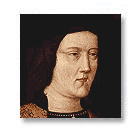 dward
IV was able to restore order, despite the temporary return to the
throne of Henry VI (reigned 1470-71, during which time Edward fled to
the Continent in exile) supported by the Earl of Warwick, 'the
Kingmaker', who had previously supported Edward and who was killed at
the Battle of Barnet in 1471. Edward also made peace with France; by
a shrewd display of force to exert pressure, Edward reached a
profitable agreement with Louis XI at Picquigny in 1475. At home,
Edward relied heavily on his own personal control in government,
reviving the ancient custom of sitting in person 'on the bench' (i.e.
in judgement) to enforce justice. He sacked Lancastrian
office-holders and used his financial acumen to introduce tight
management of royal revenues to reduce the Crown's debt. Building
closer relations with the merchant community, he encouraged
commercial treaties; he successfully traded in wool on his own
account to restore his family's fortunes and enable the King to 'live
of his own', paying the costs of the country's administration from
the Crown Estates profits and freeing him from dependence on
subsidies from Parliament. Edward rebuilt St George's Chapel at
Windsor (possibly seeing it as a mausoleum for the Yorkists, as he
was buried there) and a new great hall at Eltham