BRITISH MONARCHY AND ITS INFLUENCE UPON GOVERNMENTAL INSTITUTIONS
SAXE-COBURG AND GOTHA
1837 - 1917
THE WINDSORS
1917 – PRESENT DAY
VICTORIA = m. Prince Albert of Saxe-Coburg & Gotha
( 1837-1910)
(Prince Consort)
EDWARD VII = m. Princess Alexandra, dau. of CHRISTIAN IX, King of
(1910
– 1936) Denmark

DUKE OF WINDSOR GEORGE VI = m. Lady Elizabeth
 EDWARD
VIII
1936-1952
Bowes-Lyon, dau. of Earl of
(abdicated 1936) Strathmore and Kinghorne
(Queen Elizabeth
The Queen Mother)
QUEEN ELIZABETH II
(1952 – present day)
EDWARD VII (1901-10)
E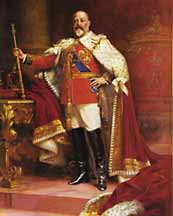 dward
VII, born November 9, 1841, was the eldest son of Queen Victoria. He
took the family name of his father, Prince Consort Albert, hence the
change in lineage, although he was still Hanoverian on his mother's
side. He married Princess Alexandra of Denmark in 1863, who bore him
three sons and three daughters. Edward died on May 6, 1910, after a
series of heart attacks.
Victoria, true to the Hanoverian name, saw the worst in Edward. She and Albert imposed a strict regime upon Edward, who proved resistant and resentful throughout his youth. His marriage at age twenty-two to Alexandra afforded him some relief from his mother's domination, but even after Albert's death in 1863, Victoria consistently denied her son any official governmental role. Edward rebelled by completely indulging himself in women, food, drink, gambling, sport and travel. Alexandra turned a blind eye to his extramarital activities, which continued well into his sixties and found him implicated in several divorce cases.
Edward succeeded the throne upon Victoria's death; despite his risquй reputation, Edward threw himself into his role of king with vitality. His extensive European travels gave him a solid foundation as an ambassador in foreign relations. Quite a few of the royal houses of Europe were his relatives, allowing him to actively assist in foreign policy negotiations. He also maintained an active social life, and his penchant for flamboyant accouterments set trends among the fashionable. Victoria's fears proved wrong: Edward's forays into foreign policy had direct bearing on the alliances between Great Britain and both France and Russia, and aside from his sexual indiscretions, his manner and style endeared him to the English populace.
Social legislation was the focus of Parliament during Edward's reign. The 1902 Education Act provided subsidized secondary education, and the Liberal government passed a series of acts benefiting children after 1906; old age pensions were established in 1908. The 1909 Labour Exchanges Act laid the groundwork for national health insurance, which led to a constitutional crisis over the means of budgeting such social legislation. The budget set forth by David Lloyd-George proposed major tax increases on wealthy landowners and was defeated in Parliament. Prime Minister Asquith appealed to Edward to create several new peerages to swing the vote, but Edward steadfastly refused. Edward died amidst the budgetary crisis at age sixty-eight, which was resolved the following year by the Liberal government's passage of the act.
Despite Edward's colorful personal life and Victoria's perceptions of him as profligate, Edward ruled peacefully (aside from the Boer War of 1899-1902) and successfully during his short reign, which is remarkable considering the shifts in European power that occurred in the first decade of the twentieth century.
THE HOUSE OF WINDSOR
The House of Windsor came into being in 1917, when the name was adopted as the British Royal Family's official name by a proclamation of King George V, replacing the historic name of Saxe-Coburg-Gotha. It remains the family name of the current Royal Family.
During the twentieth century, kings and queens of the United Kingdom have fulfilled the varied duties of constitutional monarchy. One of their most important roles was national figureheads lifting public morale during the devastating world wars of 1914-18 and 1939-45.
The period saw the modernization of the monarchy in tandem with the many social changes which have taken place over the past 80 years. One such modernization has been the use of mass communication technologies to make the Royal Family accessible to a broader public the world over. George V adopted the new relatively new medium of radio to broadcast across the Empire at Christmas; the Coronation ceremony was broadcast on television for the first time in 1953, at The Queen's insistence; and the World Wide Web has been used for the past five years to provide a global audience with information about the Royal Family. During this period British monarchs have also played a vital part in promoting international relations, retaining ties with former colonies in their role as Head of the Commonwealth.
GEORGE V (1910-36)
G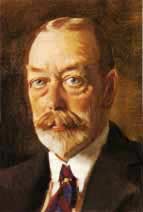 eorge
V was born June 3, 1865, the second son of Edward VII and Alexandra.
His early education was somewhat insignificant as compared to that of
the heir apparent, his older brother Albert. George chose the career
of professional naval officer and served competently until Albert
died in 1892, upon which George assumed the role of the heir
apparent. He married Mary of Teck (affectionately called May) in
1893, who bore him four sons and one daughter. He died the year after
his silver jubilee after a series of debilitating attacks of
bronchitis, on January 20, 1936.
George ascended the throne in the midst of a constitutional crisis: the budget controversy of 1910. Tories in the House of Lords were at odds with Liberals in the Commons pushing for social reforms. When George agreed to create enough Liberal peerages to pass the measure the Lords capitulated and gave up the power of absolute veto, resolving the problem officially with passage of the Parliament Bill in 1911. The first World War broke out in 1914, during which George and May made several visits to the front; on one such visit, George's horse rolled on top of him, breaking his pelvis - George remained in pain for the rest of his life from the injury. The worldwide depression of 1929-1931 deeply affected England, prompting the king to persuade the heads of the three political parties (Labour, Conservative and Liberal) to unite into a coalition government. By the end of the 1920's, George and the Windsors were but one of few royal families who retained their status in Europe.
The relationship between England and the rest of the Empire underwent several changes. An independent Irish Parliament was established in 1918 after the Sinn Fein uprising in 1916, and the Government of Ireland Act (1920) divided Ireland along religious lines. Canada, Australia, New Zealand and South Africa demanded the right of self-governance after the war, resulting in the creation of the British Commonwealth of Nations by the Statute of Westminster in 1931. India was accorded some degree of self-determination with the Government of India Act in 1935.
The nature of the monarchy evolved through the influence of George. In contrast to his grandmother and father - Victoria's ambition to exert political influence in the tradition of Elizabeth I and Edward VII's aspirations to manipulate the destiny of nations - George's royal perspective was considerably more humble. He strove to embody those qualities, which the nation saw as their greatest strengths: diligence, dignity and duty. The monarchy transformed from an institution of constitutional legality to the bulwark of traditional values and customs (particularly those concerning the family). Robert Lacey describes George as such: ". . . as his official biographer felt compelled to admit, King George V was distinguished 'by no exercise of social gifts, by no personal magnetism, by no intellectual powers. He was neither a wit nor a brilliant raconteur, neither well-read nor well-educated, and he made no great contribution to enlightened social converse. He lacked intellectual curiosity and only late in life acquired some measure of artistic taste.' He was, in other words, exactly like most of his subjects. He discovered a new job for modern kings and queens to do - representation."
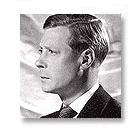
EDWARD VIII ( JANUARY-DECEMBER 1936)
A