BRITISH MONARCHY AND ITS INFLUENCE UPON GOVERNMENTAL INSTITUTIONS
H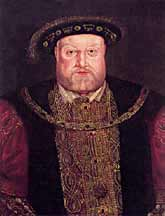 ENRY
VIII (1509-47 AD)
Henry VIII, born in 1491, was the second son of Henry VII and Elizabeth of York. The significance of Henry's reign is, at times, overshadowed by his six marriages: dispensing with these forthwith enables a deeper search into the major themes of the reign. He married Catherine of Aragon (widow of his brother, Arthur) in 1509, divorcing her in 1533; the union produced one daughter, Mary. Henry married the pregnant Anne Boleyn in 1533; she gave him another daughter, Elizabeth, but was executed for infidelity (a treasonous charge in the king's consort) in May 1536. He married Jane Seymour by the end of the same month, who died giving birth to Henry's lone male heir, Edward, in October 1536. Early in 1540, Henry arranged a marriage with Anne of Cleves, after viewing Hans Holbein's beautiful portrait of the German princess. In person, alas, Henry found her homely and the marriage was never consummated. In July 1540, he married the adulterous Catherine Howard - she was executed for infidelity in March 1542. Catherine Parr became his wife in 1543, providing for the needs of both Henry and his children until his death in 1547.
The court life initiated by his father evolved into a cornerstone of Tudor government in the reign of Henry VIII. After his father's staunch, stolid rule, the energetic, youthful and handsome king avoided governing in person, much preferring to journey the countryside hunting and reviewing his subjects. Matters of state were left in the hands of others, most notably Thomas Wolsey, Archbishop of York. Cardinal Wolsey virtually ruled England until his failure to secure the papal annulment that Henry needed to marry Anne Boleyn in 1533. Wolsey was quite capable as Lord Chancellor, but his own interests were served more than that of the king: as powerful as he was, he still was subject to Henry's favor - losing Henry's confidence proved to be his downfall. The early part of Henry's reign, however, saw the young king invade France, defeat Scottish forces at the Battle of Foldden Field (in which James IV of Scotland was slain), and write a treatise denouncing Martin Luther's Reformist ideals, for which the pope awarded Henry the title "Defender of the Faith".
The 1530's witnessed Henry's growing involvement in government, and a series of events which greatly altered England, as well as the whole of Western Christendom: the separation of the Church of England from Roman Catholicism. The separation was actually a by-product of Henry's obsession with producing a male heir; Catherine of Aragon failed to produce a male and the need to maintain dynastic legitimacy forced Henry to seek an annulment from the pope in order to marry Anne Boleyn. Wolsey tried repeatedly to secure a legal annulment from Pope Clement VII, but Clement was beholden to the Charles V, Holy Roman Emperor and nephew of Catherine. Henry summoned the Reformation Parliament in 1529, which passed 137 statutes in seven years and exercised an influence in political and ecclesiastic affairs which was unknown to feudal parliaments. Religious reform movements had already taken hold in England, but on a small scale: the Lollards had been in existence since the mid-fourteenth century and the ideas of Luther and Zwingli circulated within intellectual groups, but continental Protestantism had yet to find favor with the English people. The break from Rome was accomplished through law, not social outcry; Henry, as Supreme Head of the Church of England, acknowledged this by slight alterations in worship ritual instead of a wholesale reworking of religious dogma. England moved into an era of "conformity of mind" with the new royal supremacy (much akin to the absolutism of France's Louis XIV): by 1536, all ecclesiastical and government officials were required to publicly approve of the break with Rome and take an oath of loyalty. The king moved away from the medieval idea of ruler as chief lawmaker and overseer of civil behavior, to the modern idea of ruler as the ideological icon of the state.
The remainder of Henry's reign was anticlimactic. Anne Boleyn lasted only three years before her execution; she was replaced by Jane Seymour, who laid Henry's dynastic problems to rest with the birth of Edward VI. Fragmented noble factions involved in the Wars of the Roses found themselves reduced to vying for the king's favor in court. Reformist factions won the king's confidence and vastly benefiting from Henry's dissolution of the monasteries, as monastic lands and revenues went either to the crown or the nobility. The royal staff continued the rise in status that began under Henry VII, eventually to rival the power of the nobility. Two men, in particular, were prominent figures through the latter stages of Henry's reign: Thomas Cromwell and Thomas Cranmer. Cromwell, an efficient administrator, succeeded Wolsey as Lord Chancellor, creating new governmental departments for the varying types of revenue and establishing parish priest's duty of recording births, baptisms, marriages and deaths. Cranmer, Archbishop of Canterbury, dealt with and guided changes in ecclesiastical policy and oversaw the dissolution of the monasteries.
Henry VIII built upon the innovations instituted by his father. The break with Rome, coupled with an increase in governmental bureaucracy, led to the royal supremacy that would last until the execution of Charles I and the establishment of the Commonwealth one hundred years after Henry's death. Henry was beloved by his subjects, facing only one major insurrection, the Pilgrimage of Grace, enacted by the northernmost counties in retaliation to the break with Rome and the poor economic state of the region. History remembers Henry in much the same way as Piero Pasqualigo, a Venetian ambassador: "... he is in every respect a most accomplished prince."
EDWARD VI (1547-1553 AD)
E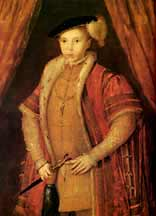 dward
VI, son of Henry VIII and Jane Seymour, was born in 1537. He ascended
the throne at age nine, upon the death of his father. He was
betrothed to his cousin, Mary Queen of Scots, but deteriorating
English-Scot relations prohibited their marriage. The frail,
Protestant boy died of consumption at age sixteen having never
married. Edward's reign was beset by problems from the onset.
Ascending the throne while stillin his minority presented a backdrop
for factional in fighting and power plays. Henry VIII, in his last
days, sought to eliminate this potential problem by decreeing that a
Council of Regency would govern until the child came of age, but
Edward Seymour (Edward VI's uncle) gained the upper hand. The Council
offered Seymour the Protectorship of the realm and the Dukedom of
Somerset; he genuinely cared for both the boy and the realm, but used
the Protectorship, as well as Edward's religious radicalism, to
further his Protestant interests. The Book of Common Prayer, the
eloquent work of Archbishop Thomas Cranmer, was instituted in 1549 as
a handbook to the new style of worship that skated controversial
issues in an effort to pacify Catholics. Henrician treason and heresy
laws were repealed, transforming England into a haven for continental
heretics. Catholics were pleased with the softer version of
Protestantism, but radical Protestants clamored for further reforms,
adding to the ever-present factional discord. Economic hardship
plagued England during Edward's rule and foreign relations were in a
state of disarray. The new faith and the dissolution of the
monasteries left a considerable amount of ecclesiastical officials
out of work, at a time when unemployment soared; enclosure of
monastic lands deprived many peasants of their means of subsistence.
The coinage lost value as new coins were minted from inferior metals,
as specie from the New World flooded English markets. A
French/Scottish alliance threatened England, prompting Somerset to
invade Scotland, where Scottish forces were trounced at Pinkie. Then
general unrest and factional maneuvering proved Somerset's undoing;
he was executed in September 1552. Thus began one of the most corrupt
eras of English political history. The author of this corruption was
the Earl of Warwick, John Dudley. Dudley was an ambitious political
survivor driven by the desire to become the largest landowner in
England. Dudley coerced Edward by claiming that the boy had reached
manhood on his 12th birthday and was now ready to rule; Dudley also
held Edward's purse strings. Dudley was created Duke of
Northumberland and virtually ruled England, although he had no
official title. The Council, under his leadership, systematically
confiscated church territories, as the recent wave of radical
Protestantism seemed a logical, and justifiable, continuation of
Henrician reform. Northumberland's ambitions grew in proportion to
his gains of power: he desperately sought to connect himself to the
royal family. Northumberland was given the opportunity to indulge in
king making - the practice by which an influential noble named the
next successor, such as Richard Neville during the Wars of the Roses
- when Edward was diagnosed with consumption in January 1553. Henry
VIII named the line of succession in his will;next in line after
Edward were his sisters Mary and Elizabeth, followed by the
descendants of Henry's sister, Mary: Frances Grey and her children.
Northumberland convinced Edward that his Catholic sister, Mary, would
ruin the Protestant reforms enacted throughout the reign; in
actuality, he knew Mary would restore Catholicism and return the
confiscated Church territories which were making the Council very
rich. Northumberland's appeal to Edward's radicalism worked as
intended: the dying lad declared his sisters to be bastards and
passed the succession to Frances Grey's daughter, Lady Jane Grey, one
of the boy's only true friends. Northumberland impelled the Greys to
consent to a marriage between his son, Guildford and Lady Jane.
Edward died on July 6, 1553, leaving a disputed succession. Jane,
against her wishes, was declared queen by the Council. Mary retreated
to Framlingham in Suffolk and claimed the throne. Northumberland took
an army to capture Mary, but bungled the escapade. The Council
abandoned Northumberland as Mary collected popular support and rode
triumphantly into London. Jane after a reign of only nine days, was
imprisoned in the Tower of London until her 1554 execution at the
hands of her cousin Mary. Edward was a highly intellectual and pious
lad who fell prey to the machinations of his powerful Council of
Regency. His frailty led to an early death. Had he lived into
manhood, he potentially could have become one of England's greatest
kings. Jane Austen wrote, "This Man was on the whole of a very
amiable character...", to which Beckett added, " as docile
as a lamb, if indeed his gentleness did not amount to absolute
sheepishness."
LADY JANE GREY (10-19 July 1553)
The Accession of Lady Jane Grey was engineered by the powerful Duke of Northumberland, President of the King's Council, in the interests of promoting his own dynastic line. Northumberland persuaded the sickly Edward VI to name Lady Jane Grey as his heir. As one of Henry VIII's great-nieces, the young girl was a genuine claimant to the throne. Northumberland then married his own son, Lord Guilford Dudley, to Lady Jane. On the death of Edward, Jane assumed the throne and her claim was recognised by the Council. Despite this, the country rallied to Mary, Catherine of Aragon's daughter and a devout Roman Catholic. Jane reigned for only nine days and was later executed with her husband in 1554.
MARY I (1553-1558)
M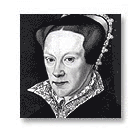 ary
I was the first Queen Regnant (that is, a queen reigning in her own
right rather than a queen through marriage to a king). Courageous and
stubborn, her character was moulded by her earlier years: an Act of
Parliament in 1533 had declared her illegitimate and removed her from
the succession to the throne (she was reinstated in 1544, but her
half-brother Edward removed her from the succession once more shortly
before his death), whilst she was pressurised to give up the Mass and
acknowledge the English Protestant Church.
Mary restored papal supremacy in England, abandoned the title of Supreme Head of the Church, reintroduced Roman Catholic bishops and began the slow reintroduction of monastic orders. Mary also revived the old heresy laws to secure the religious conversion of the country; heresy was regarded as a religious and civil offence amounting to treason (to believe in a different religion from the Sovereign was an act of defiance and disloyalty). As a result, around 300 Protestant heretics were burnt in three years - apart from eminent Protestant clergy such as Cranmer (a former archbishop and author of two Books of Common Prayer), Latimer and Ridley, these heretics were mostly poor and self-taught people. Apart from making Mary deeply unpopular, such treatment demonstrated that people were prepared to die for the Protestant settlement