disturber of the peace',
and quickly defeated him. War broke out again in 1282 when Llywelyn
joined his brother David in rebellion. Edward's determination,
military experience and skilful use of ships brought from England for
deployment along the North Welsh coast, drove Llywelyn back into the
mountains of North Wales. The death of Llywelyn in a chance battle in
1282 and the subsequent execution of his brother David effectively
ended attempts at Welsh independence. Under the Statute of Wales of
1284, Wales was brought into the English legal framework and the
shire system was extended. In the same year, a son was born in Wales
to Edward and Queen Eleanor (also named Edward, this future king was
proclaimed the first English Prince of Wales in 1301). The Welsh
campaign had produced one of the largest armies ever assembled by an
English king - some 15,000 infantry (including 9,000 Welsh and a
Gascon contingent); the army was a formidable combination of heavy
Anglo-Norman cavalry and Welsh archers, whose longbow skills laid the
foundations of later military victories in France such as that at
Agincourt. As symbols of his military strength and political
authority, Edward spent some Ј80,000 on a network of castles
and lesser strongholds in North Wales, employing a work-force of up
to 3,500 men drawn from all over England. (Some castles, such as
Conway and Caernarvon, remain in their ruined layouts today, as
examples of fortresses integrated with fortified towns.) Edward's
campaign in Wales was based on his determination to ensure peace and
extend royal authority, and it had broad support in England. Edward
saw the need to widen support among lesser landowners and the
merchants and traders of the towns. The campaigns in Wales, France
and Scotland left Edward deeply in debt, and the taxation required to
meet those debts meant enrolling national support for his policies.
To raise money, Edward summoned Parliament - up to 1286 he summoned
Parliaments twice a year. (The word 'Parliament' came from the
'parley' or talks which the King had with larger groups of advisers.)
In 1295, when money was needed to wage war against Philip of France
(who had confiscated the duchy of Gascony), Edward summoned the most
comprehensive assembly ever summoned in England. This became known as
the Model Parliament, for it represented various estates: barons,
clergy, and knights and townspeople. By the end of Edward's reign,
Parliament usually contained representatives of all these estates.
Edward used his royal authority to establish the rights of the Crown
at the expense of traditional feudal privileges, to promote the
uniform administration of justice, to raise income to meet the costs
of war and government, and to codify the legal system. In doing so,
his methods emphasised the role of Parliament and the common law.
With the able help of his Chancellor, Robert Burnell, Bishop of Bath
and Wells, Edward introduced much new legislation. He began by
commissioning a thorough survey of local government (with the results
entered into documents known as the Hundred Rolls), which not only
defined royal rights and possessions but also revealed administrative
abuses. The First Statute of Westminster (1275) codified 51 existing
laws - many originating from Magna Carta - covering areas ranging
from extortion by royal officers, lawyers and bailiffs, methods of
procedure in civil and criminal cases to freedom of elections.
Edward's first Parliament also enacted legislation on wool, England's
most important export at the time. At the request of the merchants,
Edward was given a customs grant on wool and hides which amounted to
nearly Ј10,000 a year. Edward also obtained income from the
licence fees imposed by the Statute of Mortmain (1279), under which
gifts of land to the Church (often made to evade death duties) had to
have a royal licence. The Statutes of Gloucester (1278) and Quo
Warranto (1290) attempted to define and regulate feudal
jurisdictions, which were an obstacle to royal authority and to a
uniform system of justice for all; the Statute of Winchester (1285)
codified the policing system for preserving public order. Other
statutes had a long-term effect on land law and on the feudal
framework in England. The Second Statute of Westminster (1285)
restricted the alienation of land and kept entailed estates within
families: tenants were only tenants for life and not able to sell the
property to others. The Third Statute of Westminster or Quia Emptores
(1290) stopped subinfeudation (in which tenants of land belonging to
the King or to barons subcontracted their properties and related
feudal services). Edward's assertion that the King of Scotland owed
feudal allegiance to him, and the embittered Anglo-Scottish relations
leading to war which followed, were to overshadow the rest of
Edward's reign in what was to become known as the 'Great Cause'.
Under a treaty of 1174, William the Lion of Scotland had become the
vassal to Henry II, but in 1189 Richard I had absolved William from
his allegiance. Intermarriage between the English and Scottish royal
houses promoted peace between the two countries until the premature
death of Alexander III in 1286. In 1290, his granddaughter and
heiress, Margaret the 'Maid of Norway' (daughter of the King of
Norway, she was pledged to be married to Edward's then only surviving
son, Edward of Caernarvon), also died. For Edward, this dynastic blow
was made worse by the death in the same year of his much-loved wife
Eleanor (her body was ceremonially carried from Lincoln to
Westminster for burial, and a memorial cross erected at every one of
the twelve resting places, including what became known as Charing
Cross in London). In the absence of an obvious heir to the Scottish
throne, the disunited Scottish magnates invited Edward to determine
the dispute. In order to gain acceptance of his authority in reaching
a verdict, Edward sought and obtained recognition from the rival
claimants that he had the 'sovereign lordship of Scotland and the
right to determine our several pretensions'. In November 1292, Edward
and his 104 assessors gave the whole kingdom to John Balliol or
Baliol as the claimant closest to the royal line; Balliol duly swore
loyalty to Edward and was crowned at Scone. John Balliol's position
proved difficult. Edward insisted that Scotland was not independent
and he, as sovereign lord, had the right to hear in England appeals
against Balliol's judgements in Scotland. In 1294, Balliol lost
authority amongst Scottish magnates by going to Westminster after
receiving a summons from Edward; the magnates decided to seek allies
in France and concluded the 'Auld Alliance' with France (then at war
with England over the duchy of Gascony) - an alliance which was to
influence Scottish history for the next 300 years. In March 1296,
having failed to negotiate a settlement, the English led by Edward
sacked the city of Berwick near the River Tweed. Balliol formally
renounced his homage to Edward in April 1296, speaking of 'grievous
and intolerable injuries ... for instance by summoning us outside our
realm ... as your own whim dictated ... and so ... we renounce the
fealty and homage which we have done to you'. Pausing to design and
start the rebuilding of Berwick as the financial capital of the
country, Edward's forces overran remaining Scottish resistance. Scots
leaders were taken hostage, and Edinburgh Castle, amongst others, was
seized. Balliol surrendered his realm and spent the rest of his life
in exile in England and Normandy. Having humiliated Balliol,
Edward's insensitive policies in Scotland continued: he appointed a
trio of Englishmen to run the country. Edward had the Stone of Scone
- also known as the Stone of Destiny - on which Scottish sovereigns
had been crowned removed to London and subsequently placed in the
Coronation Chair in Westminster Abbey (where it remained until it was
returned to Scotland in 1996). Edward never built stone castles on
strategic sites in Scotland, as he had done so successfully in Wales
- possibly because he did not have the funds for another ambitious
castle-building programme. By 1297, Edward was facing the biggest
crisis in his reign, and his commitments outweighed his resources.
Chronic debts were being incurred by wars against France, in
Flanders, Gascony and Wales as well as Scotland; the clergy were
refusing to pay their share of the costs, with the Archbishop of
Canterbury threatening excommunication; Parliament was reluctant to
contribute to Edward's expensive and unsuccessful military policies;
the Earls of Hereford and Norfolk refused to serve in Gascony, and
the barons presented a formal statement of their grievances. In the
end, Edward was forced to reconfirm the Charters (including Magna
Carta) to obtain the money he required; the Archbishop was eventually
suspended in 1306 by the new Gascon Pope Clement V; a truce was
declared with France in 1297, followed by a peace treaty in 1303
under which the French king restored the duchy of Gascony to Edward.
In Scotland, Edward pursued a series of campaigns from 1298 onwards.
William Wallace had risen in Balliol's name and recovered most of
Scotland, before being defeated by Edward at the battle of Falkirk in
1298. (Wallace escaped, only to be captured in 1305, allegedly by the
treachery of a fellow Scot and taken to London, where he was
executed.) In 1304, Edward summoned a full Parliament (which elected
Scottish representatives also attended), in which arrangements for
the settlement of Scotland were made. The new government in Scotland
featured a Council, which included Robert the Bruce. Bruce
unexpectedly rebelled in 1306 by killing a fellow counsellor and was
crowned king of Scotland at Scone. Despite his failing health, Edward
was carried north to pursue another campaign, but he died en route at
Burgh on Sands on 7 July 1307 aged 68. According to chroniclers,
Edward requested that his bones should be carried on Scottish
campaigns and that his heart be taken to the Holy Land. However,
Edward was buried at Westminster Abbey in a plain black marble tomb,
which in later years was painted with the words Scottorum malleus
(Hammer of the Scots) and Pactum serva (Keep troth). Throughout the
fourteenth and fifteenth centuries, the Exchequer paid to keep
candles burning 'round the body of the Lord Edward, formerly King of
England, of famous memory'.
EDWARD
II (1307-1327)
E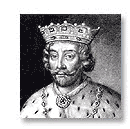 dward
II had few of the qualities that made a successful medieval king.
Edward surrounded himself with favourites (the best known being a
Gascon, Piers Gaveston), and the barons, feeling excluded from power,
rebelled. Throughout his reign, different baronial groups struggled
to gain power and control the King. The nobles' ordinances of 1311,
which attempted to limit royal control of finance and appointments,
were counteracted by Edward. Large debts (many inherited) and the
Scots' victory at Bannockburn by Robert the Bruce in 1314 made Edward
more unpopular. Edward's victory in a civil war (1321-2) and such
measures as the 1326 ordinance (a protectionist measure which set up
compulsory markets or staples in 14 English, Welsh and Irish towns
for the wool trade) did not lead to any compromise between the King
and the nobles. Finally, in 1326, Edward's wife, Isabella of France,
led an invasion against her husband. In 1327 Edward was made to
renounce the throne in favour of his son Edward (the first time that
an anointed king of England had been dethroned since Ethelred in
1013). Edward II was later murdered at Berkeley Castle.
EDWARD
III (1327-77)
Edward III was 14 when he was crowned King and assumed
government in his own right in 1330. In 1337, Edward created the
Duchy of Cornwall to provide the heir to the throne with an income
independent of the sovereign or the state. An able soldier, and an
inspiring leader, Edward founded the Order of the Garter in 1348. At
the beginning of the Hundred Years War in 1337, actual campaigning
started when the King invaded France in 1339 and laid claim to the
throne of France. Following a sea victory at Sluys in 1340, Edward
overran Brittany in 1342 and in 1346 he landed in Normandy, defeating
the French King, Philip IV, at the Battle of Crйcy and his son
Edward (the Black Prince) repeated his success at Poitiers (1356). By
1360 Edward controlled over a quarter of France. His successes
consolidated the support of the nobles, lessened criticism of the
taxes, and improved relations with Parliament. However, under the
1375 Treaty of Bruges the French King, Charles V, reversed most of
the English conquests; Calais and a coastal strip near Bordeaux were
Edward's only lasting gain. Failure abroad provoked criticism at
home. The Black Death plague outbreaks of 1348-9, 1361-2 and 1369
inflicted severe social dislocation (the King lost a daughter to the
plague) and caused deflation; severe laws were introduced to attempt
to fix wages and prices. In 1376, the 'Good Parliament' (which saw
the election of the first Speaker to represent the Commons) attacked
the high taxes and criticised the King's advisers. The ageing King
withdrew to Windsor for the rest of his reign, eventually dying at
Sheen Palace, Surrey.
Если Вам нужна помощь с академической работой (курсовая, контрольная, диплом, реферат и т.д.),
обратитесь к нашим специалистам. Более 90000 специалистов готовы Вам помочь.
Бесплатные корректировки и доработки. Бесплатная оценка стоимости работы.
Поможем написать работу на аналогичную тему
Получить выполненную работу или консультацию специалиста по вашему учебному
проекту
Нужна помощь в написании работы?
Мы - биржа профессиональных авторов (преподавателей и доцентов вузов). Пишем статьи РИНЦ, ВАК, Scopus.
Помогаем в публикации. Правки вносим бесплатно.