BRITISH MONARCHY AND ITS INFLUENCE UPON GOVERNMENTAL INSTITUTIONS
King of France


RICHARD I JOHN = Isabella, dau. of
 (1189–1199)
(1199–1216) Count of
Angoulкme
HENRY III
(1216–1272)
WILLIAM I «THE CONQUEROR» (1066-1087)
B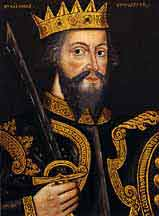 orn
around 1028, William was the illegitimate son of Duke Robert I of
Normandy, and Herleve (also known as Arlette), daughter of a tanner
in Falaise. Known as 'William the Bastard' to his contemporaries, his
illegitimacy shaped his career when he was young. On his father's
death in 1035, William was recognised by his family as the heir - an
exception to the general rule that illegitimacy barred succession.
His great uncle looked after the Duchy during William's minority, and
his overlord, King Henry I of France, knighted him at the age of 15.
From 1047 onwards, William successfully dealt with rebellion inside
Normandy involving his kinsmen and threats from neighbouring nobles,
including attempted invasions by his former ally King Henry I of
France in 1054 (the French forces were defeated at the Battle of
Mortemer) and 1057. William's military successes and reputation
helped him to negotiate his marriage to Mathilda, daughter of Count
Baldwin V of Flanders. At the time of his invasion of England,
William was a very experienced and ruthless military commander, ruler
and administrator who had unified Normandy and inspired fear and
respect outside his duchy. William's claim to the English throne was
based on his assertion that, in 1051, Edward the Confessor had
promised him the throne (he was a distant cousin) and that Harold II
- having sworn in 1064 to uphold William's right to succeed to that
throne - was therefore a usurper. Furthermore, William had the
support of Emperor Henry IV and papal approval. William took seven
months to prepare his invasion force, using some 600 transport ships
to carry around 7,000 men (including 2,000-3,000 cavalry) across the
Channel. On 28 September 1066, with a favourable wind, William landed
unopposed at Pevensey and, within a few days, raised fortifications
at Hastings. Having defeated an earlier invasion by the King of
Norway at the Battle of Stamford Bridge near York in late September,
Harold undertook a forced march south, covering 250 miles in some
nine days to meet the new threat, gathering inexperienced
reinforcements to replenish his exhausted veterans as he marched. At
the Battle of Senlac (near Hastings) on 14 October, Harold's weary
and under-strength army faced William's cavalry (part of the forces
brought across the Channel) supported by archers. Despite their
exhaustion, Harold's troops were equal in number (they included the
best infantry in Europe equipped with their terrible two-handled
battle axes) and they had the battlefield advantage of being based on
a ridge above the Norman positions. The first uphill assaults by the
Normans failed and a rumour spread that William had been killed;
William rode among the ranks raising his helmet to show he was still
alive. The battle was close-fought: a chronicler described the Norman
counter-attacks and the Saxon defence as 'one side attacking with all
mobility, the other withstanding as though rooted to the soil'. Three
of William's horses were killed under him. William skilfully
co-ordinated his archers and cavalry, both of which the English
forces lacked. During a Norman assault, Harold was killed - hit by an
arrow and then mowed down by the sword of a mounted knight. Two of
his brothers were also killed. The demoralised English forces fled.
(In 1070, as penance, William had an abbey built on the site of the
battle, with the high altar occupying the spot where Harold fell. The
ruins of Battle Abbey, and the town of Battle, which grew up around
it, remain.) William was crowned on Christmas Day 1066 in
Westminster Abbey. Three months later, he was confident enough to
return to Normandy leaving two joint regents (one of whom was his
half-brother Odo, Bishop of Bayeux, who was later to commission the
Bayeux Tapestry) behind to administer the kingdom. However, it took
William six years to consolidate his conquest, and even then he had
to face constant plotting and fighting on both sides of the Channel.
In 1068, Harold's sons raided the south-west coast of England (dealt
with by William's local commanders), and there were uprisings in the
Welsh Marches, Devon and Cornwall. William appointed earls who, in
Wales and in all parts of the kingdom, undertook to guard the
threatened frontiers and maintain internal security in return for
land. In 1069, the Danes, in alliance with Prince Edgar the
Aetheling (Ethelred's great-grandson) and other English nobles,
invaded the north and took York. Taking personal charge, and pausing
only to deal with the rising at Stafford, William drove the Danes
back to their ships on the Humber. In a harsh campaign lasting into
1070, William systematically devastated Mercia and Northumbria to
deprive the Danes of their supplies and prevent recovery of English
resistance. Churches and monasteries were burnt, and agricultural
land was laid to waste, creating a famine for the unarmed and mostly
peasant population which lasted at least nine years. Although the
Danes were bribed to leave the north, King Sweyn of Denmark and his
ships threatened the east coast (in alliance with various English,
including Hereward the Wake) until a treaty of peace was concluded in
June 1070. Further north, where the boundary with Scotland was
unclear, King Malcolm III was encroaching into England. Yet again,
William moved swiftly and moved land and sea forces north to invade
Scotland. The Treaty of Abernethy in 1072 marked a truce, which was
reinforced by Malcolm's eldest son being accepted as a hostage.
William consolidated his conquest by starting a castle-building
campaign in strategic areas. Originally these castles were wooden
towers on earthen 'mottes' (mounds) with a bailey (defensive area)
surrounded by earth ramparts, but many were later rebuilt in stone.
By the end of William's reign over 80 castles had been built
throughout his kingdom, as a permanent reminder of the new Norman
feudal order. William's wholesale confiscation of land from English
nobles and their heirs (many nobles had died at the battles of
Stamford Bridge and Senlac) enabled him to recruit and retain an
army, by demanding military duties in exchange for land tenancy
granted to Norman, French and Flemish allies. He created up to 180
'honours' (lands scattered through shires, with a castle as the
governing centre), and in return had some 5,000 knights at his
disposal to repress rebellions and pursue campaigns; the knights were
augmented by mercenaries and English infantry from the Anglo-Saxon
militia, raised from local levies. William also used the fyrd, the
royal army - a military arrangement which had survived the Conquest.
The King's tenants-in-chief in turn created knights under obligation
to them and for royal duties (this was called subinfeudation), with
the result that private armies centred around private castles were
created - these were to cause future problems of anarchy for
unfortunate or weak kings. By the end of William's reign, a small
group of the King's tenants had acquired about half of England's
landed wealth. Only two Englishmen still held large estates directly
from the King. A foreign aristocracy had been imposed as the new
governing class. The expenses of numerous campaigns, together with
an economic slump (caused by the shifts in landed wealth, and the
devastation of northern England for military and political reasons),
prompted William to order a full-scale investigation into the actual
and potential wealth of the kingdom to maximise tax revenues. The
Domesday survey was prompted by ignorance of the state of land
holding in England, as well as the result of the costs of defence
measures in England and renewed war in France. The scope, speed,
efficiency and completion of this survey was remarkable for its time
and resulted in the two-volume Domesday Book of 1086, which still
exists today. William needed to ensure the direct loyalty of his
feudal tenants. The 1086 Oath of Salisbury was a gathering of
William's 170 tenants-in-chief and other important landowners who
took an oath of fealty to William. William's reach extended
elsewhere into the Church and the legal system. French superseded the
vernacular (Anglo-Saxon). Personally devout, William used his bishops
to carry out administrative duties. Lanfranc, Archbishop of
Canterbury from 1070, was a first-class administrator who assisted in
government when William was absent in France, and who reorganised the
Church in England. Having established the primacy of his
archbishopric over that of York, and with William's approval,
Lanfranc excommunicated rebels, and set up Church or spiritual courts
to deal with ecclesiastical matters. Lanfranc also replaced English
bishops and abbots (some of whom had already been removed by the
Council of Winchester under papal authority) with Norman or French
clergy to reduce potential political resistance. In addition,
Canterbury and Durham Cathedrals were rebuilt and some of the
bishops' sees were moved to urban centres. At his coronation,
William promised to uphold existing laws and customs. The Anglo-Saxon
shire courts and 'hundred' courts (which administered defence and
tax, as well as justice matters) remained intact, as did regional
variations and private Anglo-Saxon jurisdictions. To strengthen royal
justice, William relied on sheriffs (previously smaller landowners,
but replaced by influential nobles) to supervise the administration
of justice in existing county courts, and sent members of his own
court to conduct important trials. However, the introduction of
Church courts, the mix of Norman/Roman law and the differing customs
led to a continuing complex legal framework. More severe forest laws
reinforced William's conversion of the New Forest into a vast Royal
deer reserve. These laws caused great resentment,