BRITISH MONARCHY AND ITS INFLUENCE UPON GOVERNMENTAL INSTITUTIONS
WILLIAM II (KNOWN AS WILLIAM RUFUS) (1087-1100)
Strong, outspoken and ruddy (hence his nickname 'Rufus'), William II (reigned 1087-1100) extended his father's policies, taking royal power to the far north of England. Ruthless in his relations with his brother Robert, William extended his grip on the duchy of Normandy under an agreement between the brothers in 1091. (Robert went on crusade in 1096.)
William's relations with the Church were not easy; he took over Archbishop Lanfranc's revenues after the latter's death in 1089, kept other bishoprics vacant to make use of their revenues, and had numerous arguments with Lanfranc's popular successor, Anselm. William died on 2 August 1100, after being shot by an arrow whilst hunting in the New Forest.
HENRY I (1100-1135)
W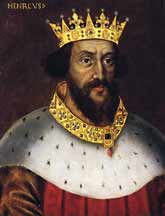 illiam's
younger brother Henry succeeded to the throne. He was crowned three
days after his brother's death, against the possibility that his
eldest brother Robert might claim the English throne. After the
decisive battle of Tinchebrai in 1106 in France, Henry completed his
conquest of Normandy from Robert, who then (unusually even for that
time) spent the last 28 years of his life as his brother's prisoner.
An energetic, decisive and occasionally cruel ruler, Henry
centralised the administration of England and Normandy in the royal
court, using 'viceroys' in Normandy and a group of advisers in
England to act on his behalf when he was absent across the Channel.
Henry successfully sought to increase royal revenues, as shown by the
official records of his exchequer (the Pipe Roll of 1130, the first
exchequer account to survive). He established peaceful relations with
Scotland, through his marriage to Mathilda of Scotland. Henry's name
'Beauclerc' denoted his good education (as the youngest son, his
parents possibly expected that he would become a bishop); Henry was
probably the first Norman king to be fluent in English. In 1120, his
legitimate sons William and Richard drowned in the White Ship which
sank in the English Channel. This posed a succession problem, as
Henry never allowed any of his illegitimate children to expect
succession to either England or Normandy. Henry had a legitimate
daughter Matilda (widow of Emperor Henry V, subsequently married to
the Count of Anjou). However, it was his nephew Stephen (reigned
1135-54), son of William the Conqueror's daughter Adela, who
succeeded Henry after his death, allegedly caused by eating too many
lampreys (fish) in 1135, as the barons mostly opposed the idea of a
female ruler.
STEPHEN AND MATILDA (1135-1154)
T
 hough
charming, attractive and (when required) a brave warrior, Stephen
(reigned 1135-54) lacked ruthlessness and failed to inspire loyalty.
He could neither control his friends nor subdue his enemies, despite
the support of his brother Henry of Blois (Bishop of Winchester) and
his able wife Matilda of Boulogne. Henry I's daughter Matilda invaded
England in 1139 to claim the throne, and the country was plunged into
civil war. Although anarchy never spread over the whole country,
local feuds were pursued under the cover of the civil war; the bond
between the King and the nobles broke down, and senior figures
(including Stephen's brother Henry) freely changed allegiances as it
suited them. In 1141, Stephen was captured at Lincoln and his defeat
seemed certain. However, Matilda's arrogant behaviour antagonised
even her own supporters (Angevins), and Stephen was released in
exchange for her captured ally and illegitimate half-brother, Earl
Robert of Gloucester. After the latter's death in 1147, Matilda
retired to Normandy (which her husband, the Count of Anjou had
conquered) in 1148. Stephen's throne was still disputed. Matilda's
eldest son, Henry, who had been given Normandy by his father in 1150
and who had married the heiress Eleanor Duchess of Aquitaine, invaded
England in 1149 and again in 1153. Stephen fought stubbornly against
Henry; Stephen even attempted to ensure his son Eustace's succession
by having him crowned in Stephen's own lifetime. The Church refused
(having quarrelled with the king some years previously); Eustace's
death later in 1153 helped lead to a negotiated peace (the treaty of
Wallingford) under which Henry would inherit the throne after
Stephen's death.
THE ANGEVINS
Henry II, the son of Geoffrey Plantagenet and Henry I's daughter Matilda, was the first in a long line of 14 Plantagenet kings, stretching from Henry II's accession through to Richard III's death in 1485. Within that line, however, four distinct Royal Houses can be identified: Angevin, Plantagenet, Lancaster and York.
The first Angevin King, Henry II, began the period as arguably the most powerful monarch in Europe, with lands stretching from the Scottish borders to the Pyrenees. In addition, Ireland was added to his inheritance, a mission entrusted to him by Pope Adrian IV (the only English Pope). A new administrative zeal was evident at the beginning of the period and an efficient system of government was formulated. The justice system developed. However there were quarrels with the Church, which became more powerful following the murder of Thomas а Becket.
As with many of his predecessors, Henry II spent much of his time away from England fighting abroad. This was taken to an extreme by his son Richard, who spent only 10 months of a ten-year reign in the country due to his involvement in the crusades. The last of the Angevin kings was John, whom history has judged harshly. By 1205, six years into his reign, only a fragment of the vast Angevin empire acquired by Henry II remained. John quarrelled with the Pope over the appointment of the Archbishop of Canterbury, eventually surrendering. He was also forced to sign the Magna Carta in 1215, which restated the rights of the church, the barons and all in the land. John died in ignominy, having broken the contract, leading the nobles to summon aid from France and creating a precarious position for his heir, Henry III.
H ENRY
II CURTMANTLE (1154-1189)
Henry II ruled over an empire which stretched from the Scottish border to the Pyrenees. One of the strongest, most energetic and imaginative rulers, Henry was the inheritor of three dynasties who had acquired Aquitaine by marriage; his charters listed them: 'King of the English, Duke of the Normans and Aquitanians and Count of the Angevins'. The King spent only 13 years of his reign in England; the other 21 years were spent on the continent in his territories in what is now France. Henry's rapid movements in carrying out his dynastic responsibilities astonished the French king, who noted 'now in England, now in Normandy, he must fly rather than travel by horse or ship'. By 1158, Henry had restored to the Crown some of the lands and royal power lost by Stephen; Malcom IV of Scotland was compelled to return the northern counties. Locally chosen sheriffs were changed into royally appointed agents charged with enforcing the law and collecting taxes in the counties. Personally interested in government and law, Henry made use of juries and re-introduced the sending of justices (judges) on regular tours of the country to try cases for the Crown. His legal reforms have led him to be seen as the founder of English Common Law. Henry's disagreements with the Archbishop of Canterbury (the king's former chief adviser), Thomas а Becket, over Church-State relations ended in Becket's murder in 1170 and a papal interdict on England. Family disputes over territorial ambitions almost wrecked the king's achievements. Henry died in France in 1189, at war with his son Richard, who had joined forces with King Philip of France to attack Normandy.
RICHARD I COEUR DE LION ('THE LIONHEART') (1189-1199)
Henry's elder son, Richard I (reigned 1189-99), fulfilled his main ambition by going on crusade in 1190, leaving the ruling of England to others. After his victories over Saladin at the siege of Acre and the battles of Arsuf and Jaffa, concluded by the treaty of Jaffa (1192), Richard was returning from the Holy Land when he was captured in Austria. In early 1193, Richard was transferred to Emperor Henry VI's custody. In Richard's absence, King Philip of France failed to obtain Richard's French possessions through invasion or negotiation. In England, Richard's brother John occupied Windsor Castle and prepared an invasion of England by Flemish mercenaries, accompanied by armed uprisings. Their mother, Queen Eleanor, took firm action against John by strengthening garrisons and again exacting oaths of allegiance to the king. John's subversive activities were ended by the payment of a crushing ransom of 150,000 marks of silver to the emperor, for Richard's release in 1194. Warned by Philip's famous message 'look to yourself, the devil is loosed', John fled to the French court. On his return to England, Richard was recrowned at Winchester in 1194. Five years later he died in France during a minor siege against a rebellious baron. By the time of his death, Richard had recovered all his lands. His success was short-lived. In 1199 his brother John became king and Philip successfully invaded Normandy. By 1203, John had retreated to England, losing his French lands of Normandy and Anjou by 1205.
JOHN (1199-1216)
J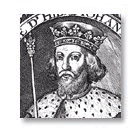 ohn
was an able administrator interested in law and government but he
neither trusted others nor was trusted by them. Heavy taxation,
disputes with the Church (John was excommunicated by the Pope in
1209) and unsuccessful attempts to recover his French possessions
made him unpopular. Many of his barons rebelled and in June 1215 they
forced the King to sign a peace treaty accepting their reforms. This
treaty, later known as Magna Carta, limited royal powers, defined
feudal obligations between the King and the barons, and guaranteed a
number of rights. The most influential clauses concerned the freedom
of the Church; the redress of grievances of owners and tenants of
land; the need to consult the Great Council of the Realm so as to
prevent unjust taxation; mercantile and trading relationships;
regulation of the machinery of justice so that justice be denied to
no one; and the requirement to control the behaviour of royal
officials. The most important clauses established the basis of habeas
corpus ('you have the body'), i.e. that no one shall be imprisoned
except by due process of law, and that 'to no one will we sell, to no
one will we refuse or delay right or justice'. The Charter also
established a council of barons who were to ensure that the Sovereign
observed the Charter, with the right to wage war on him if he did
not. Magna Carta was the first formal document insisting that the
Sovereign was as much under the rule of law as his people, and that
the rights of individuals were to be upheld even against the wishes
of the sovereign. As a source of fundamental constitutional
principles, Magna Carta came to be seen as an important definition of
aspects of English law, and in later centuries as the basis of the
liberties of the English people. As a peace treaty Magna Carta was
a failure and the rebels invited Louis of France to become their
king. When John died in 1216 England was in the grip of civil war.
THE PLANTAGENETS
The Plantagenet period was dominated by three major conflicts at home and abroad. Edward I attempted to create a British empire dominated by England, conquering Wales and pronouncing his eldest son Prince of Wales, and then attacking Scotland. Scotland was to remain elusive and retain its independence until late in the reign of the Stuart kings. In the reign of Edward III the Hundred Years War began, a struggle between England and France. At the end of the Plantagenet period,